The Question Few Educational Systems Want to Ask
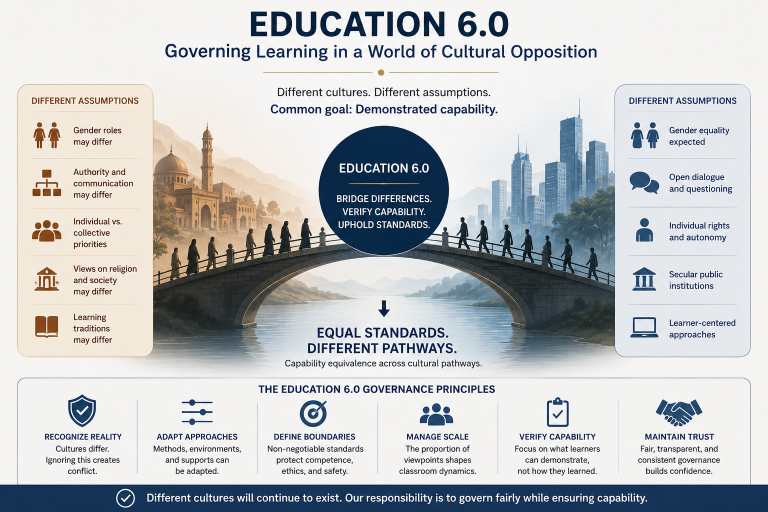
Educational institutions frequently celebrate diversity.
They promote inclusion, multiculturalism, accessibility, and global citizenship. These objectives are important and reflect the reality of an increasingly connected world.
However, there is a question that many educational systems avoid: What happens when cultures do not merely differ, but fundamentally oppose one another?
This question sits at the center of the next generation of educational governance.
For decades, educational systems have focused on managing diversity. Education 6.0 must go further. It must address the reality that some populations entering the same classroom may hold profoundly different assumptions regarding authority, gender roles, religion, ethics, communication, social responsibility, and the purpose of education itself.
The challenge is no longer diversity. The challenge is governance.
Diversity Is Easy. Opposition Is Difficult.
Most educational literature treats cultural differences as though they are variations of the same underlying values.
In practice, this is not always true. Differences in language, food, customs, holidays, or traditions can usually be accommodated without significant difficulty.
Opposing values create a different challenge.
Consider examples commonly encountered across global educational environments:
- Mixed-gender learning versus gender-segregated learning.
- Learner autonomy versus strict instructional authority.
- Individual achievement versus collective responsibility.
- Secular education versus faith-centered education.
- Open debate versus deference to authority.
- Equality of social roles versus differentiated social roles.
These differences are not administrative inconveniences.
They represent competing models of society.
When such populations enter the same classroom, educational systems must determine how learning will occur, how assessments will be conducted, and how competence will be evaluated.
The Global Classroom Reality
The modern classroom increasingly includes students from regions that have developed under very different social, religious, political, and educational traditions.
Some learners come from educational systems that encourage questioning instructors, challenging ideas, and independent analysis.
Others come from systems that emphasize discipline, hierarchy, respect for authority, and structured progression.
Some learners have spent their entire educational lives in coeducational environments.
Others may come from environments where educational interactions between men and women are more limited or governed by different cultural expectations.
Some cultures place strong emphasis on individual rights.
Others prioritize collective stability and social obligations.
None of these realities disappears when students enter a common educational environment.
They become governance challenges.
Why Numbers Matter?
One of the largest blind spots in contemporary educational policy is the assumption that cultural dynamics remain constant regardless of scale.
They do not.
The proportion of learners holding particular values influences how a classroom functions.
For example, a classroom in which 5% of students hold a significantly different set of educational assumptions may require accommodation.
A classroom in which 40% or 50% of students hold those assumptions may require structural redesign.
This is not a statement about nationality, ethnicity, or race.
It is a statement about social dynamics.
Educational institutions do not manage individuals in isolation.
They manage learning systems.
As the distribution of competing norms changes, classroom dynamics change.
Communication changes.
Teamwork changes.
Participation changes.
Conflict resolution changes.
Educational governance must account for these realities.
Ignoring them does not eliminate them.
The Failure of Uniform Educational Models
Historically, many educational reforms assumed that a single educational model could be applied universally.
The assumption was simple:
If the model is successful in one society, it can be transferred to another.
Experience has repeatedly shown otherwise. We have enough historical data to understand the wrongdoings.
Educational systems are embedded within cultural systems.
A teaching strategy that succeeds in one population may fail in another.
An assessment method that appears fair in one environment may create unintended barriers in another.
A governance model that functions effectively in one institution may generate conflict elsewhere.
Education 6.0 recognizes that human capability develops within cultural contexts.
Consequently, educational governance must adapt to cultural realities while preserving competence standards.
Capability Rather Than Uniformity
The central principle of Education 6.0 is that educational pathways and competence standards are not the same thing.
Traditional systems often assume that identical educational experiences are necessary to achieve equivalent outcomes.
Education 6.0 rejects this assumption.
The critical question is not:
"Did everyone learn in the same way?"
The critical question is:
"Can everyone demonstrate the required capability?"
Different populations may use different educational pathways.
Different instructional methods.
Different classroom structures.
Different support mechanisms.
Different learning traditions.
What matters is whether competence can be demonstrated objectively.
This principle may be described as:
Capability Equivalence Across Cultural Pathways.
Different pathways.
Common standards.
Where Adaptation Ends?
A common misconception is that cultural accommodation requires educational systems to accept every practice or value equally.
Education 6.0 does not support unlimited accommodation.
Every educational system requires governance boundaries.
Certain elements remain non-negotiable:
- public safety,
- professional competence,
- certification integrity,
- assessment validity,
- ethical conduct,
- evidence-based decision making.
Educational institutions may adapt delivery methods, learning environments, communication approaches, and support structures.
They cannot compromise competence requirements.
This distinction is essential.
Without adaptation, systems become rigid.
Without standards, systems lose credibility.
Education 6.0 requires both.
Why Artificial Intelligence Intensifies the Challenge?
Artificial intelligence introduces a new governance dimension.
AI systems increasingly influence:
- admissions,
- learning analytics,
- assessment support,
- competency evaluation,
- personalized learning pathways.
However, AI systems are trained on historical data.
Historical data reflects existing cultural assumptions.
Without governance oversight, AI may reinforce educational biases rather than eliminate them.
An Education 6.0 environment therefore, requires:
- human oversight,
- transparency,
- fairness reviews,
- cultural impact assessments,
- independent validation mechanisms.
Technology does not solve governance problems.
It magnifies them.
The Role of Professional Certification
The future may require educational institutions to separate learning from capability verification.
This is one reason professional certification systems are becoming increasingly important.
A robust certification system asks:
"Can the candidate perform?"
not
"Did the candidate follow a particular educational pathway?"
This principle is reflected in competency-based certification models and international standards such as ISO/IEC 17024.
The focus shifts from educational conformity to demonstrated competence.
This approach becomes increasingly valuable as educational populations become more culturally diverse.
The Education 6.0 Governance Imperative
The future challenge facing education is not simply technological transformation.
It is the governance of complexity.
Educational institutions can no longer assume that learners share common assumptions regarding authority, communication, gender, ethics, or social responsibility.
Nor can they assume that cultural differences become irrelevant once students enter a classroom.
Education 6.0 recognizes a reality that many educational systems have yet to confront:
Human societies will continue to differ.
Some differences will be small.
Some differences will be profound.
Some differences will become more visible as global mobility increases.
The purpose of Education 6.0 is not to eliminate these differences.
Its purpose is to build governance systems capable of managing cultural complexity while preserving competence, fairness, public trust, and educational integrity.
The future of education will not be determined by how effectively institutions standardize learners.
It will be determined by how effectively they verify capability across populations that may not share the same assumptions about the world.
That is the true governance challenge of Education 6.0.
Article blog written with ChatGPT Instant 5.5 support, June 8, 2026