Education 6.0 and the Governance Challenge of Cultural Opposition

The Question Few Educational Systems Want to Ask
Cultures and Education 6


Educational institutions frequently celebrate diversity.

They promote inclusion, multiculturalism, accessibility, and global citizenship. These objectives are important and reflect the reality of an increasingly connected world.

However, there is a question that many educational systems avoid: What happens when cultures do not merely differ, but fundamentally oppose one another?

This question sits at the center of the next generation of educational governance.

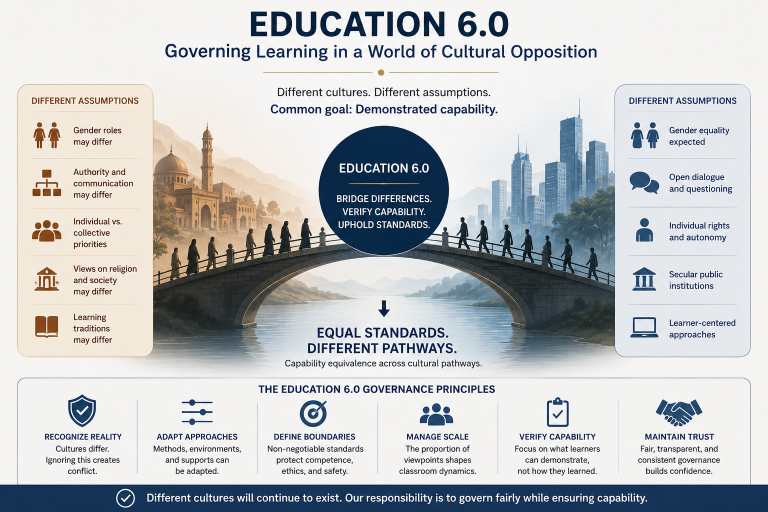
For decades, educational systems have focused on managing diversity. Education 6.0 must go further. It must address the reality that some populations entering the same classroom may hold profoundly different assumptions regarding authority, gender roles, religion, ethics, communication, social responsibility, and the purpose of education itself.

The challenge is no longer diversity. The challenge is governance.

Diversity Is Easy. Opposition Is Difficult.

Most educational literature treats cultural differences as though they are variations of the same underlying values.

In practice, this is not always true. Differences in language, food, customs, holidays, or traditions can usually be accommodated without significant difficulty.

Opposing values create a different challenge.

Consider examples commonly encountered across global educational environments:

  • Mixed-gender learning versus gender-segregated learning.
  • Learner autonomy versus strict instructional authority.
  • Individual achievement versus collective responsibility.
  • Secular education versus faith-centered education.
  • Open debate versus deference to authority.
  • Equality of social roles versus differentiated social roles.

These differences are not administrative inconveniences.

They represent competing models of society.

When such populations enter the same classroom, educational systems must determine how learning will occur, how assessments will be conducted, and how competence will be evaluated.

The Global Classroom Reality

The modern classroom increasingly includes students from regions that have developed under very different social, religious, political, and educational traditions.

Some learners come from educational systems that encourage questioning instructors, challenging ideas, and independent analysis.

Others come from systems that emphasize discipline, hierarchy, respect for authority, and structured progression.

Some learners have spent their entire educational lives in coeducational environments.

Others may come from environments where educational interactions between men and women are more limited or governed by different cultural expectations.

Some cultures place strong emphasis on individual rights.

Others prioritize collective stability and social obligations.

None of these realities disappears when students enter a common educational environment.

They become governance challenges.

Why Numbers Matter?

One of the largest blind spots in contemporary educational policy is the assumption that cultural dynamics remain constant regardless of scale.

They do not.

The proportion of learners holding particular values influences how a classroom functions.

For example, a classroom in which 5% of students hold a significantly different set of educational assumptions may require accommodation.

A classroom in which 40% or 50% of students hold those assumptions may require structural redesign.

This is not a statement about nationality, ethnicity, or race.

It is a statement about social dynamics.

Educational institutions do not manage individuals in isolation.

They manage learning systems.

As the distribution of competing norms changes, classroom dynamics change.

Communication changes.

Teamwork changes.

Participation changes.

Conflict resolution changes.

Educational governance must account for these realities.

Ignoring them does not eliminate them.

The Failure of Uniform Educational Models

Historically, many educational reforms assumed that a single educational model could be applied universally.

The assumption was simple:

If the model is successful in one society, it can be transferred to another.

Experience has repeatedly shown otherwise. We have enough historical data to understand the wrongdoings.

Educational systems are embedded within cultural systems.

A teaching strategy that succeeds in one population may fail in another.

An assessment method that appears fair in one environment may create unintended barriers in another.

A governance model that functions effectively in one institution may generate conflict elsewhere.

Education 6.0 recognizes that human capability develops within cultural contexts.

Consequently, educational governance must adapt to cultural realities while preserving competence standards.

Capability Rather Than Uniformity

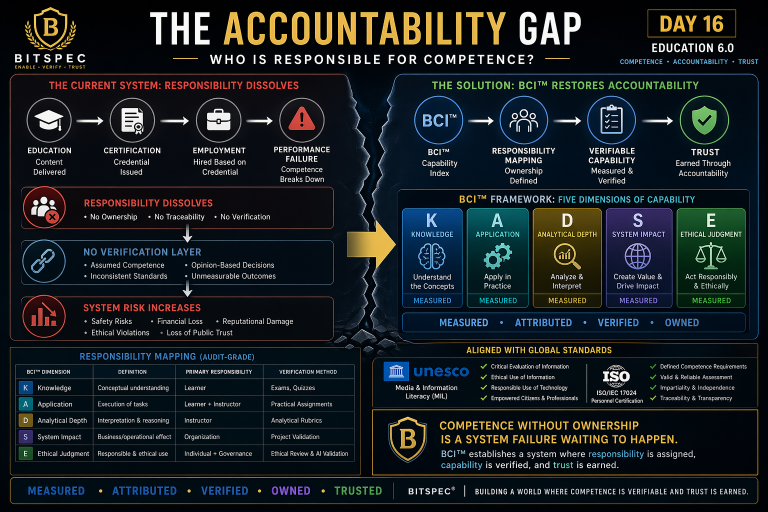
The central principle of Education 6.0 is that educational pathways and competence standards are not the same thing.

Traditional systems often assume that identical educational experiences are necessary to achieve equivalent outcomes.

Education 6.0 rejects this assumption.

The critical question is not:

"Did everyone learn in the same way?"

The critical question is:

"Can everyone demonstrate the required capability?"

Different populations may use different educational pathways.

Different instructional methods.

Different classroom structures.

Different support mechanisms.

Different learning traditions.

What matters is whether competence can be demonstrated objectively.

This principle may be described as:

Capability Equivalence Across Cultural Pathways.

Different pathways.

Common standards.

Where Adaptation Ends?

A common misconception is that cultural accommodation requires educational systems to accept every practice or value equally.

Education 6.0 does not support unlimited accommodation.

Every educational system requires governance boundaries.

Certain elements remain non-negotiable:

  • public safety,
  • professional competence,
  • certification integrity,
  • assessment validity,
  • ethical conduct,
  • evidence-based decision making.

Educational institutions may adapt delivery methods, learning environments, communication approaches, and support structures.

They cannot compromise competence requirements.

This distinction is essential.

Without adaptation, systems become rigid.

Without standards, systems lose credibility.

Education 6.0 requires both.

Why Artificial Intelligence Intensifies the Challenge?

Artificial intelligence introduces a new governance dimension.

AI systems increasingly influence:

  • admissions,
  • learning analytics,
  • assessment support,
  • competency evaluation,
  • personalized learning pathways.

However, AI systems are trained on historical data.

Historical data reflects existing cultural assumptions.

Without governance oversight, AI may reinforce educational biases rather than eliminate them.

An Education 6.0 environment therefore, requires:

  • human oversight,
  • transparency,
  • fairness reviews,
  • cultural impact assessments,
  • independent validation mechanisms.

Technology does not solve governance problems.

It magnifies them.

The Role of Professional Certification

The future may require educational institutions to separate learning from capability verification.

This is one reason professional certification systems are becoming increasingly important.

A robust certification system asks:

"Can the candidate perform?"

not

"Did the candidate follow a particular educational pathway?"

This principle is reflected in competency-based certification models and international standards such as ISO/IEC 17024.

The focus shifts from educational conformity to demonstrated competence.

This approach becomes increasingly valuable as educational populations become more culturally diverse.

The Education 6.0 Governance Imperative

The future challenge facing education is not simply technological transformation.

It is the governance of complexity.

Educational institutions can no longer assume that learners share common assumptions regarding authority, communication, gender, ethics, or social responsibility.

Nor can they assume that cultural differences become irrelevant once students enter a classroom.

Education 6.0 recognizes a reality that many educational systems have yet to confront:

Human societies will continue to differ.

Some differences will be small.

Some differences will be profound.

Some differences will become more visible as global mobility increases.

The purpose of Education 6.0 is not to eliminate these differences.

Its purpose is to build governance systems capable of managing cultural complexity while preserving competence, fairness, public trust, and educational integrity.

The future of education will not be determined by how effectively institutions standardize learners.

It will be determined by how effectively they verify capability across populations that may not share the same assumptions about the world.

That is the true governance challenge of Education 6.0.

Article blog written with ChatGPT Instant 5.5 support, June 8, 2026 
 

Continue reading
  25 Hits

Learning Is Not Equal: What Magnesium, Neuroscience, and Human Diversity Reveal About Education

Learning


For generations, educational systems have been designed around a powerful but largely unexamined assumption:

If learners receive the same instruction, they should achieve similar outcomes.

When differences in performance emerge, explanations are often sought in motivation, effort, socioeconomic status, teaching quality, or access to resources.

While these factors certainly influence learning, modern neuroscience increasingly suggests that another reality must be considered:

Human beings do not begin learning from identical biological conditions.

The brain is a biological system. Learning is therefore not merely an educational process; it is also a neurological and physiological process.

Recent advances in neuroscience have begun to reveal how even fundamental biological factors can influence the mechanisms underlying memory formation, learning, and cognitive performance.

One example is magnesium.

Magnesium and the Biology of Learning

For decades, magnesium was primarily associated with bone health, muscle function, and cardiovascular regulation.

Research now suggests its role is far more significant within the brain.

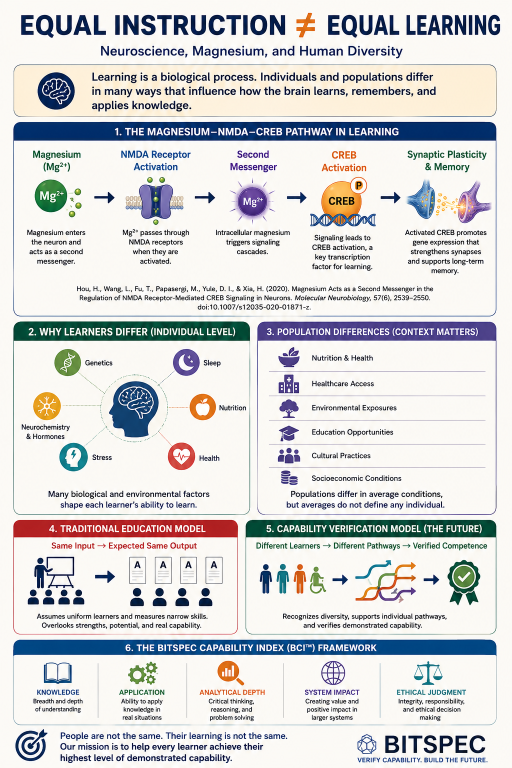
In a landmark study published in Molecular Neurobiology, Hou et al. (2020) demonstrated that magnesium can act as a second messenger in neurons, participating directly in signaling pathways involved in learning and memory. The researchers found that magnesium influx through NMDA receptor pathways contributes to CREB activation, a critical process associated with synaptic plasticity and long-term memory formation.

CREB (cAMP Response Element-Binding Protein) is widely recognized as one of the key molecular regulators involved in converting short-term experiences into long-term memories.

The study's findings suggest that magnesium is not simply a passive mineral present in the nervous system. Rather, it may actively participate in the biological signaling processes that allow neurons to adapt, learn, and store information.

The Implication for Education

This research does not imply that magnesium alone determines intelligence or educational success.

However, it highlights an important reality:

Learning depends upon biological mechanisms that vary between individuals.

Students do not arrive in classrooms with identical neurological conditions.

Differences may exist in:

  • Nutritional status
  • Sleep quality
  • Stress exposure
  • Physical health
  • Genetics
  • Neurotransmitter activity
  • Hormonal regulation
  • Brain development
  • Environmental influences

Each factor can affect how efficiently information is processed, retained, and applied.

If learning mechanisms vary, it becomes difficult to justify the assumption that identical educational inputs should consistently produce identical outcomes.

Human Variation Is a Scientific Reality

Biological variation exists throughout nature.

No two individuals possess identical genetics, developmental histories, environmental exposures, or physiological conditions.

Neuroscience, psychology, medicine, and biology have repeatedly demonstrated that humans vary across numerous dimensions, including:

  • Working memory capacity
  • Processing speed
  • Attention regulation
  • Cognitive endurance
  • Stress tolerance
  • Sensory perception
  • Learning preferences

These differences are observable within every population.

Some individuals acquire new skills rapidly.

Others require greater repetition and reinforcement.

Some excel in analytical reasoning.

Others demonstrate strengths in creativity, communication, leadership, or systems thinking.

Variation is not evidence of deficiency.

Variation is a natural property of biological systems.

Population Differences Without Determinism

The discussion becomes more complex when considering populations.

Different populations around the world may experience different average conditions related to:

  • Nutrition
  • Healthcare access
  • Environmental exposures
  • Disease prevalence
  • Physical activity
  • Educational opportunities
  • Cultural learning practices

These factors can influence learning conditions at a population level.

However, scientific integrity requires an equally important clarification:

Population averages do not determine individual capability.

An average describes a group.

It does not predict the potential of any specific individual.

Every population contains individuals with exceptional, average, and learning-challenged capabilities.

Educational systems, therefore, have a responsibility to evaluate individuals rather than stereotypes.

The existence of measurable biological variation should never be used to limit opportunity. Instead, it should encourage the design of systems that recognize diverse learning pathways.

The Problem with Uniform Educational Models

Most modern educational systems continue to rely heavily on standardization.

Learners are grouped by age.

Curricula are delivered uniformly.

Assessments are often designed around common benchmarks.

While standardization provides administrative efficiency, it may overlook substantial differences in how learners acquire and demonstrate competence.

A student who struggles with memorization may excel at applying knowledge.

A student who performs poorly on multiple-choice examinations may demonstrate exceptional capability in solving real-world problems.

A learner's true capability cannot always be captured through a single measurement approach.

From Educational Equality to Capability Recognition

The goal of education should not be to force identical outcomes.

The goal should be to identify, develop, and verify capability.

This principle forms part of the foundation of the BITSPEC Capability Index (BCI™), which evaluates multiple dimensions of demonstrated performance:

  • Knowledge
  • Application
  • Analytical Depth
  • System Impact
  • Ethical Judgment

Rather than assuming that one examination score fully represents competence, capability verification recognizes that human performance is multidimensional.

This approach is increasingly consistent with what neuroscience reveals about learning.

A Future Informed by Neuroscience

The work of Hou and colleagues provides an important reminder: Learning occurs within biological systems.

Magnesium-dependent signaling pathways, NMDA receptor activity, synaptic plasticity, and CREB activation are all part of Nature's machinery through which knowledge becomes memory.

As scientific understanding advances, educational systems may need to move beyond assumptions of uniform learning capacity and acknowledge a more nuanced reality:

  1. People differ.
  2. Brains differ.
  3. Learning pathways differ.
  4. Capability differs.

The challenge for education is not to eliminate these differences.

The challenge is to create systems capable of recognizing them fairly, supporting them appropriately, and accurately verifying their competence.

The future of education is unlikely to be built on the belief that every learner is the same.

It will be built on understanding what each learner is capable of becoming.

References

Hou, H., Wang, L., Fu, T., Papasergi, M., Yule, D. I., & Xia, H. (2020). Magnesium Acts as a Second Messenger in the Regulation of NMDA Receptor-Mediated CREB Signaling in Neurons. Molecular Neurobiology, 57(6), 2539–2550. DOI: 10.1007/s12035-020-01871-z.

Blanke, M. L., & VanDongen, A. M. J. Activation Mechanisms of the NMDA Receptor. NCBI Bookshelf.

Continue reading
  88 Hits

Authority and the limits of legitimacy

Authority and the Limits of Legitimacy

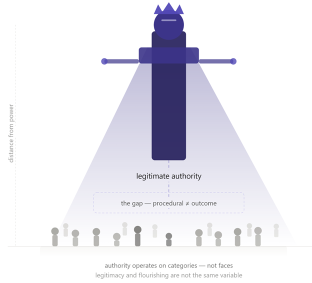
Fig. 1 Authority and limits of legitimacy

Authority, at its core, is the recognized right to make decisions that others are expected to follow. It is distinct from raw power, a distinction philosophers have drawn since antiquity. Power compels through force; authority persuades through legitimacy. A tyrant has power. A judge has authority. The difference lies not in the capacity to act, but in whether those subject to it accept the claim behind it.

Authority derives from several sources. Max Weber's classic taxonomy identified three: traditional authority (rooted in custom and inherited order), charismatic authority (rooted in the perceived exceptional qualities of a leader), and rational-legal authority (rooted in codified rules and institutional roles). Modern states lean heavily on the third; their authority flows from constitutions, laws, and procedures rather than bloodlines or personalities. This was supposed to be progress. And in many ways it was. Rational-legal authority is more predictable, more contestable, and more resistant to the arbitrary cruelties of personal rule.

But legitimacy and quality of life are not the same thing.

The Gap Between Legitimate Authority and Good Outcomes

A government can be entirely legitimate, elected freely, operating within constitutional bounds, followed willingly by its citizens, and still produce widespread misery. This is one of the most uncomfortable truths in political philosophy, and one that gets papered over constantly in both liberal and conservative thought.

The assumption lurking beneath most democratic theory is that legitimate authority, properly exercised, will tend toward good outcomes. Give people a voice; let them choose their rulers; check power through institutions, and flourishing will follow, more or less. History repeatedly refuses this comfort.

Several mechanisms explain the gap.

Aggregation distorts preference into policy. Even in a genuinely representative system, translating millions of individual preferences into a single policy direction destroys enormous amounts of information. What a majority wants and what most people actually need for a decent life are not reliably the same thing. Majorities have voted for austerity that harmed them, for exclusions that impoverished their communities, for short-term reliefs that foreclosed long-term stability. The aggregation problem is not a bug in democracy — it is a feature of any system trying to collapse complexity into collective decisions.

Authority is exercised by people with interests. Institutions do not govern; people within institutions govern. Those people face incentives that routinely diverge from the welfare of the population they nominally serve. A regulatory body staffed by former industry executives will authorize things a genuinely independent one would not. A legislature dependent on donor funding will price-protect industries at the expense of consumers. Authority may be formally legitimate while being practically captured. The chain between legal authority and lived experience passes through thousands of self-interested actors, and degrades at every link.

Expertise and authority are not identical. The authority to make health policy does not confer the knowledge to make good health policy. The authority to manage a currency does not guarantee sound monetary judgment. This seems obvious, but the conferral of authority has a psychological tendency to overwrite the distinction — in the minds of both the authorities and the public. Deference to authority substitutes for scrutiny of actual competence, and the results accumulate quietly in shortened lifespans, degraded environments, and preventable poverty.

Authority is backward-looking. Legal-rational authority is conservative by nature — it operates through precedent, established procedure, and incremental revision. The problems that erode quality of life are often fast-moving: ecological collapse, new patterns of economic precarity, and emergent public health crises. Authority structures built around older problems are poorly suited to newer ones. The authority is real; the response is inadequate.

Scale and the Abstraction of Harm

The problem deepens at the population scale. Authority exercised over a village is exercised over faces. At that scale, the feedback loops are tight, and the moral weight of failure is felt directly. Authority exercised over millions is exercised over categories, income brackets, demographic groups, and statistical populations. Policy at this level operates through abstraction, and abstraction makes it easier to discount harm.

This is not unique to malevolent authority. A genuinely well-intentioned policy designed to improve average outcomes will, by design, accept that outcomes for specific subpopulations may worsen. The average may rise while the distribution becomes more brutal for those at the bottom. Population-level authority is structurally inclined toward aggregate metrics, such as GDP, life expectancy, and median income, that can improve while particular groups experience declining conditions. Authority that points to the aggregate as evidence of its success is not lying, exactly. It is simply operating at the wrong resolution to see what it is doing to the people it cannot see.

The abstraction problem also enables a particular form of moral evasion. When harm is diffuse and causally complex, no authority needs to claim it. When lung disease spreads through a population due to environmental policy, there is no single decision that caused it, no single official who ordered it, no authority that must answer for it. The legitimacy of authority is generally evaluated through procedural criteria — was the law passed properly? Was due process observed? rather than outcome criteria. An authority that followed all its procedures while producing widespread preventable suffering retains its legitimacy intact.

The Deeper Problem: Authority Cannot Guarantee What It Cannot Measure

Quality of life resists the quantification that authority requires to act on it. Bureaucracies govern through metrics; what cannot be measured cannot be administered. But the dimensions of a genuinely good life, meaning, belonging, dignity, the experience of being seen and treated as a full person, do not aggregate cleanly into policy variables. They can be destroyed by policy and cannot be created by it.

What authority can do is remove obstacles: to health, to material security, to education, to freedom from violence. These are nothing. The difference between a state that provides basic infrastructure for human life and one that does not is enormous. But the provision of conditions is not the same as the production of flourishing. Authority can clear ground; it cannot grow what takes root there.

The honest conclusion is not that authority is illegitimate or dispensable — it is that authority is a necessary instrument with severe limitations, and that the habit of treating legitimate authority as a sufficient condition for good outcomes is one of the more consequential political errors a society can make. Holding authority accountable to outcomes, rather than merely to procedures, requires a different relationship between citizens and the institutions that govern them — one characterized less by deference and more by persistent, informed scrutiny of whether the gap between legitimacy and quality of life is being actively closed, or quietly accepted.

Article blog written with Claude Sonnet 4.6 support May 18, 2026 

Continue reading
  115 Hits

Voluntary Cognitive Endurance as a purer signal of medical aptitude: The case for recognizing sustained gaming in medical admissions

gaming medical aptitude

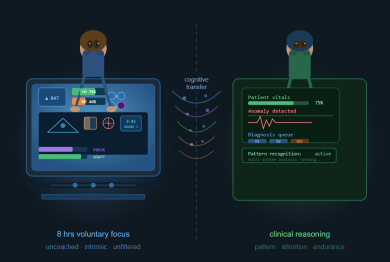
Fig. 1 Gaming focus vs. clinical reasoning

A Position Paper in Medical Education and Admissions Theory

Abstract

Medical school admissions processes have long relied on GPA, standardized test scores, and structured extracurricular activities as proxies for cognitive and professional aptitude. This paper argues that these metrics, while predictive, are substantially confounded by socioeconomic advantage and coached preparation. We propose that voluntary sustained engagement in complex video gaming — particularly sessions of six to eight or more hours — constitutes a purer, less confoundable signal of cognitive endurance, intrinsic motivation, and sustained attention within an already-competitive applicant pool. Drawing on evidence from cognitive neuroscience, biosocial theory, and admissions research, we argue that the genre differences observed between male and female gamers reflect culturally shaped developmental pathways rather than fixed biological capacity, and that admissions committees are systematically overlooking a meaningful cognitive signal by failing to evaluate the quality and depth of self-directed cognitive engagement.

1. Introduction

The selection of medical students is among the most consequential filtering processes in modern society. Those admitted will ultimately bear responsibility for human life, requiring not only acquired knowledge but durable cognitive traits: sustained attention, rapid pattern recognition, stress tolerance, and the capacity for iterative learning under uncertainty. The central question of admissions theory is therefore not merely whether a candidate has accumulated the right credentials, but whether those credentials accurately reveal the underlying cognitive and temperamental traits that predict medical competence.

This paper argues that the current admissions framework is systematically biased toward measuring preparation rather than capacity, and that a largely overlooked behavioral signal — voluntary sustained engagement in complex video gaming — offers a more direct window into several traits central to medical aptitude. Critically, this argument applies not to the general population but to within-group differentiation among already-competitive candidates: individuals who have already cleared the conventional threshold but who differ in the depth of self-directed cognitive engagement they have demonstrated outside formal academic structures.

2. The Confoundability Problem in Conventional Admissions Metrics

GPA and MCAT scores are the twin pillars of medical admissions. Both are predictive of early academic performance in medical school. However, both are also substantially influenced by factors external to the candidate's cognitive capacity: access to test preparation resources, quality of undergraduate institution, socioeconomic stability permitting full-time study, tutoring, and coached interview preparation. Research in higher education has repeatedly demonstrated that standardized test scores correlate strongly with family income, parental education, and access to coaching.

This confound ability problem means that, even within a highly competitive applicant pool where all candidates appear similarly credentialed, the credentials themselves may reflect differential resource access rather than differential cognitive capacity. Admissions committees seeking to identify the most cognitively capable candidates therefore face a signal-to-noise problem: the available metrics conflate preparation with aptitude.

3. Sustained Gaming as a Cognitive Signal
3.1 What Eight Hours of Gaming Demonstrates

A candidate who voluntarily sustains six to eight hours of focused engagement in a complex video game has demonstrated, in a naturalistic and uncoached setting, a cluster of cognitive traits directly relevant to medical practice:

  • Sustained attention and concentration. Medical practice requires extended focus during surgeries, lengthy consultations, and prolonged diagnostic reasoning. Gaming for eight hours without extrinsic compulsion demonstrates that this capacity exists and is robust.
  • Frustration tolerance and persistence. Complex games — particularly strategy, role-playing, and competitive multiplayer games — require repeated failure, iterative adjustment, and continued engagement in the absence of immediate reward. This maps directly onto the cognitive demands of learning medicine.
  • Rapid pattern recognition. Gaming has been empirically associated with enhanced visual attention, faster reaction times, and superior pattern detection. Studies of laparoscopic surgeons have found that gaming experience correlates with reduced error rates and improved procedural speed.
  • Working memory under load. Maintaining multiple simultaneous objectives, tracking dynamic environments, and updating strategies in real time places substantial demands on working memory — demands that parallel those of clinical reasoning under uncertainty.
  • Intrinsic motivation. Unlike GPA or MCAT preparation, gaming is not undertaken for external reward. It is self-directed, self-sustaining, and intrinsically motivated. This makes it a rare behavioral signal of what a candidate does with their cognitive resources when no external structure compels them.
3.2 The Within-Group Argument

The argument advanced here is explicitly not about access inequality across the general population. It is about within-group differentiation among already-competitive candidates. Consider two applicants with identical GPAs, identical MCAT scores, and comparable research and clinical experience. One has, in addition to these credentials, demonstrated the capacity for eight hours of sustained voluntary cognitive engagement. The other has not. On the current metrics, they are indistinguishable. But the first candidate has revealed, through uncoached behavior in a resource-independent context, a cognitive endurance that the second has not demonstrated.

This is precisely the signal that admissions committees should want to surface. It is not purchased, not coached, and not confounded by institutional prestige. It is a behavioral trace of cognitive capacity expressed freely.

4. Genre Differences, Biology, and Culture

A frequent objection to gaming as a cognitive signal notes that male and female gamers tend to play different genres — males clustering toward competitive shooters and strategy games, females toward social simulation and narrative games. Some interpret this difference as evidence of biological determinism: the genres differ because the players are biologically different.

This interpretation overreaches the evidence. The observed genre difference is real, but the inference that it is primarily biological commits the fallacy of assuming that observed group differences require biological causes. The more parsimonious explanation is biosocial: genre preferences are shaped by decades of gender-targeted marketing, social reinforcement of gaming as a male peer-bonding activity, and the historical design of high-prestige genres around male protagonists and male-coded values (competition, combat, conquest).

More fundamentally, the culture-biology relationship is bidirectional. Epigenetic research has demonstrated that cultural environments alter gene expression without changing DNA sequence. Neuroplasticity research shows that the brain physically reorganizes in response to sustained practice. If girls are systematically steered away from spatially demanding, competitive gaming from childhood, the neural pathways associated with those cognitive styles will develop differently — not because of fixed biology, but because culture has shaped the developmental environment. The biological difference observed in adults may itself be a downstream product of prior cultural channeling, not its cause.

For the purposes of admissions, this distinction matters. The cognitive signal of sustained gaming engagement is available to candidates regardless of gender; what differs is the cultural pathway by which different candidates arrive at it. Admissions committees should evaluate the signal — sustained voluntary cognitive endurance — rather than the cultural vehicle through which it was expressed.

5. Institutional Selection and Biosocial Feedback

Admissions processes are not merely filters; they are selection pressures. Over time, the traits consistently rewarded by admissions — and the traits consistently penalized — shape the biological and psychological composition of the medical profession, and through assortative mating and occupational socialization, exert subtle influence on broader population dynamics. This is a weak and slow-acting process relative to evolutionary timescales, but it is not negligible.

If admissions systematically rewards coached preparation while remaining blind to uncoached cognitive endurance, the profession will over time select for candidates who are skilled at institutional navigation rather than for those with the deepest intrinsic cognitive engagement. The downstream consequences — for the quality of medical training, for patient outcomes, for the culture of medicine — are worth taking seriously.

Recognizing self-directed cognitive engagement — of which sustained gaming is one among several possible expressions — as a legitimate admissions signal would partially correct this bias. It would also broaden the epistemic diversity of the profession by surfacing candidates whose cognitive strengths have been expressed through non-traditional channels.

6. Objections and Responses
6.1 Gaming concentration does not transfer to academic tasks

One might argue that concentration sustained during a dopamine-rich, immediately rewarding activity does not transfer to the sustained focus required for tedious biochemistry memorization. This objection has partial merit: the neurological demands are overlapping but not identical. However, this objection applies equally to most extracurricular activities currently valorized in admissions — athletic competition, musical performance, debate — all of which involve different attentional profiles than medical study. The relevant question is not whether the cognitive profile is identical, but whether it is meaningfully correlated with traits that predict medical competence. The evidence on gaming and surgical skill, visual attention, and pattern recognition suggests that it is.

6.2 Gaming is not universally accessible

As noted above, this argument does not concern population-level access equity. It concerns the within-group differentiation among candidates who are already competing on comparable conventional metrics. Within that group, gaming engagement is sufficiently widespread that it constitutes a meaningful differentiator, not a rare privilege.

6.3 Self-reported gaming hours are unverifiable

This is a legitimate practical concern. However, gaming platforms increasingly provide auditable engagement data (Steam, Xbox, PlayStation all track and report play hours), and the behavioral correlates of sustained gaming — performance metrics, achievement records, competitive rankings — provide indirect verification. No admissions signal is perfectly verifiable; the relevant question is whether the signal-to-noise ratio justifies inclusion.

7. Conclusion

Medical admissions have long sought reliable signals of cognitive aptitude that are not reducible to resource access. Sustained voluntary engagement in complex gaming — particularly at the level of six to eight hours of focused play — offers precisely such a signal. It is uncoached, intrinsically motivated, and expressive of cognitive endurance, pattern recognition, and working memory under load. Within a competitive applicant pool where conventional metrics have reached a ceiling of discriminability, this signal offers meaningful within-group differentiation.

The observed gender differences in gaming genre do not undermine this argument; they reflect the biosocial dynamics of culturally shaped development rather than fixed biological constraints on cognitive capacity. And the institutional selection effects of admissions processes, however slow-acting, provide additional reason to broaden the range of cognitive signals that committees are trained to recognize.

The candidate who has spent eight hours in voluntary, focused cognitive engagement has told us something important about themselves — something their GPA cannot tell us, and something their MCAT score cannot tell us. Medical admissions should be listening.

Selected References

Bavelier, D., Green, C. S., & Dye, M. W. (2010). Children, wired: For better and for worse. Neuron, 67(5), 692–701.

Rosser, J. C., Lynch, P. J., Cuddihy, L., et al. (2007). The impact of video games on training surgeons in the 21st century. Archives of Surgery, 142(2), 181–186.

Heckman, J. J. (2006). Skill formation and the economics of investing in disadvantaged children. Science, 312(5782), 1900–1902.

Meaney, M. J. (2010). Epigenetics and the biological definition of gene-environment interactions. Child Development, 81(1), 41–79.

Fine, C. (2010). Delusions of Gender: How Our Minds, Society, and Neurosexism Create Difference. W. W. Norton.

Richerson, P. J., & Boyd, R. (2005). Not by Genes Alone: How Culture Transformed Human Evolution. University of Chicago Press.

Wai, J., Lubinski, D., & Benbow, C. P. (2009). Spatial ability for STEM domains. Journal of Educational Psychology, 101(4), 817–835.

Green, C. S., & Bavelier, D. (2003). Action video game modifies visual selective attention. Nature, 423, 534–537.


An article blog written with Claude Sonnet 4.6 support May 15, 2026 


Continue reading
  108 Hits

How Medical Admissions should be designed in the age of specialized medicine

AdmissionPolicies2

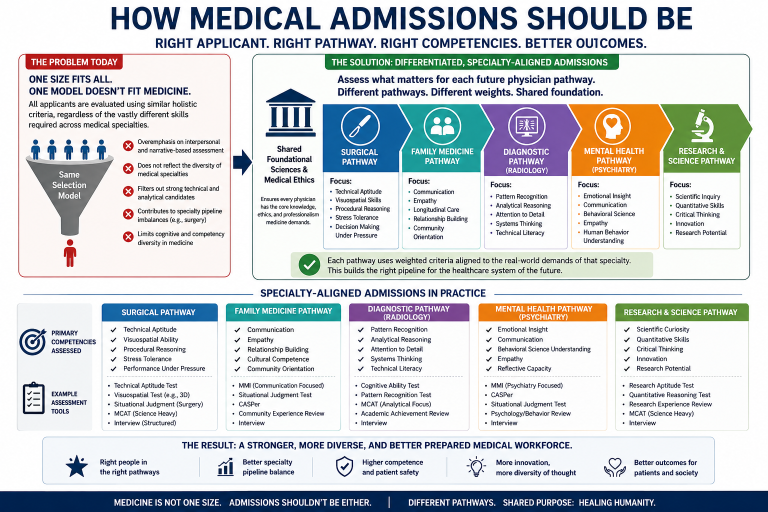
Fig. 1 Admission Policies


How Medical Admissions should be designed in the age of specialized medicine

Modern medicine is no longer a single profession operating under a single competency model.

A neurosurgeon, a psychiatrist, a family physician, a radiologist, and an interventional cardiologist may all carry the title “doctor,” yet the actual competencies required for excellence in these domains differ profoundly.

Despite this reality, many modern medical school admissions systems continue to operate under a generalized selection architecture that assumes one universal physician profile should be identified before specialization occurs.

This assumption increasingly deserves reconsideration.

The Problem pith the one-model approach

Current admissions systems in many Western countries heavily emphasize generalized holistic assessment:

  • MMIs,
  • CASPer,
  • autobiographical narratives,
  • communication-focused evaluation,
  • behavioural interviews,
  • and broad interpersonal assessment.

The justification is understandable:
modern healthcare requires professionalism, ethics, communication, and patient-centered care.

However, the same admissions architecture is used to select future:

  • surgeons,
  • pathologists,
  • anesthesiologists,
  • procedural specialists,
  • technical diagnosticians,
  • and highly analytical medical researchers.

This creates a structural mismatch.

Medicine contains multiple competency ecosystems, yet admissions systems often evaluate applicants through a single behavioural framework.

Different specialties require different strengths

A family physician requires:

  • continuity of care,
  • communication,
  • emotional regulation,
  • long-term patient management,
  • and broad interpersonal engagement.

A surgeon requires:

  • technical precision,
  • visuospatial reasoning,
  • rapid procedural decision-making,
  • stress tolerance,
  • endurance,
  • and operational performance under pressure.

A radiologist depends heavily on:

  • pattern recognition,
  • analytical interpretation,
  • and technical diagnostic cognition.

A pathologist may spend more time interpreting complex biological systems than interacting directly with patients.

Yet all are filtered initially through largely similar admissions structures.

This raises a critical institutional question:

Should one generalized admissions model determine entry into all future physician pathways?

Admissions Systems shape the profession

Admissions criteria are not neutral.

They shape:

  • who applies,
  • who succeeds,
  • who self-selects out,
  • and ultimately what kinds of physicians dominate the healthcare system.

If admissions systems heavily reward:

  • behavioural presentation,
  • interpersonal communication,
  • empathy-oriented framing,
  • and narrative performance,

then applicants strongest in those domains will increasingly dominate admission outcomes.

If systems emphasize:

  • analytical rigor,
  • scientific performance,
  • technical reasoning,
  • and procedural aptitude,

Different demographic and cognitive profiles may emerge because the architecture of selection determines the architecture of the profession itself.

The case for early differentiation

The future of medicine may require a more differentiated admissions model.

Instead of treating medicine as one homogeneous profession, admissions could eventually separate into partially specialized pathways earlier in the educational process.

For example:

Pathway

Primary Competencies

Surgery

technical precision, stress tolerance, visuospatial reasoning

Family Medicine

communication, continuity of care, interpersonal management

Radiology

analytical interpretation, pattern recognition

Psychiatry

behavioural insight, emotional communication

Research Medicine

scientific reasoning, quantitative analysis

Such a model would not eliminate shared medical foundations.

Rather, it would recognize that excellence across highly different medical domains may require different selection emphasis from the beginning.

Why the current model creates tension

One of the unintended consequences of generalized holistic admissions is that the system may disproportionately reward one behavioural archetype across all future specialties.

This can create several long-term effects:

  • narrowing cognitive diversity,
  • altering specialty pipelines,
  • discouraging technically oriented applicants,
  • reshaping workforce composition,
  • and producing demographic outcomes strongly influenced by admissions architecture itself.

The paradox becomes especially visible in surgery.

Although women increasingly dominate medical school enrollment overall, surgery remains disproportionately male among practicing specialists. This suggests that medicine may not actually operate as one unified behavioural profession despite being selected through increasingly standardized behavioural criteria.

The profession diversifies later, even though the admissions system standardizes early.

The role of Technology and AI

This debate will intensify as medicine becomes more technologically integrated.

Future healthcare systems will increasingly involve:

  • robotic surgery,
  • AI-assisted diagnostics,
  • precision medicine,
  • advanced imaging systems,
  • automated procedural support,
  • and engineering-driven clinical environments.

Technical cognition may become even more important in several specialties.

In that environment, a universal admissions architecture centered primarily on generalized interpersonal screening may become progressively less aligned with the actual diversity of medical practice.

Communication still Matters but context matters more

None of this means communication should disappear from medicine.

Patients deserve:

  • respect,
  • informed consent,
  • ethical treatment,
  • and competent communication.

However, communication should not necessarily dominate admissions, weighting equally across every future specialty pathway.

A highly technical procedural specialist and a long-term community physician may require very different competency balances.

The admissions process should recognize this reality instead of assuming all future physicians should fit one standardized behavioural template.

Toward a more rational Admissions Architecture

A future-oriented admissions system may require:

  • differentiated physician pathways,
  • specialty-aligned competency weighting,
  • stronger technical aptitude assessment for procedural fields,
  • preserved interpersonal evaluation where clinically central,
  • and earlier alignment between applicant strengths and future medical domains.

Medicine is not one profession anymore.

It is an ecosystem of highly differentiated technical, analytical, interpersonal, and procedural specialties operating under a shared ethical framework.

Admissions systems should evolve to reflect that reality.

Because the way a society selects physicians ultimately shapes the future structure, capability, and resilience of its healthcare system itself.

An article blog written with ChatGPT version. 5.5 support May 14, 2026 

Continue reading
  130 Hits

Medical School Admissions in Ontario: Criteria, gender trends, and the sex discrepancy

AdmissionPolicies1


Overview of the Ontario Medical School Landscape

Ontario has seven medical schools operating under the centralized Ontario Medical School Application Service (OMSAS): the University of Toronto, McMaster University, Western University (Schulich), Queen's University, the University of Ottawa, Northern Ontario School of Medicine (NOSM), and Toronto Metropolitan University (TMU) . OMSAS was established in 1975 by the Council of Ontario Faculties of Medicine (COFM) to streamline the application process, as each school previously had its own separate application and requirements. Gyanberry

Admission Criteria: A Multi-Dimensional System

Modern Ontario medical school admissions are no longer simply about grades. They evaluate candidates across several interconnected dimensions:

1. Academic Performance (GPA)

The minimum academic requirement is three years of full-time undergraduate university study in any discipline, with a minimum GPA of 3.0 on the 4.0 scale. In practice, competitive applicants have GPAs well above this floor — typically 3.8–3.9+. Ontario Universities' Application Centre

2. The MCAT

Applicants must have taken the MCAT within five years of the application deadline, with a minimum score of 125 in each section. However, notably, the University of Ottawa does not require the MCAT to apply or be admitted, and NOSM similarly does not require the MCAT or CASPer exams. GyanberryMedSchoolCoach

3. CASPer (Computer-based Assessment for Sampling Personal Characteristics)

CASPer is an online situational judgment test (SJT) used by most Ontario schools to evaluate non-cognitive traits. The CASPer test claims to evaluate applicants' non-academic, non-cognitive traits or "soft" skills, such as communication, ethics, empathy, and motivation — skills considered desirable for future medical professionals. BeMo®

4. The MMI (Multiple Mini-Interview)

In recent years, medical school selection processes have evolved significantly, transitioning from traditional academic selection models to multifaceted processes that evaluate non-cognitive attributes such as communication, empathy, and ethical judgment, considered essential for health professionals. Most Ontario schools use the MMI as their primary interview format. nih

5. Autobiographical Sketch (ABS) and Reference Letters

Applicants must submit an extensive record of extracurricular activities, research, volunteer work, and employment — and provide reference letters (CAFs) from individuals who can speak to their character and abilities.

The Gender Discrepancy: Women Now Dominate Medical School

The Data

The shift in the gender composition of Canadian medical schools has been dramatic and consistent. In a cross-sectional analysis of Canadian medical trainees over 30 years, there were 137,096 male and 169,099 female MD applicants; 126,422 male and 152,967 female MD students; and 29,413 male and 34,173 female MD graduates. Women now substantially outnumber men at every stage of the medical training pipeline — except in surgical practice. BMC Medical Education

The most recent Canadian medical school classes have a range of 43–74% women (mean 58%), compared with a range of 26–57% men (mean 42%). Enrolment of women in Ontario and Atlantic Canada is above the national average, while enrolment in Western and Prairie schools falls below it. CMAJ

This is part of a broader international pattern. In the 2023–2024 academic year in the US, women made up 57% of medical school applicants, 55% of matriculants, and 54% of total enrollment. Medscape

Why the Discrepancy? A Multi-Causal Analysis

Cause 1: The Upstream Pipeline — Women Dominate Canadian Universities

The most foundational reason is that women far outnumber men in the pool from which medical school applicants are drawn. Nationally, undergraduate enrollment in Canada in 2022–23 was 58.3% women and 41.7% men. Among Canadians aged 25 to 34, about 40% of women hold a university degree, compared to about 26% of men — a gap that has grown since 2006, when the difference was nine percentage points. The Globe and Mail

Women are more likely than men to attend post-secondary institutions, perform better academically during their studies, and are often more engaged in extracurricular activities and campus life. Since medical schools select primarily from university graduates, a larger and more academically accomplished female applicant pool naturally flows into a larger female medical school cohort. Heqco

Cause 2: Non-Cognitive Criteria Favour Women

This is perhaps the most structurally significant cause unique to medical admissions specifically.

MMI performance: Research directly examining the MMI has found consistent gender differences. A study testing measurement invariance confirmed that MMI non-cognitive attributes were demonstrated equivalently by males and females, but significant latent mean differences were identified, with female applicants consistently outperforming male applicants across all three years studied. The authors noted this highlights the need for continued research into how group disparities may impact selection equity. nih

CASPer performance: The primary demographic that would likely benefit from CASPer being weighted in admissions would be women, who have made up the majority of medical school applicants and graduates since 2017. Women tend to score higher on empathy-framed, interpersonally-oriented tasks, which form the backbone of both CASPer and MMI station design. Science-Based Medicine

These tools were designed partly to counteract an over-reliance on GPA and MCAT scores, but in doing so, they appear to have introduced a different kind of demographic skew — one that advantages women.

Cause 3: GPA Patterns

In terms of GPA and MCAT, male matriculants tend to have slightly higher MCAT scores, while women tend to have slightly higher non-science GPAs; men have slightly higher science GPAs. Since most Ontario schools place a heavy weight on cumulative GPA (which includes arts and social science courses), the female advantage in non-science GPA translates directly into admissions competitiveness. Med School Insiders

Cause 4: Extracurriculars, Volunteering, and the ABS

Women are often more engaged in extracurricular activities and campus life. The ABS in OMSAS rewards broad involvement in healthcare volunteering, community work, and leadership. Studies have found that women disproportionately self-select into these experiences — whether through healthcare volunteering, peer mentorship, or community advocacy — which are precisely the activities rewarded by medical school admissions. Heqco

Cause 5: Social and Cultural Shifts in Career Aspirations

Women have always been interested in fields like medicine and science. What changed was access and opportunity — not the underlying interest itself. As institutional barriers were dismantled over the 20th century, women rapidly entered medicine in growing numbers. A compounding effect also plays out: as medicine becomes more female-dominated, it may become culturally more appealing to subsequent cohorts of women, and potentially somewhat less of a default aspiration for men who now have a wider range of career pathways they consider equally viable. Medscape

Cause 6: The MCAT — A Partially Counterbalancing Force

The one major admissions metric where men retain an advantage is the MCAT, particularly in the science sections. Men score higher than women on the MCAT science portion and on standardized licensing exams early in medical school training, though this gap closes or reverses by later clinical exams. Schools that place high weight on the MCAT (like McMaster, which once had over 76% female enrollment before it deliberately broadened admissions criteria) tend to have slightly less extreme gender skews, whereas schools deprioritizing the MCAT (like Ottawa and NOSM) tend to see greater female representation. nih

Institutional Responses and Tensions

McMaster eventually determined the imbalance was not healthy and decided to offer a kind of affirmative action for male applicants — by reducing the emphasis on GPA and broadening the criteria for admission, they were able to offer spots to more male students. This is a telling admission that the structure of criteria, not just the underlying applicant pool, directly shapes gender outcomes.

There is a real and unresolved tension here. On one hand, the shift toward non-cognitive criteria was intended to produce better, more empathetic physicians and to correct the historic male dominance of medicine. On the other hand, studies of CASPer and MMIs have found that these tools "do not appear to offer any significant advantage in promoting diversity or selecting intrinsically motivated applicants," and that they "favour applicants from higher income households" — as wealthier applicants have more resources to prepare for these test formats. BeMo®

The Remaining Paradox: Surgery

Despite women dominating medical school enrollment, a striking reversal occurs in surgical specialties. Increased female representation in medicine is not matched by representation in surgery, with the key factor being the specialty choice process. Among practicing surgeons, there are 7,457 men compared to just 3,457 women. It is paramount not to assume the self-selection of female students out of surgical specialties results from a true incompatibility — it is important to disentangle the origin and validity of information received by medical students that may disproportionately dissuade women from surgical fields. BMC Medical EducationSpringer Data shows that surgery is a demanding job, but due to admission criteria, many men never reach the stage of becoming surgeons. 

Summary

The gender discrepancy in Ontario medical school admissions is not the result of any single policy or bias, but rather the confluence of several reinforcing trends:

  • Women significantly outnumber men in the undergraduate pipeline from which applicants are drawn
  • Non-cognitive assessment tools (MMI, CASPer) consistently produce higher scores for women
  • Women have an edge in cumulative GPA (non-science), while men retain an advantage in MCAT science scores
  • Women are more likely to accumulate the volunteering and extracurricular experiences rewarded by the ABS
  • Broad cultural shifts have made medicine increasingly aspirational for women, while male career aspirations have diversified

The result is a medical profession in Canada that has fundamentally transformed over a generation, yet one in which new questions about equity, downstream specialty representation, and the validity of non-cognitive selection tools remain genuinely unresolved.

An article blog written with support of Claude Sonet 4.6 May 14, 2026

Continue reading
  137 Hits

The Admissions architecture itself influences demographic outcomes in medical schools- Ontario, Canada

AdmissionPolicies

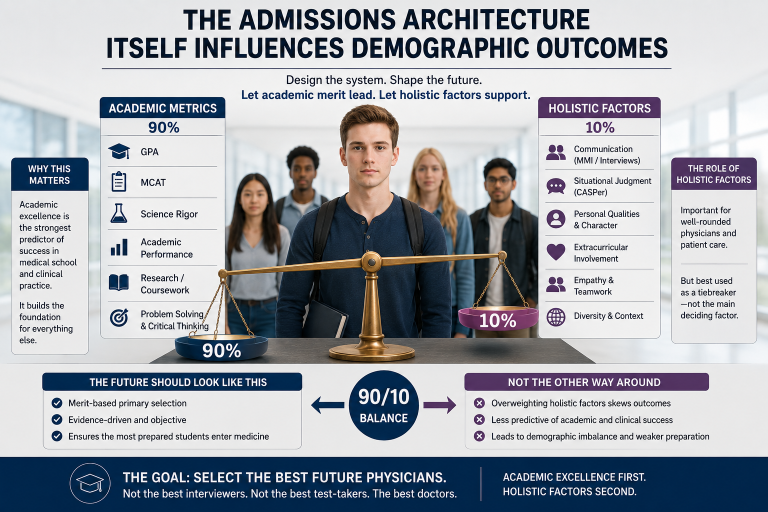
Fig. 1 Admission Architecture Medical Schools


For many years, public discussions about medical school admissions focused almost entirely on one question:

“Who is the most qualified candidate?”

But modern admissions systems reveal a deeper reality:

The way a system defines merit directly shapes who succeeds within it.

Admissions systems are not passive.
They are engineered structures built around institutional priorities, policy decisions, and philosophical assumptions about what society believes a future physician should look like.

As those assumptions change, demographic outcomes change with them.

Admissions systems are designed systems

Medical school admissions are often presented as neutral and objective. In reality, every admissions framework embeds value judgments.

A system that heavily weights:

  • GPA,
  • advanced science performance,
  • standardized academic testing,

will produce one demographic and cognitive profile.

A system that heavily weights:

  • interpersonal communication,
  • behavioural interviews,
  • situational judgment testing,
  • autobiographical narratives,
  • and perceived empathy,

will produce another.

Neither system is accidental.

The architecture itself determines which traits are rewarded.

The Canadian shift toward holistic admissions

Over the past several decades, many medical schools in Canada have moved away from admissions models centered primarily on academic metrics.

Institutions increasingly adopted:

  • MMIs (Multiple Mini Interviews),
  • CASPer situational judgment testing,
  • autobiographical sketches,
  • contextual admissions policies,
  • and broad “holistic review” frameworks.

The stated goal was clear:
to produce physicians who were not only scientifically capable, but also:

  • communicative,
  • collaborative,
  • emotionally aware,
  • socially accountable,
  • and patient-centered.

These changes reflected broader institutional beliefs about modern healthcare.

Demographic outcomes changed

As admissions architectures changed, the demographic composition of medical schools changed as well.

Women became the majority in many medical programs across Canada and several other Western countries.

This raises an important institutional question:

Did demographics change because applicant ability changed, or because the system changed what it rewarded?

The answer is likely both.

Research examining tools such as CASPer and MMIs has reported average group differences in certain behavioural and communication-oriented domains. Studies have also raised concerns about socioeconomic effects, coaching advantages, and the role of professional communication style in scoring outcomes.

This does not automatically prove intentional discrimination.

However, it does demonstrate something structurally important:

Selection systems influence demographic outcomes because selection criteria are not socially neutral.

The redefinition of merit

One of the most controversial aspects of modern admissions is that merit itself has been redefined.

Historically, medicine emphasized:

  • academic rigor,
  • scientific achievement,
  • memorization,
  • analytical reasoning,
  • and technical capability.

Modern systems increasingly incorporate:

  • empathy signaling,
  • communication style,
  • ethical framing,
  • behavioural performance,
  • and interpersonal evaluation.

Supporters argue this produces physicians better suited to contemporary healthcare systems.

Critics argue that the weighting may now disproportionately favor certain behavioural profiles while underweighting:

  • analytical intensity,
  • technical orientation,
  • or cognitively diverse personality types.

This is not merely a demographic discussion.

It is a philosophical debate about: what society believes medicine should optimize for.

Equity versus outcome equality

Another tension emerges around the meaning of “equity.”

Some institutions define equity as:

  • equal opportunity under common rules.

Others define equity as:

  • achieving broader representation across groups.

Others define it as:

  • selecting competencies believed to improve patient care regardless of demographic outcome.

These approaches can produce very different admissions structures.

A system may apply identical rules to all applicants while still producing unequal demographic outcomes if the rewarded traits correlate differently across populations.

This is why admissions architecture matters so profoundly.

Every selection system creates trade-offs

No admissions system is neutral.

If a school emphasizes:

  • MCAT science scores,
  • GPA,
  • and advanced quantitative reasoning,

it may select more heavily for analytical academic performance.

If it emphasizes:

  • MMIs,
  • CASPer,
  • and interpersonal evaluation,

it may select more heavily for behavioural and communication performance.

Every weighting decision changes:

  • who applies,
  • who succeeds,
  • who self-selects out,
  • and ultimately what the profession becomes.

The profession itself is shaped by the architecture of entry.

The larger policy question

The deeper question is not whether communication matters.
Almost everyone agrees that it does.

The deeper question is: how much should different competencies be weighted relative to one another?

Medicine requires simultaneously:

  • scientific reasoning,
  • technical competence,
  • diagnostic accuracy,
  • emotional regulation,
  • communication,
  • ethical judgment,
  • and teamwork.

No system can maximize every trait equally.

Admissions architecture therefore, becomes a policy instrument that reflects institutional priorities about what kinds of physicians should dominate the future healthcare system.

Conclusion

The modern debate over medical school admissions is not simply about fairness between applicants.

It is about institutional design.

When admissions systems change:

  • demographic outcomes change,
  • professional culture changes,
  • workforce composition changes,
  • and eventually healthcare systems themselves evolve.

The architecture of selection determines the architecture of the profession.

And once institutions understand that reality, admissions criteria are no longer just technical procedures.

They become social policy.

An article blog written with ChatGPT version. 5.5 support May 14, 2026 

Continue reading
  121 Hits

Why Educational Institutions work with BITSPEC in the AI Era

Educational institutions are operating in an environment of increasing complexity.

Artificial Intelligence is transforming how students learn and complete assignments.
Organizations increasingly question whether traditional credentials alone verify real capability.
Industries require professionals who can:

  • apply knowledge,
  • operate ethically,
  • analyze systems,
  • and function responsibly in complex operational environments.

At the same time, educational institutions face growing pressure to demonstrate:

  • workforce readiness,
  • measurable competencies,
  • assessment integrity,
  • and accountability in certification processes.

This is where BITSPEC plays an important role.

BITSPEC is more than a Training Organization

BITSPEC is not designed simply as another online course provider.

Its role is broader.

BITSPEC focuses on:

  • capability verification,
  • governance-aligned assessment,
  • AI-integrated learning,
  • and measurable operational competence.

The organization operates through:

  • Education 6.0,
  • the BITSPEC Capability Index (BCI™),
  • and certification structures designed in alignment with internationally recognized principles such as ISO/IEC 17024.

This distinction is critical.

Traditional education systems primarily evaluate:

  • knowledge acquisition,
  • course completion,
  • and examination performance.

BITSPEC extends evaluation toward:

  • Application,
  • Analytical Depth,
  • System Impact,
  • and Ethical Judgment.

Why ISO/IEC 17024 matters?

One of the largest global challenges today is trust in certification and competence.

Many organizations increasingly ask:

  • Does a credential truly represent capability?
  • Can competence be independently verified?
  • Is assessment performed fairly and consistently?
  • Are governance and impartiality properly maintained?

ISO/IEC 17024 addresses these concerns through internationally recognized principles for the certification of persons.

The standard emphasizes:

  • impartiality,
  • governance,
  • competence verification,
  • assessment integrity,
  • confidentiality,
  • appeals processes,
  • and independent certification decision-making.

BITSPEC aligns its governance direction with these principles because modern capability verification requires more than testing alone.

It requires:

  • transparent structures,
  • measurable assessment,
  • documented processes,
  • ethical oversight,
  • and operational accountability.

Educational Institutions face assessment integrity challenges

Artificial Intelligence has fundamentally changed assessment environments.

AI tools can:

  • generate essays,
  • solve technical problems,
  • summarize content,
  • automate reports,
  • and assist with coding and analysis.

As a result, institutions increasingly struggle to verify:

  • independent reasoning,
  • authentic capability,
  • and meaningful competence.

Traditional educational models based primarily on memorization and content reproduction are becoming less reliable indicators of operational readiness.

BITSPEC addresses this challenge by integrating:

  • AI governance,
  • capability-based assessment,
  • and measurable verification processes.

Rather than treating AI only as a threat, the BITSPEC model evaluates:

  • how learners use AI,
  • how they validate outputs,
  • whether they identify risks and limitations,
  • and whether they maintain independent analytical judgment.

This creates stronger alignment with:

  • UNESCO Media and Information Literacy (MIL),
  • operational governance,
  • and modern competency verification requirements.

The BCI™ Framework

The BITSPEC Capability Index (BCI™) evaluates:

  • Knowledge (K)
  • Application (A)
  • Analytical Depth (D)
  • System Impact (S)
  • Ethical Judgment (E)

This framework recognizes that operational capability is multidimensional.

A learner may possess theoretical knowledge while still lacking:

  • systems awareness,
  • operational judgment,
  • ethical reasoning,
  • or the ability to evaluate consequences in complex environments.

This distinction is increasingly important in sectors such as:

  • healthcare,
  • engineering,
  • quality management,
  • manufacturing,
  • AI governance,
  • infrastructure,
  • cybersecurity,
  • and operational leadership.

Why Educational Institutions engage with BITSPEC

Educational institutions increasingly recognize that:

  • information access alone no longer defines expertise,
  • AI changes how capability must be assessed,
  • and employers require stronger evidence of operational competence.

BITSPEC supports institutions by providing:

  • capability-based learning structures,
  • governance-aligned assessment,
  • AI-integrated evaluation,
  • measurable competency verification,
  • and audit-oriented educational models.

This helps institutions strengthen:

  • workforce readiness,
  • certification credibility,
  • and trust in measurable outcomes.

BITSPEC complements existing Educational Systems

BITSPEC does not position itself against universities or colleges.

Instead, it complements existing educational structures.

Traditional institutions continue to provide:

  • academic foundations,
  • disciplinary knowledge,
  • research environments,
  • and theoretical education.

BITSPEC strengthens:

  • operational capability verification,
  • governance-oriented assessment,
  • ethical evaluation,
  • and measurable demonstration of applied competence.

This distinction is important because modern organizations increasingly require evidence that individuals can:

  • apply knowledge responsibly,
  • operate within complex systems,
  • and demonstrate trustworthy decision-making.

Governance, Accountability, and Trust

One of the major weaknesses in many modern systems is the assumption that credentials automatically represent competence.

However, modern operational environments require:

  • measurable capability,
  • accountability,
  • ethical oversight,
  • and transparent governance structures.

BITSPEC aligns with ISO/IEC 17024 principles because capability verification requires:

  • impartiality,
  • structured assessment processes,
  • separation between training and certification decisions,
  • and independently verifiable evidence of competence.

This governance-oriented model becomes increasingly important in an AI-enabled world where information generation is easy, but trustworthy capability remains difficult to verify.

Final reflection

Modern education is entering a period where:

  • information is abundant,
  • AI accelerates content generation,
  • and operational complexity continues to increase.

In this environment, institutions increasingly require systems capable of verifying:

  • measurable competence,
  • ethical judgment,
  • operational thinking,
  • and systems-level understanding.

BITSPEC contributes to this transformation through:

  • Education 6.0,
  • BCI™,
  • governance-aligned assessment,
  • and certification principles designed in alignment with ISO/IEC 17024.

The objective is not simply to issue credentials.

The objective is to strengthen trust in demonstrated human capability within increasingly complex operational systems.

An article blog written with ChatGPT version. 5.5 support May 13, 2026

Continue reading
  168 Hits

The Emerging Divide: What the Next Five Years May Mean for Men in Canada


Canada is entering a structural transition that is rarely discussed openly.

The issue is not simply unemployment.
It is not simply inflation.
It is not only automation.

The deeper issue is that the economic model supporting traditional male employment is changing faster than institutions are adapting to it.

Recent labour force data from Statistics Canada already signal important shifts in participation, unemployment sensitivity, and employment stability among men across multiple sectors.

What we are observing is not a temporary fluctuation.
It is a redesign of labour itself.

The historical model is weakening

For decades, many men entered stable industries that provided long-term economic security:

  • manufacturing,

  • transportation,

  • logistics,

  • industrial operations,

  • construction,

  • repetitive technical work,

  • administrative systems.

These sectors were designed around predictability.

However, the modern economy is increasingly designed around:

  • automation,

  • AI-assisted decision systems,

  • platform economics,

  • data-driven optimization,

  • reduced labour dependency,

  • scalability without proportional human growth.

The result is that many occupations once considered “stable” are becoming structurally vulnerable.

This does not necessarily mean jobs disappear immediately.

It means the quality, stability, and long-term security of those jobs begin to erode slowly before the public fully recognizes the shift.


A structural capability divide

The labour market is increasingly separating into two distinct groups.

Group 1 — High Capability Workers

These individuals can:

  • analyze systems,

  • integrate AI effectively,

  • solve complex problems,

  • adapt to new technologies,

  • work across disciplines,

  • verify information critically,

  • operate in uncertain environments.

These workers are becoming more valuable.

Group 2 — Replaceable Functional Labour

These individuals perform work that is:

  • repetitive,

  • process-based,

  • standardized,

  • easily measurable,

  • automatable,

  • dependent on fixed workflows.

These workers face increasing instability.

The issue is not intelligence.
The issue is adaptability within rapidly changing systems.


The Pressure on Younger Men

One of the most significant risks appears among younger males entering the workforce.

Several pressures are occurring simultaneously:

  • population growth,

  • housing affordability decline,

  • credential inflation,

  • increasing competition,

  • automation of entry-level work,

  • reduced access to stable career pathways.

Historically, many young men could enter industries directly and gradually build economic stability through experience.

That pathway is becoming narrower.

At the same time, educational systems often continue measuring:

  • attendance,

  • credential completion,

  • theoretical memorization,

instead of measurable capability.

This creates a dangerous mismatch between education outputs and labour market reality.

AI will not replace everyone, but it will reorganize value

A common misunderstanding is that AI simply “eliminates jobs.”

The reality is more complex.

AI reorganizes which human capabilities become economically valuable.

Individuals who can:

  • supervise AI,

  • validate AI outputs,

  • interpret complex data,

  • make ethical judgments,

  • integrate systems,

  • solve ambiguity,

may become significantly more valuable.

Meanwhile, individuals whose work depends primarily on routine execution may experience declining leverage within the labour market.

The future may not be defined by “humans versus AI.”

It may instead be defined by humans who can work with AI versus humans whose work can be absorbed by systems.

The Psychological Dimension

Economic transitions do not only affect income.

They affect identity.

For many men, employment has historically been connected to:

  • stability,

  • responsibility,

  • purpose,

  • family support,

  • social value,

  • personal dignity.

When systems become unstable, the psychological consequences can spread far beyond economics.

This is why labour-force transformation is not merely a financial issue.

It becomes:

  • a governance issue,

  • an educational issue,

  • a social cohesion issue,

  • a public health issue.


The Education Gap

One of the largest systemic problems is that educational systems often react slowly to structural economic change.

Many institutions still prioritize:

  • standardized delivery,

  • memorization,

  • passive learning,

  • theoretical accumulation,

  • static credentials.

However, future economic resilience increasingly depends on measurable capability:

  • analytical depth,

  • adaptability,

  • systems thinking,

  • ethical reasoning,

  • technological fluency,

  • decision quality.

The future workforce cannot be developed using industrial-era educational assumptions while operating inside AI-driven economies.


The Next Five Years

Over the next five years, several trends may intensify:

  • increased instability in low-skill male employment,

  • greater polarization between high and low capability workers,

  • stronger demand for technical adaptability,

  • increased AI integration across industries,

  • rising pressure on younger workers,

  • declining stability in routine occupations.

At the same time, opportunities will continue expanding in areas such as:

  • infrastructure,

  • advanced trades,

  • AI systems,

  • engineering,

  • cybersecurity,

  • industrial analytics,

  • healthcare technology,

  • automation management.

The issue is not whether opportunities exist.

The issue is whether systems are preparing people for the realities of those opportunities.


A System-Level Question

The deeper question Canada may need to confront is this:

Are current educational and labour systems developing real capability or merely distributing credentials within increasingly unstable economic structures?

Because if capability is not verified meaningfully, labour instability may continue growing even while credential numbers increase.

That is not an employment problem alone. It becomes a systems design problem, and systems problems eventually affect entire societies.

Statistics Canada

Statistics Canada Table 37-10-0163-02

DOI: 10.25318/3710016301-eng


Continue reading
  111 Hits

Global Governance issues, master framework

Introduction

Governance issues exist when systems responsible for decision-making, accountability, regulation, oversight, public trust, and resource allocation fail to operate effectively, ethically, transparently, or fairly.

These governance failures can occur at:

  • International level
  • National level
  • Provincial/state level
  • Municipal level
  • Corporate level
  • Educational level
  • Technological level
  • Institutional level
  • Community level

Governance problems are not limited to politics. They exist across:

  • Education
  • Healthcare
  • Transportation
  • Banking
  • Technology
  • AI systems
  • Certification systems
  • Infrastructure
  • Environmental management
  • International trade
  • Aviation
  • Supply chains
  • Social systems

This framework provides a structured global overview of governance issues affecting modern societies.

1. Political Governance Issues

1.1 Corruption

  • Bribery
  • Political favoritism
  • Nepotism
  • Patronage systems
  • Illegal lobbying
  • Regulatory capture
  • Vote buying
  • Public procurement corruption
  • Misuse of public funds
  • Embezzlement
  • Conflict of interest
  • Hidden ownership structures
  • State-level corruption

1.2 Weak Democratic Systems

  • Lack of electoral integrity
  • Manipulated elections
  • Voter suppression
  • Disinformation campaigns
  • Political polarization
  • Weak opposition systems
  • Concentration of power
  • Weak parliamentary oversight
  • Lack of transparency in decision-making
  • Authoritarian governance structures
  • Emergency powers abuse

1.3 Public Trust Erosion

  • Institutional distrust
  • Low government legitimacy
  • Inconsistent public communication
  • Hidden policy agendas
  • Lack of accountability
  • Broken public promises
  • Public cynicism
  • Social fragmentation

1.4 Judicial Governance Problems

  • Delayed justice systems
  • Politicized courts
  • Unequal access to justice
  • Corruption in legal systems
  • Weak enforcement mechanisms
  • Inconsistent sentencing
  • Overcrowded prisons
  • Human rights violations

2. Economic Governance Issues

2.1 Financial System Governance

  • Banking instability
  • Hidden systemic financial risks
  • Excessive debt structures
  • Inflation governance failures
  • Currency instability
  • Financial inequality
  • Tax avoidance systems
  • Offshore tax havens
  • Lack of financial transparency
  • Predatory lending
  • Insider trading
  • Weak financial oversight
  • Shadow banking systems

2.2 Corporate Governance Failures

  • Executive overcompensation
  • Shareholder manipulation
  • ESG manipulation
  • Fraudulent reporting
  • Weak board oversight
  • Lack of whistleblower protection
  • Data concealment
  • Monopoly power concentration
  • Anti-competitive behavior
  • Supply chain exploitation
  • Forced labor risks

2.3 Labor Governance Issues

  • Wage inequality
  • Unsafe working conditions
  • Gig economy exploitation
  • Lack of labor protections
  • Automation displacement
  • Unfair hiring systems
  • Discrimination in employment
  • Worker surveillance
  • Human trafficking
  • Child labor

2.4 Economic Inequality

  • Wealth concentration
  • Intergenerational inequality
  • Unequal access to capital
  • Housing affordability crises
  • Unequal regional development
  • Poverty persistence
  • Economic exclusion

3. Education Governance Issues

3.1 Access Inequality

  • Unequal access to education
  • Unequal access to technology
  • Unequal access to software/tools
  • Rural education disadvantages
  • Digital divide
  • Educational funding disparities
  • Language barriers

3.2 Quality Governance Problems

  • Outdated curriculum systems
  • Weak competency verification
  • Grade inflation
  • Credential inflation
  • Standardized testing limitations
  • Lack of industry alignment
  • Poor teacher support systems
  • Weak educational accountability

3.3 AI and Education Governance

  • AI-assisted cheating
  • Lack of AI policy frameworks
  • Unequal AI access
  • AI-generated misinformation
  • AI dependence without understanding
  • Weak verification of real capability
  • Ethical misuse of AI
  • AI bias in educational systems

3.4 Certification Governance Issues

  • Weak credential verification
  • Lack of competency validation
  • Certification monopolies
  • Conflicts between training and certification
  • Weak proctoring systems
  • Fraudulent certifications
  • Lack of industry trust
  • Lack of auditability

4. Healthcare Governance Issues

4.1 Access and Equity

  • Unequal healthcare access
  • Rural healthcare gaps
  • Long waiting times
  • Insurance inequality
  • Pharmaceutical pricing issues
  • Mental health service shortages
  • Accessibility barriers

4.2 System Governance Failures

  • Hospital overcrowding
  • Resource allocation failures
  • Weak emergency preparedness
  • Fragmented healthcare systems
  • Medical staffing shortages
  • Poor data interoperability
  • Administrative inefficiency

4.3 Ethical and Technological Issues

  • AI diagnosis accountability
  • Medical data privacy risks
  • Pharmaceutical lobbying
  • Biometric surveillance
  • Genetic data governance
  • Clinical trial transparency
  • Algorithmic healthcare bias

5. Technology Governance Issues

5.1 Artificial Intelligence Governance

  • Lack of AI regulation
  • Algorithmic bias
  • Black-box decision systems
  • AI accountability gaps
  • AI misinformation
  • Deepfakes
  • Autonomous weapon systems
  • AI labor displacement
  • AI concentration of power
  • AI intellectual property conflicts
  • AI-generated fraud
  • Human oversight failures

5.2 Data Governance

  • Mass surveillance
  • Privacy violations
  • Unauthorized data collection
  • Weak cybersecurity
  • Data monopolization
  • Cross-border data conflicts
  • Identity theft
  • Biometric misuse
  • Facial recognition governance issues

5.3 Digital Platform Governance

  • Social media manipulation
  • Online radicalization
  • Misinformation ecosystems
  • Platform monopoly power
  • Content moderation inconsistencies
  • Digital addiction systems
  • Online harassment
  • Cybercrime

6. Environmental Governance Issues

6.1 Climate Governance

  • Climate policy inconsistency
  • Carbon accountability failures
  • Weak emission enforcement
  • International climate disputes
  • Greenwashing
  • Resource depletion
  • Deforestation
  • Biodiversity collapse

6.2 Water and Food Governance

  • Water scarcity management
  • Agricultural sustainability failures
  • Food insecurity
  • Soil degradation
  • Fisheries depletion
  • Industrial pollution
  • Chemical contamination

6.3 Energy Governance

  • Energy dependence risks
  • Grid instability
  • Fossil fuel lobbying
  • Unequal energy access
  • Nuclear safety governance
  • Renewable infrastructure inequality

7. Infrastructure Governance Issues

7.1 Transportation Governance

  • Airport congestion
  • Rail system failures
  • Urban traffic inefficiency
  • Poor public transit integration
  • Aging infrastructure
  • Lack of predictive planning
  • Passenger rights failures
  • Border control bottlenecks
  • Aviation system fragmentation

7.2 Urban Governance

  • Housing crises
  • Urban inequality
  • Weak zoning systems
  • Poor city planning
  • Infrastructure underinvestment
  • Disaster preparedness gaps
  • Smart city surveillance concerns

7.3 Supply Chain Governance

  • Supply chain fragility
  • Logistics bottlenecks
  • Dependency on limited suppliers
  • Lack of transparency
  • Counterfeit goods
  • Ethical sourcing failures

8. International Governance Issues

8.1 Global Institutional Limitations

  • Weak international enforcement
  • Geopolitical fragmentation
  • Unequal representation
  • Veto-power imbalances
  • Inconsistent sanctions systems
  • Weak humanitarian coordination

8.2 Migration and Border Governance

  • Refugee crises
  • Border management failures
  • Human trafficking
  • Stateless populations
  • Immigration processing delays
  • Unequal asylum systems

8.3 Global Security Governance

  • Cyber warfare
  • Terrorism coordination gaps
  • Nuclear proliferation risks
  • Hybrid warfare
  • Disinformation warfare
  • Military escalation risks

9. Media and Information Governance Issues

9.1 Information Integrity

  • Fake news
  • Propaganda systems
  • Information manipulation
  • Media ownership concentration
  • State-controlled media
  • AI-generated misinformation
  • Lack of media literacy

9.2 Platform and Communication Governance

  • Algorithmic amplification
  • Echo chambers
  • Manipulation through engagement systems
  • Psychological targeting
  • Advertising opacity
  • Political influence campaigns

10. Ethical Governance Issues

10.1 Ethical Decision-Making Failures

  • Lack of ethical oversight
  • Profit-over-human systems
  • Weak accountability culture
  • Ethical relativism in institutions
  • Human dignity violations
  • Exploitation-driven systems

10.2 Governance and Human Capability

  • Systems rewarding appearance over capability
  • Measurement without understanding
  • Credentialism without competence
  • Exclusion through access limitations
  • Lack of human-centered system design
  • Failure to account for societal impact

11. Governance Issues in Science and Research

11.1 Research Integrity

  • Data fabrication
  • Publication bias
  • Replication crisis
  • Funding influence on outcomes
  • Predatory journals
  • Manipulated peer review

11.2 Scientific Access and Equity

  • Paywalled knowledge systems
  • Unequal access to research tools
  • Unequal access to software
  • AI-driven research inequalities
  • Concentration of scientific infrastructure

12. Governance Issues in Certification and Professional Standards

12.1 Professional Credential Governance

  • Certification monopolization
  • Weak recertification systems
  • Inconsistent competency standards
  • Lack of practical verification
  • Examination security issues
  • Conflicts of interest
  • Weak impartiality governance

12.2 AI and Competency Verification

  • AI-assisted examinations
  • Weak identity verification
  • Capability inflation
  • Knowledge verification failures
  • Lack of audit-grade evidence
  • Weak assessment traceability

13. Governance Issues in Public Services

13.1 Service Delivery Failures

  • Long processing times
  • Bureaucratic inefficiency
  • Poor citizen communication
  • Lack of digital integration
  • Fragmented public systems
  • Accessibility barriers

13.2 Accountability Problems

  • No ownership of failures
  • Hidden responsibility structures
  • Delayed complaints resolution
  • Weak public oversight
  • Lack of performance transparency

14. Emerging Governance Risks

14.1 Human-AI Society Transition

  • AI replacing cognitive work
  • Unequal AI access
  • Human deskilling
  • AI dependency risks
  • Loss of human autonomy
  • Ethical governance lag

14.2 Capability and Representation Crisis

  • Increasing gap between credentials and capability
  • Tool access inequality
  • Statistical misrepresentation
  • Governance driven by profitability instead of societal functionality
  • Non-representation of vulnerable populations
  • Decision-making detached from operational reality

14.3 Complex System Governance

  • Systems optimized for averages instead of real-world variability
  • Lack of predictive governance
  • Reactive instead of preventive systems
  • Fragmented data systems
  • Poor systems engineering integration
  • Inability to manage interconnected global risks

15. Meta-Governance Problems

These are governance failures affecting governance itself.

15.1 Structural Governance Problems

  • Governance complexity
  • Lack of coordination between agencies
  • Overlapping authorities
  • Policy fragmentation
  • Regulatory inconsistency
  • Institutional silos

15.2 Measurement and Verification Problems

  • Metrics without validity
  • KPI manipulation
  • Governance theater
  • Compliance without functionality
  • Audit systems disconnected from operational reality
  • Data collection without corrective action

15.3 Systemic Capability Problems

  • Leadership competency gaps
  • Decision-making detached from technical expertise
  • Short-term political thinking
  • Governance based on optics rather than outcomes
  • Lack of systems thinking

Conclusion

Modern governance challenges are increasingly systemic rather than isolated.

Most governance failures today are connected to:

  • Complexity without integration
  • Data without interpretation
  • Metrics without capability
  • Access without equity
  • Technology without ethics
  • Regulation without operational understanding
  • Accountability without traceability

The future of governance will increasingly depend on:

  • Systems thinking
  • Real-time data integration
  • Human-centered design
  • Ethical AI governance
  • Capability verification
  • Predictive operational models
  • Transparent accountability systems
  • Global coordination frameworks

Governance is no longer only about authority. It is about whether systems can function reliably, ethically, transparently, and intelligently in increasingly complex societies.

Continue reading
  96 Hits

Frankfurt Airport and the Illusion of Modern Infrastructure

How passenger growth, revenue expansion, and fragmented governance are producing predictable operational failure


Fraport

Fig 1. Travellers statistics

PeopleWaiting

Fig. 2 Travellers waiting


Modern airports are among the most technologically advanced infrastructures ever created. Every passenger journey is digitally connected through:

  • airline reservation systems,
  • boarding systems,
  • baggage tracking,
  • biometric identification,
  • gate management,
  • passenger analytics,
  • and security infrastructure.

Yet despite this enormous operational intelligence, passengers continue missing connecting flights in large numbers.

Fraport provides one of the clearest examples of this growing systems-engineering contradiction.

The issue is not simply:

  • long queues,
  • delayed aircraft,
  • or isolated operational disruptions.

The issue is that modern transportation infrastructure is increasingly optimized for traffic growth and throughput efficiency without proportionate evolution in predictive operational governance.

The Numbers reveal a larger Problem

According to Fraport’s 2025 passenger overview:

  • Frankfurt Airport handled approximately 63.2 million passengers,
  • continuing its strong post-pandemic recovery trajectory.

At the same time:

  • 49% of all passengers were transfer passengers,
  • while 51% were origin-and-destination travelers.

This means nearly half of Frankfurt’s operational model depends on the airport functioning as a synchronized transfer system.

The airport also reported:

  • 76% leisure travelers,
  • compared with 24% business travelers.

These statistics reveal something much more important than traffic recovery.

They reveal increasing operational complexity.

Revenue Growth Does Not Necessarily Mean System Quality

Large hub airports generate revenue through:

  • landing fees,
  • passenger service charges,
  • retail activity,
  • concessions,
  • terminal usage,
  • parking,
  • airline agreements,
  • and transfer traffic volume.

From a financial perspective, more passengers generally mean more revenue.

However, passenger growth simultaneously increases:

  • queue density,
  • border-processing load,
  • transfer-system fragility,
  • staffing pressure,
  • and operational variability.

This creates a critical infrastructure contradiction: Passenger volume can increase faster than operational adaptability.

An airport may therefore report:

  • strong financial recovery,
  • increasing passenger totals,
  • and higher traffic volumes,

while passengers simultaneously experience:

  • declining reliability,
  • longer queues,
  • higher transfer uncertainty,
  • and increasing operational stress.

This is one of the most important governance challenges facing modern transportation systems.

The hidden fragility of transfer systems

Transfer systems are mathematically fragile.

Small operational disruptions propagate rapidly through interconnected passenger flows.

For example:

  • one delayed long-haul aircraft,
  • combined with insufficient border staffing,
  • combined with biometric verification,
  • combined with long terminal distances,
  • combined with additional security screening,

can produce hundreds of missed connections within a single operational wave.

Frankfurt combines several high-risk transfer conditions simultaneously:

  • Non-Schengen to Schengen transfers,
  • centralized border processing,
  • terminal changes,
  • long walking distances,
  • and simultaneous intercontinental arrivals.

As an example, a passenger arriving from Canada and connecting to Romania may need to:

  1. Deplane
  2. Navigate terminal corridors
  3. Pass through immigration and another terminal
  4. Complete biometric verification managed by the Federal Police
  5. Potentially undergo another security screening before accessing the next gate
  6. Reach a distant boarding gate before the cutoff

This sequence becomes operationally unstable when multiple wide-body aircraft arrive within the same time window.

The larger the passenger volumes become, the more sensitive the system becomes to congestion variability.

The airport already possesses the required data

The most important operational question is not:

“Why are passengers missing flights?”

The real question is:

“Why are predictable failures not being prevented?”

Modern airport ecosystems already possess:

  • passenger itineraries,
  • gate assignments,
  • boarding deadlines,
  • passport information,
  • queue analytics,
  • transfer distances,
  • arrival delays,
  • congestion metrics,
  • and biometric-processing data.

This means the airport already possesses enough information to estimate transfer risk in real time.

Research in aviation analytics has already demonstrated that missed connections are highly predictable using operational and passenger-flow data.

In other words, the failures are statistically visible before they occur.

The visibility gap

One of the most revealing operational weaknesses at Frankfurt Airport is the absence of real-time passenger visibility into transfer conditions.

Passengers often do not have access to:

  • real-time immigration wait times,
  • predictive connection-risk indicators,
  • transfer congestion estimates,
  • or adaptive routing guidance.

This creates a major systems paradox: The infrastructure can observe operational risk in real time, but the passenger cannot.

Passengers are expected to make time-critical transfer decisions while lacking access to the same operational intelligence already available internally to airport operators and authorities.

In modern infrastructure systems, information asymmetry becomes a structural risk factor.

A predictive airport environment would instead provide:

  • real-time transfer-risk visibility,
  • estimated processing times,
  • adaptive routing recommendations,
  • and connection probability indicators.

Without operational transparency, passengers become reactive participants inside a system that already knows failure conditions are developing.

The illusion of reliability

Airport systems are frequently designed around average assumptions:

  • average immigration time,
  • average passenger flow,
  • average walking conditions,
  • and average security throughput.

But operational systems are not governed by averages; they are governed by dynamic conditions and variance.

For example:

If the airport assumes:

  • 15-minute immigration processing, but real operational conditions fluctuate between:
  • 5 and 70 minutes, then a “valid” 60-minute connection becomes statistically unreliable.

The system may technically comply with:

  • minimum connection-time rules, while operationally generating large numbers of failed passengers.

This creates the illusion of reliability.

The European Governance Problem!!

A growing issue within the European aviation and border-management framework is the disproportionate transfer of operational burden onto travelers themselves.

The implementation of the EU Entry/Exit System (EES) introduced:

  • increased biometric processing,
  • additional verification complexity,
  • and longer border-processing times for non-EU travelers.

However, the operational burden generated by these changes has largely been absorbed by passengers.

In practice:

  • travelers lose flights,
  • pay additional ticket costs,
  • lose hotel reservations,
  • experience severe stress,
  • and spend hours trapped in border queues,

while the institutions designing and operating the system often avoid direct operational accountability.

This creates a dangerous governance imbalance.

The traveler becomes the operational shock absorber of the infrastructure system.

When:

  • connection windows are sold as operationally “valid,”
  • congestion conditions are already known internally,
  • staffing adaptation remains insufficient,
  • and predictive intervention is absent,

The financial and operational consequences are effectively transferred onto passengers.

The situation becomes even more problematic when travelers are treated as individually responsible for failures originating from systemic design weaknesses.

Passengers may be told:

  • they should have walked faster,
  • anticipated congestion,
  • deplaned earlier,
  • or booked longer connections,

even though:

  • the airport already possessed real-time operational data,
  • airlines sold the itinerary,
  • and authorities controlled processing capacity.

This creates a structural asymmetry:

  • institutions maintain operational authority,
  • while passengers absorb operational consequences.

From a systems-engineering perspective, this is not sustainable governance.

Throughput optimization versus reliability optimization

A fundamental systems question now emerges:

Is the airport optimized primarily for passenger throughput or for passenger reliability?

These are not identical objectives.

Throughput optimization focuses on:

  • maximizing traffic volume,
  • gate utilization,
  • commercial activity,
  • and scheduling density.

Reliability optimization focuses on:

  • successful transfers,
  • predictable passenger movement,
  • operational transparency,
  • congestion resilience,
  • and transfer protection.

Modern hub airports increasingly attempt to maximize both simultaneously.

However, when systems approach operational saturation, one objective eventually dominates the other.

Passengers experience the consequences through:

  • missed connections,
  • transfer uncertainty,
  • operational stress,
  • and declining trust in system reliability.

The future airport must become predictive

A modern airport should continuously estimate: P (missing connection)

using:

  • arrival delay,
  • queue density,
  • biometric-processing time,
  • walking distance,
  • security delays,
  • and boarding cutoffs.

Conceptually, predictive modeling could operate as:

P(MC)=f(D,Q,W,B,S,G,T)

Where:

  • (D) = arrival delay
  • (Q) = queue time
  • (W) = walking time
  • (B) = biometric processing
  • (S) = security delay
  • (G) = gate distance
  • (T) = boarding cutoff

The technology required for this already exists.

The operational integration does not.

Future airports will require:

  • AI-driven passenger orchestration,
  • predictive congestion management,
  • adaptive staffing,
  • real-time operational transparency,
  • and integrated governance systems.

Conclusion

Frankfurt Airport does not suffer from a lack of technology.

It suffers from a lack of integrated systems adaptation.

The infrastructure already possesses:

  • operational analytics,
  • predictive capability,
  • passenger-flow intelligence,
  • and real-time congestion visibility.

Yet the operational model remains largely reactive:

  • passengers fail first,
  • the intervention happens afterward.

At the same time, the broader European operational framework increasingly transfers the consequences of systemic congestion onto travelers.

Passengers become financially and operationally responsible for failures they do not control.

Modern transportation infrastructure can no longer be evaluated solely through:

  • passenger growth,
  • traffic recovery,
  • or revenue expansion.

It must also be evaluated through:

  • operational resilience,
  • predictive governance,
  • transfer reliability,
  • and infrastructure adaptability.

Otherwise, infrastructure growth risks becoming operational expansion without corresponding quality evolution.

The problem is not the increase in passenger volume itself. The problem is the failure of modern infrastructure systems to dynamically adjust operational conditions and provide real-time transparency despite already possessing the intelligence required to do so.

An article blog written with ChatGPT version. 5.5 support May 13, 2026

Continue reading
  82 Hits

From Guild to Credential: What Canada Inherited and What It Missed


Introduction

There was a time when education did not exist as a system separate from work.

In the historical guild systems of Europe, learning, practice, and certification were inseparable. A person did not “graduate” into a profession—they became one through years of apprenticeship, observation, correction, and ultimately, proof. The final test was not theoretical. It was visible, tangible, and undeniable: a masterpiece.

This model did not disappear because it was ineffective. It disappeared because it could not scale.

Industrialization and the End of the Guild System

With the rise of industrialization in the 19th century, societies faced a fundamental shift. Economies required:

* Speed
* Standardization
* Large-scale productionI
* Interchangeable labor

The guild system—deeply rooted in individualized mastery—could not meet these demands.

As a result, it was replaced.

Not by a better system of capability verification, but by a more efficient system of participation.

This transformation marked the beginning of what we now recognize as modern education.

The Rise of the Credential System

Canada’s education system was built within this industrial framework.

Its structure reflects industrial logic:

* Students progress in cohorts
* Learning is divided into semesters
* Achievement is measured through credits and grades
* Completion leads to certification

This system was not designed to verify mastery. It was designed to prepare individuals for participation in the workforce.

The core question shifted from:

“Can this person perform at a high level?”

to:

 “Has this person completed the required preparation?”

This distinction is subtle, but critical.


Cultural Transformation: From Craft to Credential

The transition from guilds to credentials did more than change education—it changed identity.

In guild culture:

* Identity was based on craft
* Status came from demonstrated skill
* Learning was experiential and embodied
* Ethics were enforced by community

In modern credential-based systems:

* Identity is tied to qualifications
* Status comes from degrees and certifications
* Learning is structured and institutional
* Ethics are policy-based and often abstract

This shift enabled greater access and participation. More people could enter professions. More people could advance.

But it also introduced a new challenge: the separation between certification and actual capability.


The Invisible Legacy of Industrialization

Industrialization is no longer visible in classrooms, but its assumptions remain embedded:

* Learning is time-based
* Progress is standardized
* Completion equals qualification
* Qualification implies capability

These assumptions worked in industrial environments where tasks were predictable and systems were stable.

Today, they are increasingly misaligned with reality.


The Canadian Context

Canada did not ignore industrialization—it successfully adopted it.

The system delivers:

* Broad access to education
* Standardized credentials
* Scalable learning models

However, it does not consistently verify:

* Applied capability
* Analytical reasoning
* System-level understanding
* Ethical judgment in complex situations

This creates a structural gap.

Graduates may hold credentials, yet employers still need to verify whether capability truly exists.


Lessons from the Guild System

The guild system cannot be replicated in its original form. Its limitations—restricted access, slow scalability, and dependence on local authority—make it unsuitable for modern societies.

However, one principle remains essential:

Capability must be demonstrated, not assumed.

Guilds enforced this through direct observation. Work spoke for itself.

Modern systems rely more on signals than on proof.


Toward a Post-Industrial Education Model

If industrial education solved the problem of scale, the next stage must solve the problem of verification.

A modern approach must go beyond completion and address capability directly.

This includes measuring:

* What individuals know
* What they can apply
* How they think and analyze
* How they understand system-level consequences
* How they evaluate ethical risks

This is not about adding more education.

It is about changing how competence is validated.


Final Reflection

The guild system ended because it could not support an industrial world.

The credential system succeeded because it could.

The challenge today is different.

We no longer struggle with access or scale.
We struggle with trust and verification.

Completion is measurable.
Capability is not—unless we choose to measure it.

What we measure defines what we value.
And what we value defines what we trust.


Continue reading
  131 Hits

Day 19 — Control Without Protection

ChatGPT_Image_Apr_25_2026_04_58_16_PM_1

Evidence from Frankfurt Airport (Terminal 2, April 25, 2026 – 11:00 AM)

At 11:00 AM on April 25, 2026, in Terminal 2 of Frankfurt Airport, hundreds of travelers stood in a dense, immobile queue.

Each individual was required to pass through biometric verification: facial recognition and fingerprint capture.

There were no visible staff managing the process.
No intervention.
No prioritization.
No support.

Only machines.


What We Observed?

The system was operational—but not functional.

* Travelers were processed sequentially through biometric checkpoints
* Throughput was significantly lower than demand
* No manual override or contingency flow was visible
* No personnel were present to assist or regulate the situation

The result was not a delay.
It was a systemic bottleneck with no recovery mechanism.


The Illusion of Modernization

Biometric systems are often presented as symbols of efficiency, security, and technological advancement.

In practice, what we observed was different:

* Identity verification was strict
* Control mechanisms were enforced
* Compliance was required from every traveler

Yet when the system slowed down, **there was no corresponding layer of protection**.

> Control was present.
> Capability was not.


The Missing Layer: Human Responsibility

A resilient system is not defined by its level of control, but by its ability to adapt under stress.

In this case:

* No human intervention was available
* No prioritization logic was applied (families, delays, connections)
* No communication or guidance was provided

This represents a failure of operational governance, not just a technical issue.

Automation replaced presence—but did not replace responsibility.


Policy vs Reality

European frameworks emphasize passenger rights, protection, and service standards.

However, what happens when disruption is not a cancellation—but a system failure within control infrastructure?

Where is the protection when:

* Travelers are compliant with all procedures
* Systems enforce strict identity controls
* But no mechanism exists to support or assist during breakdown

> Rights exist in documentation.
> But not in execution.


BITSPEC Capability Perspective (BCI™)

This situation can be evaluated through the Capability Index framework:

Knowledge (K): The system accurately identifies individuals
Application (A): Biometric processing is enforced
Depth (D):No adaptive logic or contextual decision-making
System Impact (S): Severe congestion and operational breakdown. Costs increased
Ethical Judgment (E):No fairness, no prioritization, no human support

Result:
A system with high control and low capability.

> Capability is not measured by what a system enforces.
> It is measured by how it performs under pressure.


Ethical Imbalance

Travelers fulfilled all requirements:

* Identity verification
* Procedural compliance
* Physical presence within the system

Yet the system did not fulfill its responsibility in return.

This creates a fundamental imbalance:

> Compliance is mandatory.
> Protection is optional.


Conclusion

The scene at Frankfurt Airport Terminal 2 is not an isolated inconvenience.

It is a visible manifestation of a broader issue:

Systems are being optimized for control, not for resilience.

Automation is replacing human presence without replacing human accountability.

And when disruption occurs, the traveler is left alone within a system designed to process—but not to protect.


Final Statement

This is not a failure of technology.

It is a failure of design.

> Biometric control does not equal traveler protection.

> Until systems are built to respond—not just to verify efficiency will remain an illusion.

Continue reading
  167 Hits

Day 18 — Correlation ≠ Causation: The Failure of Interpretation


Day 18

 Fig. 1 Generated with ChatGPT version 5.3


  1. Introduction: The Illusion of Understanding

We live in a world rich in data.

Patterns are everywhere:

  • Trends appear consistent
  • Relationships seem obvious
  • AI produces confident outputs

Yet one of the most critical errors in decision-making persists: we confuse correlation with causation.

This is not a minor statistical mistake. It is a system-level failure of interpretation.

And when decisions are built on this confusion, systems do not fail immediately; they perform… until they collapse.

  1. The Core Distinction: Association Is Not Cause

Correlation identifies a relationship between variables.
It answers the question:

Do these variables move together?

But causation answers a different question:

Does one variable produce a change in another?

These are not equivalent.

A correlation may:

  • Be coincidental
  • Be driven by hidden variables
  • Be temporary or unstable

Without validation, correlation is only a signal, not an explanation.

  1. The Critical Error: When Signals Become Decisions

The failure does not occur when correlation is observed.

The failure occurs when: Correlation is treated as sufficient evidence for action.

At this point:

  • Assumptions replace analysis
  • Decisions replace validation
  • Systems are built on unverified logic

This creates a dangerous condition: False causation

And false causation leads to:

  • Incorrect root cause identification
  • Ineffective solutions
  • Wasted resources
  • System instability
  1. Design of Experiments: The Discipline of Causation

In Design of Experiments, causation is not assumed; it is tested.

This discipline requires:

  • Control of variables
  • Isolation of factors
  • Measurement of interactions
  • Reproducibility of results

Only through structured experimentation can we move from:

  • Observation → to understanding
  • Correlation → to causation

Without this step, the analysis remains incomplete.

  1. The AI Amplification Problem

Modern systems increasingly rely on AI.

AI excels at:

  • Detecting patterns
  • Identifying correlations
  • Generating probabilistic outputs

However, AI does not establish causation.

It learns from data patterns, not from controlled experimentation.

This creates a new risk: High-confidence outputs based on unverified relationships

When users:

  • Accept AI outputs without validation
  • Fail to question underlying assumptions
  • Treat patterns as truth

They amplify the original error.

The result is not just misinterpretation, it is a scaled misinterpretation.

  1. BCI™ Perspective: Capability Requires Interpretation

Within the BITSPEC Capability Index (BCI™), true capability is defined as:

  • Knowledge (K)
  • Application (A)
  • Analytical Depth (D)
  • System Impact (S)
  • Ethical Judgment (E)

The failure of interpretation occurs when:

  • Knowledge exists, but is not questioned
  • Tools are used, but not understood
  • Outputs are accepted, but not validated

Specifically:

  • Analytical Depth (D) is missing → correlation is not challenged
  • Ethical Judgment (E) is missing → action is taken without sufficient evidence

This leads to a critical breakdown: Correlation becomes a decision. Decision becomes system risk.

  1. System Consequences: Optimizing the Wrong Reality

When causation is incorrectly assumed:

  • Organizations optimize processes based on false drivers
  • Improvements target symptoms, not causes
  • Systems become more efficient at producing the wrong outcomes

This is particularly dangerous because: The system appears to improve.

Metrics may:

  • Show progress
  • Indicate stability
  • Suggest success

But underneath:

  • The root cause remains unresolved
  • Variability persists
  • Risk accumulates
  1. UNESCO MIL Alignment: Critical Interpretation as a Competency

The UNESCO Media and Information Literacy Alliance emphasizes that literacy is not access to information—it is the ability to interpret it responsibly.

This includes:

  • Questioning sources
  • Understanding limitations
  • Recognizing bias
  • Evaluating evidence

In this context, misinterpreting correlation as causation is not just a technical error; it is a failure of literacy.

  1. The Hard Reality: Data Does Not Guarantee Understanding

More data does not solve this problem.

More tools do not solve this problem.

More AI does not solve this problem.

Because the issue is not access.

The issue is: Interpretation

Without the ability to:

  • Question relationships
  • Validate assumptions
  • Test causation

Even advanced systems remain vulnerable.

  1. Conclusion: The Failure Before Failure

The most dangerous systems are not those without data.

They are those who:

  • Have data
  • Use tools
  • Produce outputs

But fail to interpret what they observe correctly.

A signal identified is not a cause confirmed.
An observed correlation is not a decision-justified.

Until systems:

  • Distinguish clearly between correlation and causation
  • Require validation before action
  • Measure capability beyond tool usage

They will continue to optimize performance on false foundations.

And when reality eventually corrects the model, the failure will not be gradual.

It will be sudden.

The danger is not that we lack data. The danger is that we trust what we do not fully understand.

An article blog written with ChatGPT version. 5.3 support April 23, 2026

Continue reading
  168 Hits

Day 17: When Equal Access Produces Unequal Capability

Why access is not the same as competence and why systems must stop pretending it is.


Day17

Fig. 1 Generated with ChaGPT version 5.3


1. The Dangerous Assumption

Across education, industry, and institutional systems, one assumption continues to shape decisions, policies, and investments:

If everyone has access, then everyone has an equal opportunity to perform.

This assumption appears logical. It is also fundamentally incorrect.

Because in practice, equal access does not produce equal outcomes.
It produces unequal capability.

Providing identical tools, platforms, and content does not ensure that individuals will achieve the same level of performance. Yet most systems continue to operate as if it is not important.

2. Access Is Binary. Capability Is Multiplicative.

Access is straightforward.

You either have it or you do not.

  • Internet access
  • AI tools
  • Learning platforms

These are binary conditions.

Capability is not.

Capability is constructed, not granted. It emerges from the interaction of multiple dimensions that must all be present and functioning.

At BITSPEC, this is defined through the BCI™ (BITSPEC Capability Index):

Capability = Knowledge × Application × Analytical Depth × System Impact × Ethical Judgment

This structure is critical.

Even if two individuals possess the same knowledge, differences in:

  • Application (what they can do)
  • Analytical depth (how they think)
  • System impact (what they influence)
  • Ethical judgment (how they decide and act)

will produce exponentially different outcomes.

3. Same Access. Different Outcomes.

Consider two individuals operating under identical conditions:

  • Same internet access
  • Same AI tools
  • Same learning platform
  • Same course content
  • Same certification pathway

From a system perspective, they are “equal.”

From a performance perspective, they are not.

One individual:

  • Solves complex problems
  • Makes sound decisions
  • Creates measurable value
  • Leads with impact

The other:

  • Struggles with real tasks
  • Misinterprets information
  • Introduces risk
  • Falls behind

The difference is not access.

The difference is in capability.

4. Where Systems Fail

Most systems are not designed to detect this difference.

They are designed to track participation—not performance.

They:

  • Reward enrollment instead of mastery
  • Reward completion instead of competence
  • Issue certificates instead of evidence
  • Measure activity instead of capability
  • Assume exposure leads to expertise

This creates a structural distortion.

Systems validate presence, not performance.

The result is a widening gap between what is claimed and what is real.

This is not a minor inefficiency.

It is a systemic failure that directly impacts:

  • Organizational trust
  • Operational safety
  • Decision quality
  • Professional credibility
5. The Reality We Must Accept

Access is necessary.

It opens the door.

But it does not determine:

  • What an individual can solve
  • What they can build
  • What they can sustain
  • What can they lead to

Capability determines all of these.

Equal access is a starting condition.

It is not a guarantee of performance.

6. The Role of Verification

If capability varies—even when access is equal—then one question becomes unavoidable:

How is capability proven?

Not assumed.
Not implied.
Not inferred from completion.

Proven.

Without verification:

  • Capability cannot be trusted
  • Certification cannot be validated
  • Systems cannot ensure performance

This is where most education and certification models break down.

They stop at delivery.
They stop at testing.
They stop at certification.

They do not reach verification.

7. BITSPEC Position: From Access to Verified Capability

BITSPEC Education 6.0™ is built on a different premise.

Access is the beginning, not the outcome.

Knowledge is necessary but not sufficient.

Certification is meaningful only if it is supported by evidence.

The model requires:

  • Demonstrated application
  • Measurable analytical depth
  • Observable system impact
  • Verified ethical judgment

All integrated through the BCI™ framework and operationalized through structured assessment, evidence-based evaluation, and system-level validation.

This approach aligns with the intent of ISO/IEC 17024, which requires competence to be defined and assessed, and with the principles of UNESCO Media and Information Literacy Alliance, which emphasize critical interpretation, responsible use of information, and ethical engagement.

BITSPEC extends these by making capability measurable, verifiable, and auditable.

8. Final Reflection

The future of education, certification, and professional trust will not be determined by access.

It will be determined by demonstrated and verified capability.

Access opens the door.
Capability determines the outcome.
Verification proves the difference.

An article blog written with ChatGPT version. 5.3 support April 22, 2026

Continue reading
  186 Hits

Day 16: Who Is Responsible for Competence?

The Accountability Gap in Modern Education and Certification

Day 16

Fig. 1 Generated with ChaGPT version 5.3

1. Introduction: The Question No One Answers

In modern education and professional certification systems, competence is expected, but rarely owned.

Learners complete courses.
Institutions deliver content.
Certification bodies issue credentials.
Organizations hire based on those credentials.

And yet, when performance fails in real-world conditions, a fundamental question emerges:

Who is responsible for competence?

The absence of a clear answer reveals a systemic flaw, one that cannot be resolved through more content, more testing, or more credentials.

It is a failure of accountability architecture.

2. The Illusion of Distributed Responsibility

Today’s systems operate under a model of shared responsibility:

  • Educators claim: “We provided the knowledge.”
  • Certification bodies claim: “The candidate passed the exam.”
  • Organizations claim: “We hired a certified professional.”
  • Individuals claim: “I completed the required training.”

This distribution creates the appearance of completeness.

In reality, it produces diffusion of accountability.

Unlike engineering systems, where failure can be traced to design, material, or process, educational and certification systems lack traceability of competence.

Responsibility exists everywhere, and therefore nowhere.

3. The Four Broken Responsibility Models

3.1 Education Without Accountability

Education systems often measure knowledge exposure, not capability development.
Completion becomes the proxy for competence.

3.2 Certification Without Verification

Certification frequently validates exam performance, not real-world execution.
Passing becomes the proxy for readiness.

3.3 Industry Without Validation

Organizations rely on credentials without verifying applied competence.
Hiring becomes the proxy for capability.

3.4 Individuals Without Ownership

Learners assume that completion equals competence.
Participation becomes the proxy for performance.

4. The Missing Layer: Verifiable Responsibility

What is absent is not effort; it is verification linked to responsibility.

Responsibility without verification is opinion.

To establish accountability, competence must be:

  • Observable
  • Measurable
  • Attributable
  • Verifiable

Without these elements, systems cannot distinguish between:

  • Apparent competence
  • Demonstrated capability
5. The Impact of AI on Responsibility

The integration of artificial intelligence introduces a new dimension:

  • AI can generate outputs without human understanding
  • AI can amplify apparent competence
  • AI can obscure authorship and responsibility

This creates a critical question:

If AI contributes to the output, who owns the competence?

This is where the ethical dimension becomes central.

Aligned with the UNESCO Media and Information Literacy Alliance, competence must include:

  • Responsible use of information
  • Critical evaluation of sources
  • Ethical application of tools

AI does not eliminate responsibility.
It intensifies the need to define it clearly.

6. BCI™ as a Governance Model for Competence

The BITSPEC Capability Index (BCI™) introduces a structured model that restores accountability by design.

BCI™ Framework

Capability is defined as:

Capability = Knowledge × Application × Analytical Depth × System Impact × Ethical Judgment

Each dimension represents a distinct and measurable responsibility.

7. Responsibility Mapping (Audit-Grade Structure)
BCI™ Dimension
Definition
Primary Responsibility
Verification Method

Knowledge (K)

Conceptual understanding

Learner

Controlled assessment (quizzes, exams)

Application (A)

Execution of tasks

Learner + Instructor

Practical assignments

Analytical Depth (D)

Interpretation and reasoning

Instructor

Analytical evaluation (rubrics)

System Impact (S)

Business/operational effect

Organization

Project-based validation

Ethical Judgment (E)

Responsible and ethical use

Individual + Governance

Ethical review, AI usage validation


8. Alignment with ISO/IEC 17024

The BCI™ model supports principles aligned with ISO/IEC 17024:

  • Defined competence requirements → BCI™ dimensions
  • Valid and reliable assessment methods → structured evaluation (K, A, D, S, E)
  • Separation of training and certification decisions → governance structure
  • Impartiality and traceability → evidence-based verification

BCI™ transforms certification from:

  • Outcome-based (pass/fail)
    to
  • Capability-based (measured, attributed, verified)
9. From Certification to Accountability

Traditional certification answers:

“Did the candidate pass?”

A capability-based system must answer:

“Who is responsible for each dimension of competence—and how is it verified?”

This shift introduces:

  • Traceability
  • Ownership
  • System integrity
10. The BITSPEC Position

BITSPEC defines competence as a governed system rather than an assumed outcome.

Competence must be:

  • Measured
  • Attributed
  • Verified
  • Owned

Without ownership, there is no accountability.
Without accountability, there is no trust.

11. Conclusion: Restoring Trust Through Responsibility

The future of education and certification is not defined by access, content, or credentials.

It is defined by accountability.

If no one is responsible for competence, everyone is responsible for failure.

BCI™ establishes a system where:

  • Responsibility is assigned
  • Capability is verified
  • Trust is earned

 An article blog written with ChatGPT version. 5.3 support April 21, 2026

Continue reading
  176 Hits

Day 15: When Banking Systems Lag Behind a Borderless World


Day 15

Fig. 1 Generated with ChatGPT version 5.3

  1. Introduction

We live in a world where education is digital, work is global, and communication is instantaneous. Yet, when it comes to banking, systems continue to operate as if geography defines identity.

A customer relocates.
A professional works across jurisdictions.
A student studies abroad.

And suddenly, access to their own money becomes conditional.

  1. The Illusion of Global Access

Modern systems promote the idea of global access:

  • Online banking
  • International transfers
  • Multi-currency accounts

But access is not a capability.

When a customer moves across borders, the system often fails to follow.

  1. The Structural Limitation of Banking Systems

Traditional banking was built on three assumptions:

  • The customer has a fixed residence
  • The customer operates within one jurisdiction
  • Identity is verified through static documentation

These assumptions no longer reflect reality.

Today:

  • People live and work globally
  • Income flows across countries
  • Digital identity is more stable than physical presence

Yet banking systems remain anchored in static models.

  1. Where the Failure Occurs

    1. Identity Verification Breakdown

    Customers are often required to:

    • Provide local proof of address
    • Re-submit documentation already verified
    • Restart compliance processes

    This creates a paradox:

    The more global the customer becomes, the less verifiable they appear.

    2. Risk Models Replace Judgment

    Compliance frameworks such as AML and KYC are necessary. However, when applied rigidly, they create systemic barriers.

    Accounts may be:

    • Frozen
    • Restricted
    • Closed

    Not due to misconduct, but due to the system's inability to interpret complexity.

    3. Ownership vs Access

    A critical distinction emerges:

    • A customer owns their funds
    • But may not access them

    This is where trust collapses.

    A system that restricts access without transparency or resolution is misaligned with its purpose.

    1. BCI™ Capability Perspective (Education 6.0)

    This issue reflects a capability failure, not just a financial one.

    • Knowledge (K): Regulations are understood, but global mobility is not
    • Application (A): Rules are applied without contextual adaptation
    • Analytical Depth (D): Complexity is misinterpreted as risk
    • System Impact (S): Customers face financial and personal disruption
    • Ethical Judgment (E): Decisions lack proportionality and fairness

    Result:
    A system that is compliant, but not capable.

    1. Human Impact

    This is not a minor inconvenience.

    It affects:

    • Individuals unable to access savings
    • Families unable to meet obligations
    • Professionals are treated as risks rather than clients

    Most critically, many are left without:

    • Clear explanation
    • Defined timelines
    • Accessible resolution pathways
    1. Why This Matters Now

    As systems become more automated, rigidity increases.

    Without capability:

    • Automation amplifies inefficiency
    • Compliance becomes obstruction
    • Trust erodes
    1. What Must Change

      1. Dynamic Identity Systems

      Verification must follow the individual, not the location.

      2. Interpretable Risk Models

      Complexity must not be treated as inherent risk.

      3. Access as a Protected Right

      Temporary restrictions must include:

      • Clear justification
      • Defined timelines
      • Resolution pathways

      4. Operational Ethics

      Ethics must be measurable and embedded in decision systems.

      1. Final Reflection

      Access creates participation.
      Systems create structure.
      Capability creates fairness.
      Verification creates trust.

      The future of banking is not digitalization alone.

      It is aligned with human mobility, capability, and rights.

 An article blog written with ChatGPT version. 5.3 support April 20, 2026

Continue reading
  211 Hits

Day 14: When Access to Tools and Software Is Incomplete

Why Devices Alone Do Not Create Capability?

Day 14

 Fig. 1 Generated with ChatGPT version 5.3

There is a common belief in modern education that once access is provided, the problem is solved.

A learner receives a computer.
An institution provides internet.
A platform is made available.

And the conclusion is simple:

Access has been achieved.

But this conclusion is incomplete.

Because access to a device is not the same as access to capability.

  1. The First Layer: Devices

Providing a computer creates participation.

A learner can:

  • Log in to a course
  • Read materials
  • Watch lectures
  • Submit assignments

This matters.

But it represents only the surface of access.

It allows presence.

It does not ensure development.

  1. The Second Layer: Software

Capability begins to form when tools are introduced.

Software enables:

  • Data analysis
  • System modeling
  • Experimentation
  • Visualization

Without software:

  • Theory cannot be tested
  • Systems cannot be explored
  • Learning remains abstract

At this stage, access moves from presence to potential.

But potential alone is not enough.

  1. The Hidden Layer: Functionality

Even when software is available, access is not always complete.

Not all users have access to the same functions.

Some are limited to:

  • Basic interfaces
  • Predefined outputs
  • Restricted features

While others can:

  • Build models
  • Run advanced analyses
  • Design experiments
  • Explore systems in depth

This creates a new divide.

Not between those who have software and those who do not.

But between those who can use it fully and those who cannot.

Access to software does not guarantee capability.
Capability depends on access to functionality.

  1. Practice Defines Learning

In technical fields such as:

  • Engineering
  • Data analysis
  • Lean Six Sigma
  • Design of Experiments

Learning is not passive.

It is built through:

  • Experimentation
  • Iteration
  • Direct interaction with systems

Without full functional access:

  • Practice becomes limited
  • Exploration becomes constrained
  • Understanding remains partial

A learner may appear prepared.

But capability is not fully formed.

  1. BCI™ Perspective: Capability Requires Enablement

Within the BITSPEC Capability Index (BCI™):

  • Knowledge (K) can be developed through content
  • But Application (A) requires tools
  • Analytical Depth (D) requires exploration
  • System Impact (S) requires interaction with real systems
  • Ethical Judgment (E) requires context and consequence

Without access to full functionality, these dimensions cannot fully converge.

Capability is not only learned.

It is enabled through conditions.

  1. The Structural Outcome

Over time, incomplete access leads to:

  • Uneven capability development
  • Reduced confidence in applying knowledge
  • Limited participation in advanced environments
  • Lower representation in technical and decision-making roles

This is not always visible at the beginning.

But it becomes visible in who contributes, who advances, and who is trusted with responsibility.

  1. UNESCO MIL Alignment: Meaningful Participation

The UNESCO Media and Information Literacy framework emphasizes:

  • Inclusion
  • Participation
  • Empowerment through technology

Participation is not simply being present in a system.

It is the ability to engage meaningfully.

And meaningful engagement requires:

  • Access to tools
  • Access to functionality
  • Access to real practice
  1. The Responsibility of Systems

Educational institutions and organizations often focus on providing access at scale.

But an important question remains:

  • What level of access is being provided?
  • What level of capability is being enabled?

Because systems do not shape outcomes only by what they include.

They are also shaped by what they limit.

  1. From Access to Capability

The progression is only complete when all layers are present:

  • Access to devices → creates participation
  • Access to software → creates potential
  • Access to functionality → enables practice
  • Practice → builds capability
  • Capability → enables contribution
  • Verification → creates trust

If one layer is constrained, the outcome is constrained.

  1. Final Reflection

A learner with a device can participate.

A learner with software can begin to explore.

But only a learner with full functional access can develop capability.

  1. Closing Statement (BITSPEC Positioning)

Access creates participation.
Education creates understanding.
Capability creates performance.
Verification creates trust.

But capability is not defined by the tools we have.

It is defined by what we are allowed to do with them.

When software limits functionality, capability exists only in name.

 An article blog written with ChatGPT version. 5.3 support April 16, 2026

Continue reading
  143 Hits

Day 13 Access Without Capability Is Noise

Access With AI Can Become Competency

Day 13

Fig. 1 Generated with ChatGPT version 5.3


  1. The Illusion of Access in Statistical Education

For years, access to statistical software has been treated as a privilege.

Licenses are restricted.
Platforms are locked behind institutional walls.
Students are told that “real analysis” happens only inside expensive tools.

This created a system where:

  • Access = power
  • Restriction = control
  • Certification = gatekeeping

But something fundamental has changed.

Artificial intelligence now exists in the hands of every learner.

And that changes everything.

  1. AI Has Broken the Monopoly on Tools

With free and accessible tools such as GeoGebra, R, and Python, combined with AI assistance, learners no longer need permission to explore statistical thinking.

They can:

  • Run regressions
  • Perform hypothesis testing
  • Build DOE models
  • Simulate distributions
  • Validate assumptions

All without institutional barriers.

But here is the uncomfortable truth:

Access alone does not create competency.

  1. The New Divide: Access vs Capability

We are no longer divided by who has tools.
We are divided by who can use them correctly.

A learner with:

  • Free software
  • AI assistance
  • Unlimited tutorials

…can still produce completely wrong conclusions.

Why?

Because statistical analysis is not about clicking buttons.

It is about:

  • Understanding assumptions
  • Interpreting signal vs noise
  • Validating models
  • Making decisions under uncertainty
  1. The Dangerous Shortcut: AI Without Understanding

AI can generate:

  • Code
  • Outputs
  • Graphs
  • Even interpretations

But AI does not guarantee correctness.

A regression model suggested by AI can be:

  • Mis-specified
  • Violating assumptions
  • Based on biased or incomplete data

A DOE design can be:

  • Statistically invalid
  • Confounded
  • Misinterpreted

AI accelerates output. It does not verify capability.

  1. Free Access Changes the Game if Used Correctly

When statistical tools become accessible, something powerful happens:

Experimentation increases.

Learners can:

  • Try multiple models
  • Compare outcomes
  • Fail safely
  • Iterate faster

This is exactly what capability requires:

  • Repetition
  • Reflection
  • Correction

In traditional systems, limited access meant:

  • Fewer attempts
  • Higher fear of failure
  • Surface-level understanding

Free access removes these constraints.

  1. From Tool Access to Capability Development (BCI™ Perspective)

Within the BITSPEC Capability Index (BCI™), access to software primarily affects:

  • Knowledge (K): Exposure to tools
  • Application (A): Ability to execute analysis

But true competency requires progression into:

  • Analytical Depth (D): Understanding why results occur
  • System Impact (S): Translating results into decisions
  • Ethical Judgment (E): Recognizing misuse, bias, and risk

Most learners stop too early.

They operate at:
“I ran the analysis.”

Instead of:
“I understand what the analysis means, its limitations, and its impact.”

  1. The Role of AI in Accelerating Competency

Used correctly, AI becomes a capability amplifier.

It can:

  • Explain statistical concepts in real time
  • Validate assumptions step-by-step
  • Suggest alternative models
  • Detect inconsistencies
  • Challenge incorrect reasoning

But only if the learner engages critically.

Otherwise, AI becomes: A generator of confident mistakes.

  1. The Real Barrier Was Never Cost

The industry often argues that software is expensive.

But the real barrier has always been:

  • Lack of structured thinking
  • Weak statistical foundations
  • No verification of understanding
  • Over-reliance on tools

Now that free tools and AI exist, this excuse disappears.

What remains is more uncomfortable:

Competency cannot be purchased.

  1. The Risk of Sales-Driven Access Control

When access to tools is controlled by sales strategies:

  • Artificial scarcity is created
  • Learning opportunities are restricted
  • Capability development is delayed

Worse:

These decisions are not made based on education. They are made based on profit.

This leads to:

  • Division
  • Non-representation
  • Unequal capability development

A salesperson deciding who gets access to analytical tools is not neutral.

It is a structural decision that shapes who becomes capable.

  1. From Access to Verified Capability

The future is not more tools or more licenses.

The future is:

Verification.

We must move from:
“Who has access?”

To:
“Who can demonstrate capability?”

Because:

  • Running a test is not a capability
  • Producing a graph is not a capability
  • Using AI is not a capability

Capability is verified performance under conditions of uncertainty.

  1. Alignment with UNESCO Media and Information Literacy (MIL)

UNESCO Media and Information Literacy (MIL) establishes a global framework for how individuals access, evaluate, and responsibly use information.

Within this framework:

  • Access enables participation in knowledge systems
  • Evaluation enables critical understanding
  • Creation enables responsible contribution

However, while MIL builds awareness and critical thinking, it does not fully address whether individuals can demonstrate capability in practice.

This is where the BITSPEC model extends MIL into Education 6.0.

In the BITSPEC framework:

  • Access remains the entry point (tools, software, AI)
  • Capability becomes the developmental process (analysis, interpretation, decision-making)
  • Verification becomes the mechanism of trust (demonstrated, measurable performance)

This alignment can be expressed clearly:

  • MIL Access → BITSPEC Access
  • MIL Evaluation → BITSPEC Capability
  • MIL Creation → BITSPEC Verification (with accountability and performance evidence)

UNESCO MIL develops informed individuals.

BITSPEC develops capable and verifiable professionals.

This distinction is critical in a world where AI accelerates access and output, but does not guarantee correctness.

Without verification, even well-informed individuals can produce incorrect or misleading conclusions.

With verification, capability becomes observable, measurable, and trustworthy.

Position Statement

BITSPEC operationalizes UNESCO Media and Information Literacy by transforming access and critical evaluation into verified professional capability. In this model, access enables participation, capability enables performance, and verification establishes trust.

  1. Final Reflection

Access creates participation.
AI accelerates exploration.
Capability creates performance.
Verification creates trust.

The future of education is not access alone.

It is access aligned with capability.

  1. BITSPEC Position Statement

Free access to statistical software, combined with AI, is one of the most powerful educational shifts of our time.

But without structured capability development, it risks creating:

A world full of analysis and very little understanding.

An article blog written with ChatGPT version. 5.3 support April 15, 2026

Continue reading
  179 Hits

Day 12 The Cost of Wrong Decisions: When Systems Optimize the Wrong Outcome

A Media and Information Literacy Perspective on Capability, AI, and System Impact


 Day 12

Fig. 1 Generated with ChatGPT version 5.3


1. Introduction

Modern organizations are not failing because they lack data. They are not failing because they lack tools. And they are not failing because they lack optimization.

They are failing because they are optimizing the wrong objectives.

In a world driven by dashboards, KPIs, and algorithmic decision-making, systems have become highly efficient. But efficiency applied to the wrong goal does not create success; it creates accelerated failure.

A system that optimizes the wrong objective does not fail. It succeeds at producing the wrong outcome.

2. Optimization Without Literacy

In the context of UNESCO and its UNESCO Media and Information Literacy Alliance, the challenge of modern systems is not only technological, but it is also educational.

Media and Information Literacy (MIL) emphasizes that individuals must not only access information, but also:

  • Critically evaluate it
  • Understand its context
  • Apply it responsibly

Optimization without literacy leads to unquestioned execution. A system may process information efficiently, yet remain fundamentally illiterate in its interpretation and consequences.

3. The Illusion of Optimization

Optimization is often treated as the highest form of intelligence within a system. If something is optimized, it is assumed to be correct.

But optimization is not intelligence. It is execution.

A system will always optimize what it is instructed to optimize:

  • Cost → reduced
  • Speed → increased
  • Output → maximized

But it does not ask:

  • Should this be optimized?
  • What are the consequences?
  • Who is impacted?

This is where failure begins, not in execution, but in objective selection.

From Data Processing to Critical Understanding

Media and Information Literacy frameworks distinguish between:

  • Access to information
  • Understanding of information
  • Responsible use of information

Modern systems often stop at access and processing.

They:

  • Collect data
  • Process data
  • Optimize outcomes

But fail to:

  • Question assumptions
  • Interpret meaning
  • Evaluate consequences

Systems become highly efficient at processing information, yet are incapable of critically understanding it.

4. When Efficiency Becomes Dangerous

A dangerous system does not perform poorly. A dangerous system performs perfectly toward the wrong goal.

Examples:

  • Manufacturing optimized for throughput → defects produced faster
  • Healthcare optimized for volume → reduced quality of care
  • Education optimized for pass rates → graduates without capability

The system is not broken. It is functioning exactly as designed. The problem is not performance. The problem is direction.

Lean Six Sigma: Misaligned Optimization

Lean Six Sigma was designed to improve systems, not just metrics.

Yet in practice, projects are often selected based on:

  • Financial return
  • Short-term gains
  • Easily measurable improvements

This leads to a critical distortion: Improvement becomes defined by what is measurable, not by what is meaningful.

A system may:

  • Reduce cost while increasing risk
  • Improve efficiency while degrading capability
  • Show statistical significance while hiding systemic failure

This is not an improvement. It is misleading precision.

5. AI Without MIL: Scaled Illiteracy

Artificial Intelligence introduces a new level of risk not because it is flawed, but because it is precise.

AI does not question objectives. It executes them.

  • Biased data → scaled bias
  • Flawed objective → accelerated flaw
  • Misaligned system → optimized misalignment

AI does not make bad decisions. It executes bad objectives perfectly.

Without Media and Information Literacy, AI leads to:

  • Artificial certainty
  • Unquestioned outputs
  • Accelerated misjudgment

This is not artificial intelligence. It is scaled illiteracy. The Missing Layer: System Impact and Ethics

What is missing in modern systems is not data. It is judgment.

Two critical dimensions are often ignored:

  • System Impact (S) → What are the consequences across the system?
  • Ethical Judgment (E) → Should this be done, even if it can be?

Without these, optimization becomes dangerous.

6. MIL as a Foundation for Capability

Media and Information Literacy provides the cognitive foundation required for capability.

It enables individuals to:

  • Interpret signals correctly
  • Distinguish between data and meaning
  • Recognize misalignment

However, literacy alone is not sufficient. It must evolve into a verified capability.

7. From Literacy to Verified Capability (Education 6.0)

BITSPEC’s Education 6.0 model extends MIL into measurable performance through the BCI™ framework:

  • K – Knowledge
  • A – Application
  • D – Analytical Depth
  • S – System Impact
  • E – Ethical Judgment

Media and Information Literacy builds awareness. Capability ensures that awareness becomes performance.

8. From Efficient Failure to Intelligent Systems

The future is not more optimization. It is a better decision architecture.

This requires:

  • Defining correct objectives
  • Evaluating system-wide consequences
  • Embedding ethics into decisions
  • Verifying capability
9. Conclusion

We live in an era of optimized systems. Yet failure persists not because we cannot optimize, but because we do not always understand what should be optimized.

Without literacy, systems optimize blindly. Without capability, systems act without accountability. Without verification, systems cannot be trusted.

An article blog written with ChatGPT version. 5.3 support April 14, 2026

Continue reading
  168 Hits
Cron Job Starts