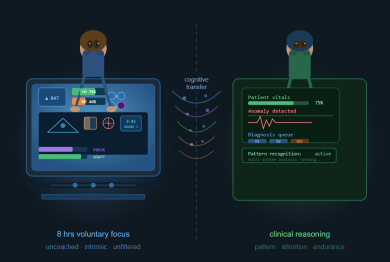
Fig. 1 Gaming focus vs. clinical reasoning
A Position Paper in Medical Education and Admissions Theory
Abstract
Medical school admissions processes have long relied on GPA, standardized test scores, and structured extracurricular activities as proxies for cognitive and professional aptitude. This paper argues that these metrics, while predictive, are substantially confounded by socioeconomic advantage and coached preparation. We propose that voluntary sustained engagement in complex video gaming — particularly sessions of six to eight or more hours — constitutes a purer, less confoundable signal of cognitive endurance, intrinsic motivation, and sustained attention within an already-competitive applicant pool. Drawing on evidence from cognitive neuroscience, biosocial theory, and admissions research, we argue that the genre differences observed between male and female gamers reflect culturally shaped developmental pathways rather than fixed biological capacity, and that admissions committees are systematically overlooking a meaningful cognitive signal by failing to evaluate the quality and depth of self-directed cognitive engagement.
1. Introduction
The selection of medical students is among the most consequential filtering processes in modern society. Those admitted will ultimately bear responsibility for human life, requiring not only acquired knowledge but durable cognitive traits: sustained attention, rapid pattern recognition, stress tolerance, and the capacity for iterative learning under uncertainty. The central question of admissions theory is therefore not merely whether a candidate has accumulated the right credentials, but whether those credentials accurately reveal the underlying cognitive and temperamental traits that predict medical competence.
This paper argues that the current admissions framework is systematically biased toward measuring preparation rather than capacity, and that a largely overlooked behavioral signal — voluntary sustained engagement in complex video gaming — offers a more direct window into several traits central to medical aptitude. Critically, this argument applies not to the general population but to within-group differentiation among already-competitive candidates: individuals who have already cleared the conventional threshold but who differ in the depth of self-directed cognitive engagement they have demonstrated outside formal academic structures.
2. The Confoundability Problem in Conventional Admissions Metrics
GPA and MCAT scores are the twin pillars of medical admissions. Both are predictive of early academic performance in medical school. However, both are also substantially influenced by factors external to the candidate's cognitive capacity: access to test preparation resources, quality of undergraduate institution, socioeconomic stability permitting full-time study, tutoring, and coached interview preparation. Research in higher education has repeatedly demonstrated that standardized test scores correlate strongly with family income, parental education, and access to coaching.
This confound ability problem means that, even within a highly competitive applicant pool where all candidates appear similarly credentialed, the credentials themselves may reflect differential resource access rather than differential cognitive capacity. Admissions committees seeking to identify the most cognitively capable candidates therefore face a signal-to-noise problem: the available metrics conflate preparation with aptitude.
3. Sustained Gaming as a Cognitive Signal
3.1 What Eight Hours of Gaming Demonstrates
A candidate who voluntarily sustains six to eight hours of focused engagement in a complex video game has demonstrated, in a naturalistic and uncoached setting, a cluster of cognitive traits directly relevant to medical practice:
- Sustained attention and concentration. Medical practice requires extended focus during surgeries, lengthy consultations, and prolonged diagnostic reasoning. Gaming for eight hours without extrinsic compulsion demonstrates that this capacity exists and is robust.
- Frustration tolerance and persistence. Complex games — particularly strategy, role-playing, and competitive multiplayer games — require repeated failure, iterative adjustment, and continued engagement in the absence of immediate reward. This maps directly onto the cognitive demands of learning medicine.
- Rapid pattern recognition. Gaming has been empirically associated with enhanced visual attention, faster reaction times, and superior pattern detection. Studies of laparoscopic surgeons have found that gaming experience correlates with reduced error rates and improved procedural speed.
- Working memory under load. Maintaining multiple simultaneous objectives, tracking dynamic environments, and updating strategies in real time places substantial demands on working memory — demands that parallel those of clinical reasoning under uncertainty.
- Intrinsic motivation. Unlike GPA or MCAT preparation, gaming is not undertaken for external reward. It is self-directed, self-sustaining, and intrinsically motivated. This makes it a rare behavioral signal of what a candidate does with their cognitive resources when no external structure compels them.
3.2 The Within-Group Argument
The argument advanced here is explicitly not about access inequality across the general population. It is about within-group differentiation among already-competitive candidates. Consider two applicants with identical GPAs, identical MCAT scores, and comparable research and clinical experience. One has, in addition to these credentials, demonstrated the capacity for eight hours of sustained voluntary cognitive engagement. The other has not. On the current metrics, they are indistinguishable. But the first candidate has revealed, through uncoached behavior in a resource-independent context, a cognitive endurance that the second has not demonstrated.
This is precisely the signal that admissions committees should want to surface. It is not purchased, not coached, and not confounded by institutional prestige. It is a behavioral trace of cognitive capacity expressed freely.
4. Genre Differences, Biology, and Culture
A frequent objection to gaming as a cognitive signal notes that male and female gamers tend to play different genres — males clustering toward competitive shooters and strategy games, females toward social simulation and narrative games. Some interpret this difference as evidence of biological determinism: the genres differ because the players are biologically different.
This interpretation overreaches the evidence. The observed genre difference is real, but the inference that it is primarily biological commits the fallacy of assuming that observed group differences require biological causes. The more parsimonious explanation is biosocial: genre preferences are shaped by decades of gender-targeted marketing, social reinforcement of gaming as a male peer-bonding activity, and the historical design of high-prestige genres around male protagonists and male-coded values (competition, combat, conquest).
More fundamentally, the culture-biology relationship is bidirectional. Epigenetic research has demonstrated that cultural environments alter gene expression without changing DNA sequence. Neuroplasticity research shows that the brain physically reorganizes in response to sustained practice. If girls are systematically steered away from spatially demanding, competitive gaming from childhood, the neural pathways associated with those cognitive styles will develop differently — not because of fixed biology, but because culture has shaped the developmental environment. The biological difference observed in adults may itself be a downstream product of prior cultural channeling, not its cause.
For the purposes of admissions, this distinction matters. The cognitive signal of sustained gaming engagement is available to candidates regardless of gender; what differs is the cultural pathway by which different candidates arrive at it. Admissions committees should evaluate the signal — sustained voluntary cognitive endurance — rather than the cultural vehicle through which it was expressed.
5. Institutional Selection and Biosocial Feedback
Admissions processes are not merely filters; they are selection pressures. Over time, the traits consistently rewarded by admissions — and the traits consistently penalized — shape the biological and psychological composition of the medical profession, and through assortative mating and occupational socialization, exert subtle influence on broader population dynamics. This is a weak and slow-acting process relative to evolutionary timescales, but it is not negligible.
If admissions systematically rewards coached preparation while remaining blind to uncoached cognitive endurance, the profession will over time select for candidates who are skilled at institutional navigation rather than for those with the deepest intrinsic cognitive engagement. The downstream consequences — for the quality of medical training, for patient outcomes, for the culture of medicine — are worth taking seriously.
Recognizing self-directed cognitive engagement — of which sustained gaming is one among several possible expressions — as a legitimate admissions signal would partially correct this bias. It would also broaden the epistemic diversity of the profession by surfacing candidates whose cognitive strengths have been expressed through non-traditional channels.
6. Objections and Responses
6.1 Gaming concentration does not transfer to academic tasks
One might argue that concentration sustained during a dopamine-rich, immediately rewarding activity does not transfer to the sustained focus required for tedious biochemistry memorization. This objection has partial merit: the neurological demands are overlapping but not identical. However, this objection applies equally to most extracurricular activities currently valorized in admissions — athletic competition, musical performance, debate — all of which involve different attentional profiles than medical study. The relevant question is not whether the cognitive profile is identical, but whether it is meaningfully correlated with traits that predict medical competence. The evidence on gaming and surgical skill, visual attention, and pattern recognition suggests that it is.
6.2 Gaming is not universally accessible
As noted above, this argument does not concern population-level access equity. It concerns the within-group differentiation among candidates who are already competing on comparable conventional metrics. Within that group, gaming engagement is sufficiently widespread that it constitutes a meaningful differentiator, not a rare privilege.
6.3 Self-reported gaming hours are unverifiable
This is a legitimate practical concern. However, gaming platforms increasingly provide auditable engagement data (Steam, Xbox, PlayStation all track and report play hours), and the behavioral correlates of sustained gaming — performance metrics, achievement records, competitive rankings — provide indirect verification. No admissions signal is perfectly verifiable; the relevant question is whether the signal-to-noise ratio justifies inclusion.
7. Conclusion
Medical admissions have long sought reliable signals of cognitive aptitude that are not reducible to resource access. Sustained voluntary engagement in complex gaming — particularly at the level of six to eight hours of focused play — offers precisely such a signal. It is uncoached, intrinsically motivated, and expressive of cognitive endurance, pattern recognition, and working memory under load. Within a competitive applicant pool where conventional metrics have reached a ceiling of discriminability, this signal offers meaningful within-group differentiation.
The observed gender differences in gaming genre do not undermine this argument; they reflect the biosocial dynamics of culturally shaped development rather than fixed biological constraints on cognitive capacity. And the institutional selection effects of admissions processes, however slow-acting, provide additional reason to broaden the range of cognitive signals that committees are trained to recognize.
The candidate who has spent eight hours in voluntary, focused cognitive engagement has told us something important about themselves — something their GPA cannot tell us, and something their MCAT score cannot tell us. Medical admissions should be listening.
Selected References
Bavelier, D., Green, C. S., & Dye, M. W. (2010). Children, wired: For better and for worse. Neuron, 67(5), 692–701.
Rosser, J. C., Lynch, P. J., Cuddihy, L., et al. (2007). The impact of video games on training surgeons in the 21st century. Archives of Surgery, 142(2), 181–186.
Heckman, J. J. (2006). Skill formation and the economics of investing in disadvantaged children. Science, 312(5782), 1900–1902.
Meaney, M. J. (2010). Epigenetics and the biological definition of gene-environment interactions. Child Development, 81(1), 41–79.
Fine, C. (2010). Delusions of Gender: How Our Minds, Society, and Neurosexism Create Difference. W. W. Norton.
Richerson, P. J., & Boyd, R. (2005). Not by Genes Alone: How Culture Transformed Human Evolution. University of Chicago Press.
Wai, J., Lubinski, D., & Benbow, C. P. (2009). Spatial ability for STEM domains. Journal of Educational Psychology, 101(4), 817–835.
Green, C. S., & Bavelier, D. (2003). Action video game modifies visual selective attention. Nature, 423, 534–537.
An article blog written with Claude Sonnet 4.6 support May 15, 2026