
Bitspec
Frankfurt Airport and the Illusion of Modern Infrastructure
How passenger growth, revenue expansion, and fragmented governance are producing predictable operational failure
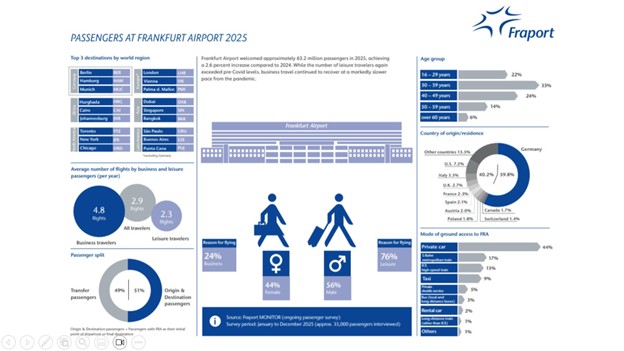
Fig 1. Travellers statistics
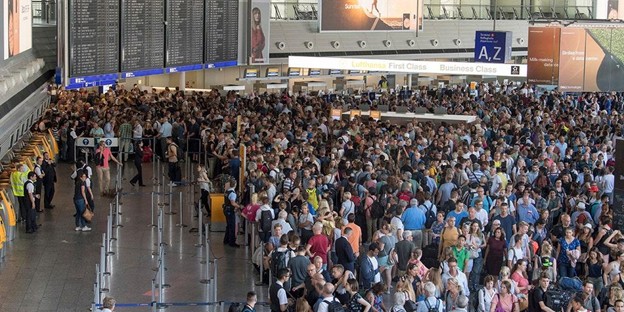
Fig. 2 Travellers waiting
Modern airports are among the most technologically advanced infrastructures ever created. Every passenger journey is digitally connected through:
- airline reservation systems,
- boarding systems,
- baggage tracking,
- biometric identification,
- gate management,
- passenger analytics,
- and security infrastructure.
Yet despite this enormous operational intelligence, passengers continue missing connecting flights in large numbers.
Fraport provides one of the clearest examples of this growing systems-engineering contradiction.
The issue is not simply:
- long queues,
- delayed aircraft,
- or isolated operational disruptions.
The issue is that modern transportation infrastructure is increasingly optimized for traffic growth and throughput efficiency without proportionate evolution in predictive operational governance.
The Numbers reveal a larger Problem
According to Fraport’s 2025 passenger overview:
- Frankfurt Airport handled approximately 63.2 million passengers,
- continuing its strong post-pandemic recovery trajectory.
At the same time:
- 49% of all passengers were transfer passengers,
- while 51% were origin-and-destination travelers.
This means nearly half of Frankfurt’s operational model depends on the airport functioning as a synchronized transfer system.
The airport also reported:
- 76% leisure travelers,
- compared with 24% business travelers.
These statistics reveal something much more important than traffic recovery.
They reveal increasing operational complexity.
Revenue Growth Does Not Necessarily Mean System Quality
Large hub airports generate revenue through:
- landing fees,
- passenger service charges,
- retail activity,
- concessions,
- terminal usage,
- parking,
- airline agreements,
- and transfer traffic volume.
From a financial perspective, more passengers generally mean more revenue.
However, passenger growth simultaneously increases:
- queue density,
- border-processing load,
- transfer-system fragility,
- staffing pressure,
- and operational variability.
This creates a critical infrastructure contradiction: Passenger volume can increase faster than operational adaptability.
An airport may therefore report:
- strong financial recovery,
- increasing passenger totals,
- and higher traffic volumes,
while passengers simultaneously experience:
- declining reliability,
- longer queues,
- higher transfer uncertainty,
- and increasing operational stress.
This is one of the most important governance challenges facing modern transportation systems.
The hidden fragility of transfer systems
Transfer systems are mathematically fragile.
Small operational disruptions propagate rapidly through interconnected passenger flows.
For example:
- one delayed long-haul aircraft,
- combined with insufficient border staffing,
- combined with biometric verification,
- combined with long terminal distances,
- combined with additional security screening,
can produce hundreds of missed connections within a single operational wave.
Frankfurt combines several high-risk transfer conditions simultaneously:
- Non-Schengen to Schengen transfers,
- centralized border processing,
- terminal changes,
- long walking distances,
- and simultaneous intercontinental arrivals.
As an example, a passenger arriving from Canada and connecting to Romania may need to:
- Deplane
- Navigate terminal corridors
- Pass through immigration and another terminal
- Complete biometric verification managed by the Federal Police
- Potentially undergo another security screening before accessing the next gate
- Reach a distant boarding gate before the cutoff
This sequence becomes operationally unstable when multiple wide-body aircraft arrive within the same time window.
The larger the passenger volumes become, the more sensitive the system becomes to congestion variability.
The airport already possesses the required data
The most important operational question is not:
“Why are passengers missing flights?”
The real question is:
“Why are predictable failures not being prevented?”
Modern airport ecosystems already possess:
- passenger itineraries,
- gate assignments,
- boarding deadlines,
- passport information,
- queue analytics,
- transfer distances,
- arrival delays,
- congestion metrics,
- and biometric-processing data.
This means the airport already possesses enough information to estimate transfer risk in real time.
Research in aviation analytics has already demonstrated that missed connections are highly predictable using operational and passenger-flow data.
In other words, the failures are statistically visible before they occur.
The visibility gap
One of the most revealing operational weaknesses at Frankfurt Airport is the absence of real-time passenger visibility into transfer conditions.
Passengers often do not have access to:
- real-time immigration wait times,
- predictive connection-risk indicators,
- transfer congestion estimates,
- or adaptive routing guidance.
This creates a major systems paradox: The infrastructure can observe operational risk in real time, but the passenger cannot.
Passengers are expected to make time-critical transfer decisions while lacking access to the same operational intelligence already available internally to airport operators and authorities.
In modern infrastructure systems, information asymmetry becomes a structural risk factor.
A predictive airport environment would instead provide:
- real-time transfer-risk visibility,
- estimated processing times,
- adaptive routing recommendations,
- and connection probability indicators.
Without operational transparency, passengers become reactive participants inside a system that already knows failure conditions are developing.
The illusion of reliability
Airport systems are frequently designed around average assumptions:
- average immigration time,
- average passenger flow,
- average walking conditions,
- and average security throughput.
But operational systems are not governed by averages; they are governed by dynamic conditions and variance.
For example:
If the airport assumes:
- 15-minute immigration processing, but real operational conditions fluctuate between:
- 5 and 70 minutes, then a “valid” 60-minute connection becomes statistically unreliable.
The system may technically comply with:
- minimum connection-time rules, while operationally generating large numbers of failed passengers.
This creates the illusion of reliability.
The European Governance Problem!!
A growing issue within the European aviation and border-management framework is the disproportionate transfer of operational burden onto travelers themselves.
The implementation of the EU Entry/Exit System (EES) introduced:
- increased biometric processing,
- additional verification complexity,
- and longer border-processing times for non-EU travelers.
However, the operational burden generated by these changes has largely been absorbed by passengers.
In practice:
- travelers lose flights,
- pay additional ticket costs,
- lose hotel reservations,
- experience severe stress,
- and spend hours trapped in border queues,
while the institutions designing and operating the system often avoid direct operational accountability.
This creates a dangerous governance imbalance.
The traveler becomes the operational shock absorber of the infrastructure system.
When:
- connection windows are sold as operationally “valid,”
- congestion conditions are already known internally,
- staffing adaptation remains insufficient,
- and predictive intervention is absent,
The financial and operational consequences are effectively transferred onto passengers.
The situation becomes even more problematic when travelers are treated as individually responsible for failures originating from systemic design weaknesses.
Passengers may be told:
- they should have walked faster,
- anticipated congestion,
- deplaned earlier,
- or booked longer connections,
even though:
- the airport already possessed real-time operational data,
- airlines sold the itinerary,
- and authorities controlled processing capacity.
This creates a structural asymmetry:
- institutions maintain operational authority,
- while passengers absorb operational consequences.
From a systems-engineering perspective, this is not sustainable governance.
Throughput optimization versus reliability optimization
A fundamental systems question now emerges:
Is the airport optimized primarily for passenger throughput or for passenger reliability?
These are not identical objectives.
Throughput optimization focuses on:
- maximizing traffic volume,
- gate utilization,
- commercial activity,
- and scheduling density.
Reliability optimization focuses on:
- successful transfers,
- predictable passenger movement,
- operational transparency,
- congestion resilience,
- and transfer protection.
Modern hub airports increasingly attempt to maximize both simultaneously.
However, when systems approach operational saturation, one objective eventually dominates the other.
Passengers experience the consequences through:
- missed connections,
- transfer uncertainty,
- operational stress,
- and declining trust in system reliability.
The future airport must become predictive
A modern airport should continuously estimate: P (missing connection)
using:
- arrival delay,
- queue density,
- biometric-processing time,
- walking distance,
- security delays,
- and boarding cutoffs.
Conceptually, predictive modeling could operate as:
P(MC)=f(D,Q,W,B,S,G,T)
Where:
- (D) = arrival delay
- (Q) = queue time
- (W) = walking time
- (B) = biometric processing
- (S) = security delay
- (G) = gate distance
- (T) = boarding cutoff
The technology required for this already exists.
The operational integration does not.
Future airports will require:
- AI-driven passenger orchestration,
- predictive congestion management,
- adaptive staffing,
- real-time operational transparency,
- and integrated governance systems.
Conclusion
Frankfurt Airport does not suffer from a lack of technology.
It suffers from a lack of integrated systems adaptation.
The infrastructure already possesses:
- operational analytics,
- predictive capability,
- passenger-flow intelligence,
- and real-time congestion visibility.
Yet the operational model remains largely reactive:
- passengers fail first,
- the intervention happens afterward.
At the same time, the broader European operational framework increasingly transfers the consequences of systemic congestion onto travelers.
Passengers become financially and operationally responsible for failures they do not control.
Modern transportation infrastructure can no longer be evaluated solely through:
- passenger growth,
- traffic recovery,
- or revenue expansion.
It must also be evaluated through:
- operational resilience,
- predictive governance,
- transfer reliability,
- and infrastructure adaptability.
Otherwise, infrastructure growth risks becoming operational expansion without corresponding quality evolution.
The problem is not the increase in passenger volume itself. The problem is the failure of modern infrastructure systems to dynamically adjust operational conditions and provide real-time transparency despite already possessing the intelligence required to do so.
An article blog written with ChatGPT version. 5.5 support May 13, 2026
When you subscribe to the blog, we will send you an e-mail when there are new updates on the site so you wouldn't miss them.
