Course Description
The Lean Six Sigma Yellow Belt course prepares participants to perform effectively in the role of a Lean Six Sigma Yellow Belt within organizational improvement initiatives.
Certified Lean Six Sigma Yellow Belts demonstrate both theoretical knowledge and practical skills acquired through structured learning and applied exercises. Participants learn how to support improvement projects, understand process performance, and contribute to operational excellence initiatives across organizations.
The course introduces the Define, Measure, and Control (D-M-C) phases of the Lean Six Sigma DMAIC methodology, enabling participants to understand how process improvement projects are structured and managed.
Course Learning Objectives
At the end of this course, participants will be able to:
• Define and select improvement projects aligned with organizational goals
• Understand roles and responsibilities within a Lean Six Sigma organization
• Explain the principles of Lean Enterprise and waste reduction
• Understand basic statistical metrics used in process measurement
• Develop and evaluate process performance metrics
• Apply Measurement System Analysis (MSA) concepts
• Evaluate control methods including 5S
• Perform cost–benefit analysis for improvement initiatives
• Understand the elements of response plans and control plans
• Use analytical software tools to analyze data and monitor performance
Certification Track
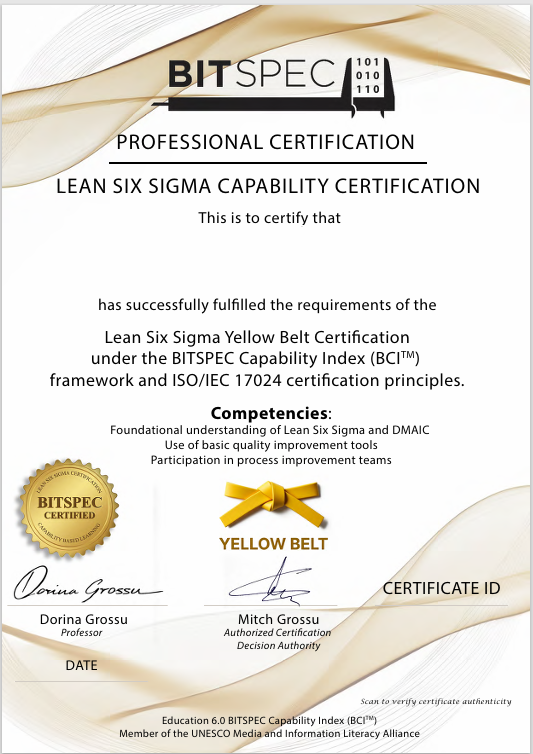
The Lean Six Sigma Yellow Belt course follows a comprehensive curriculum aligned with the Lean Six Sigma DMAIC Body of Knowledge and prepares participants to obtain the credential:
Certified Lean Six Sigma Yellow Belt
Participants who complete the course demonstrate competence in both theory and applied process improvement methods.
Professional Development Units (PDU)
BITSPEC provides 20 Professional Development Units (PDUs) applicable toward Project Management Professional (PMP®) certification maintenance.
BITSPEC Capability Transcript
Education 6.0 Performance Record
Learner performance is recorded using the BITSPEC Capability Index (BCI™) framework as part of the Education 6.0 capability-based learning model.
Participants are evaluated across five competency dimensions:
• Knowledge
• Application
• Analytical Depth
• System Impact
• Ethical Judgment
BCI™ Formula

For the Yellow Belt certification, the minimum required score is:
BCI™ ≥ 60
This capability-based scoring model ensures that learners demonstrate real competence rather than only course completion.
Duration
Approximately 20 hours, including:
• Case studies
• Software demonstrations using MINITAB® and MINITAB Workspace
Access
Participants receive unlimited access to training materials through the BITSPEC eLearning Management System (AI-enabled Moodle platform).
AI access is standardized to ensure fairness across candidates; however, certification decisions are based solely on verified capability demonstrated through BCI™not on AI usage.
AI access is proportionally scaled by certification level to support increasing analytical and system-level complexity.
AI usage is explicitly assessed under:
- Analytical Depth (D)
- System Impact (S)
- Ethical Judgment (E)
Passing Requirements
Each module includes:
• One quiz
• 4 assignments
Quiz requirements:
• Minimum passing score: 60%
• Maximum attempts: 4 attempts
Assignments contribute to the BITSPEC Capability Index (BCI™) performance evaluation.
Course Delivery Options
eLearning Delivery
Approximate duration: 21 hours
Self-paced online learning through the BITSPEC AI-enabled learning platform.
Hybrid Delivery
Available upon request.
Participants complete:
• eLearning component
• 6 hours instructor-led session
In-Class Delivery
Available upon request.
Total duration: 25 hours of instructor-led training.
Recommended Software
Participants are encouraged to use:
• MINITAB®
• MINITAB Workspace
Free 30-day trial versions are available through links provided in the course.
Course exercises and examples are demonstrated using MINITAB and MINITAB Workspace.
Language
English
Reference Materials
All supporting materials are provided through:
• Course resources
• Recommended textbooks
• External reference links
Certification and Governance
BITSPEC certification programs are designed in alignment with internationally recognized certification principles, including ISO/IEC 17024.
Certification decisions are based on documented evidence of capability and follow structured governance procedures to ensure impartiality, consistency, and transparency.
Certificate: