
Bitspec
From Certification Branding to Capability Verification
Why Education 6.0 Is Changing Professional Credentials?
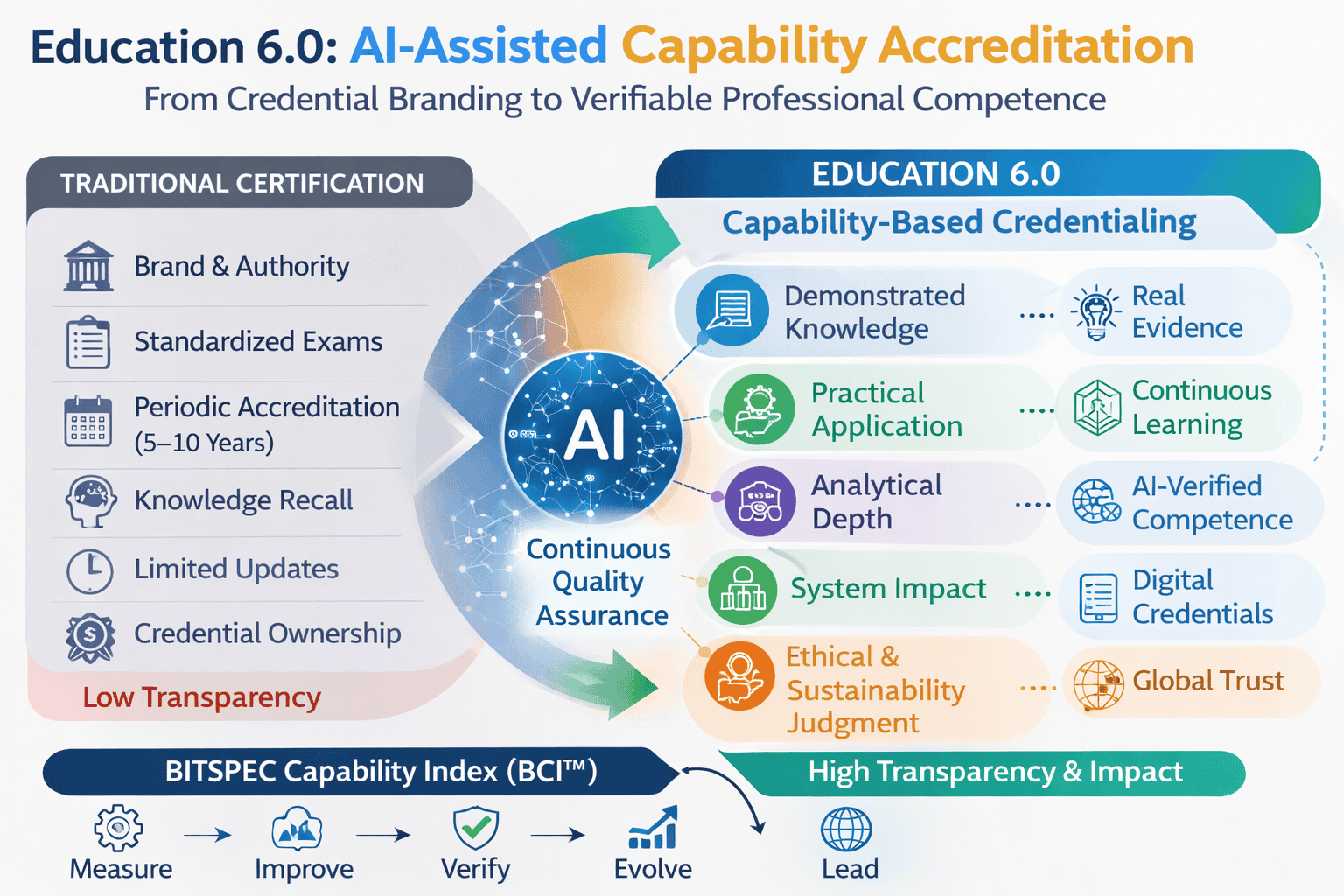
Education 6.0 AI-Assisted Capability Accreditation Model.
Source: BITSPEC (2026). Generated with AI assistance.
Professional certification has played an important role in the development of modern industries. Over the past decades, certification bodies have helped establish global standards that have allowed professionals to demonstrate their expertise and enabled organizations to identify qualified specialists.
Organizations such as the American Society for Quality, Project Management Institute, and PeopleCert created certification frameworks that helped structure bodies of knowledge across many professional domains.
However, the nature of professional work has changed significantly. Today’s organizations operate in environments shaped by data analytics, artificial intelligence, digital transformation, and complex systems thinking. As a result, the way professional competence is evaluated is also evolving.
Increasingly, employers are asking a different question:
What can a professional actually do in real operational environments?
This shift is leading to a new paradigm in professional education and credentialing.
The Limits of Traditional Certification
Traditional certification systems typically rely on:
• standardized examinations
• institutional authority
• periodic accreditation reviews.
While these mechanisms remain valuable, they do not always capture whether a professional can effectively apply knowledge in practice.
In many industries, professionals may successfully pass examinations while still lacking the ability to:
• analyze real operational data
• design improvement experiments
• implement sustainable process changes
• evaluate complex systems interactions.
As industries become more data-driven and interdisciplinary, certification systems must evolve to ensure that credentials reflect true professional capability.
The Emergence of Education 6.0
Education systems have evolved alongside technological and societal changes.
Earlier education models focused primarily on:
• knowledge transmission
• standardized instruction
• institutional authority.
Education 6.0 represents a new stage in this evolution, emphasizing:
• capability development
• evidence-based learning outcomes
• continuous competency verification
• integration of artificial intelligence in learning systems.
In this paradigm, professional credentials are based not only on examination results but also on demonstrated ability to apply knowledge in real-world environments.
AI-Assisted Capability Accreditation
Artificial intelligence is increasingly becoming a powerful tool for supporting educational quality assurance.
Rather than replacing educators, AI systems assist in analyzing evidence of learning and professional capability.
AI-supported evaluation can help verify:
• alignment between curriculum and competency frameworks
• consistency and validity of assessment methods
• patterns in learner performance across cohorts
• authenticity and integrity of assessment submissions.
These capabilities allow education systems to move from periodic accreditation reviews toward continuous evidence-based quality assurance.
The BITSPEC Capability Index (BCI™)
At BITSPEC, professional certification is structured around the BITSPEC Capability Index (BCI™), which evaluates professional competence across five interconnected dimensions.
| Capability | Description |
|---|---|
| Knowledge | theoretical understanding of principles and frameworks |
| Application | ability to apply methods to real operational problems |
| Analytical Depth | use of statistical reasoning and data analysis |
| System Impact | measurable improvements in processes or systems |
| Ethical and Sustainability Judgment | responsible decision-making considering long-term societal and environmental impact |
Through assignments, analytical exercises, and real-world improvement projects, BCI evaluates the depth and effectiveness of professional capability.
Governance and Certification Integrity
As professional credentialing evolves, transparency and governance remain essential.
BITSPEC certification programs operate under a documented governance framework that ensures:
• impartial certification decisions
• competency-based evaluation standards
• transparent certification procedures
• oversight through a Certification Governance Advisory Board.
These governance principles align with the international certification framework described in ISO/IEC 17024, which defines requirements for certification bodies responsible for professional credentialing.
Toward Evidence-Based Professional Credentials
The future of professional credentialing is likely to be characterized by:
• competency-based certification models
• digital credentials supported by evidence
• project and portfolio-based evaluation
• AI-assisted quality monitoring.
In this environment, the value of a credential will increasingly depend on the evidence supporting the capability behind it, rather than on institutional branding alone.
Education 6.0 reflects this transformation by focusing on the development and verification of professional capability in complex, data-driven environments.
The Role of Responsible Technology
As artificial intelligence becomes more integrated into learning systems, professionals must also develop the ability to critically evaluate digital information and technology systems.
As a member of the UNESCO Media and Information Literacy Alliance, BITSPEC integrates principles of media and information literacy within its education framework.
Professionals must be able to:
• critically assess information sources
• understand the capabilities and limitations of AI systems
• apply ethical reasoning in technology-supported decision-making
• promote responsible and sustainable innovation.
A New Direction for Professional Education
The evolution from traditional certification models toward capability-based credentialing reflects broader changes in how knowledge and professional competence are understood.
Education 6.0 represents an opportunity to create credentialing systems that are:
• transparent
• evidence-based
• aligned with real professional practice
• supported by modern analytical technologies.
By combining competency frameworks, AI-assisted evaluation, and transparent governance, BITSPEC contributes to the development of a professional education ecosystem in which credentials represent verified capability and measurable impact.
Blog written with the support of OpenAI, ChatGPT (GPT-5.2 Instant), Mar 16, 2026
When you subscribe to the blog, we will send you an e-mail when there are new updates on the site so you wouldn't miss them.
