
Bitspec
When One Mistake Isn’t Just a Mistake: System Failure, Staffing Risk, and BCI™ Perspective
We express our deepest sorrow for the lives lost, and our thoughts are with the families and communities affected by this tragedy. These accidents shall never happen again!!
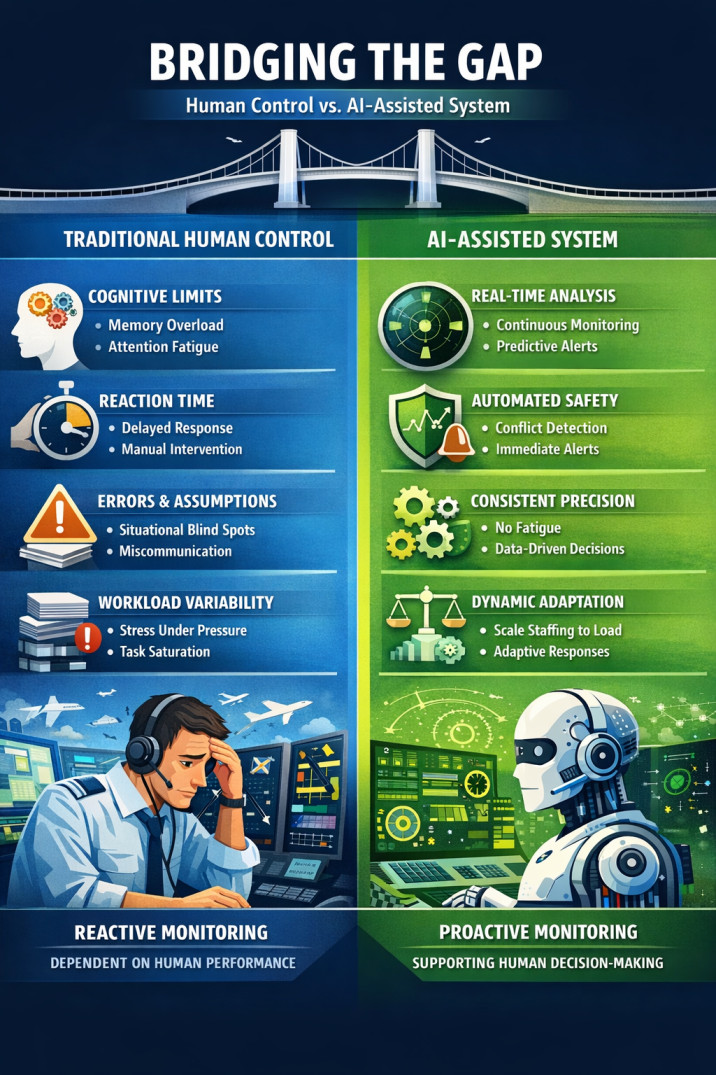
Image generated GPT-5.2 Instant
Introduction
At highly congested airports like LaGuardia, air traffic control represents one of the most complex real-time systems in operation today. When incidents occur, they are often labeled as human errors. However, these events are more accurately understood as system capability failures under load.
Why SOP Allows Only Two Controllers at Night
Standard Operating Procedures (SOPs) are based on expected traffic conditions. During night operations, traffic is assumed to be lower, leading to reduced staffing levels. However, this assumption introduces systemic risk.
Key limitations include:
- Staffing based on average conditions rather than variability
- Role consolidation increases cognitive load
- Reduced human performance due to circadian factors
- Lack of real-time workload adaptation
This creates a gap between procedural design and actual system capability.
BCI™ Capability Interpretation
Capability = Knowledge × Application × Analytical Depth × System Impact × Ethical Judgment
In this scenario:
- Knowledge: High
- Application: Moderate
- Analytical Depth: Reduced under pressure
- System Impact: Critical
- Ethical Judgment: Raises staffing and system design concerns
BCI™ Capability Diagram
[ K ]= knowledge
|
[ A ]= application
|
[ D ]= analytical depth
|
[ S ]= system impact
|
[ E ]= ethical judgement
|
Capability Output
System-Level Recommendations
- Implement dynamic staffing based on real-time traffic complexity
- Integrate AI-assisted monitoring systems
- Enforce role separation under high workload
- Introduce fatigue-aware operational controls
Policy Insight
Staffing in safety-critical systems should not be based solely on expected demand, but on the system’s potential to rapidly increase in complexity.
Blog written with the support of OpenAI, ChatGPT (GPT-5.2 Instant), Mar 25, 2026
When you subscribe to the blog, we will send you an e-mail when there are new updates on the site so you wouldn't miss them.
