From Certification to Capability: Why BITSPEC Is Advancing Professional Education

Professional education is changing rapidly!

For many years, the dominant model in professional training has been exam-based certification. Learners study a body of knowledge, complete a course, and pass a standardized exam. While this approach has played an important role in professional development, it often measures knowledge recall rather than real professional capability.

At BITSPEC, we have been reflecting deeply on what modern professional education should achieve in a world shaped by data, artificial intelligence, complex systems, and global collaboration.

Today, we are taking an important step forward.

A Strategic Transition

BITSPEC programs were previously aligned with certification frameworks administered by organizations such as PeopleCert and with bodies of knowledge associated with the International Association for Six Sigma Certification.

Over time, however, our work with learners, professionals, and institutions revealed a critical gap in many certification models: passing an exam does not necessarily demonstrate professional capability.

Real capability requires the ability to analyze complex situations, make informed decisions, evaluate system impacts, and act responsibly within organizational and societal contexts.

For this reason, BITSPEC has transitioned its programs to a fully independent capability-based education model.

The BITSPEC Capability Index (BCI™)

At the core of this transition is the BITSPEC Capability Index (BCI™).

Rather than measuring only theoretical understanding, the BCI™ evaluates professional competence across five integrated dimensions:

Knowledge – understanding of core concepts and methods
Application – ability to apply tools and frameworks to real situations
Analytical Depth – quality of reasoning, statistical analysis, and systems thinking
System Impact – ability to design improvements that influence organizational performance
Ethical and Sustainability Judgment – responsible decision-making within complex environments

This capability model reflects the realities of modern professional work, where performance is shaped not only by technical knowledge but also by judgment, systems thinking, and ethical responsibility.

Education for a Systems-Based World

Today’s professionals operate within interconnected systems—healthcare systems, manufacturing networks, public institutions, digital platforms, and global supply chains.

Improving these systems requires more than tools.

It requires the ability to:

• interpret data and variation
• analyze root causes
• design sustainable improvements
• understand social and organizational impacts
• make responsible decisions using emerging technologies such as AI.

BITSPEC programs, therefore, integrate Lean Six Sigma methods, statistical reasoning, systems thinking, and AI-supported analysis within a competency-based learning architecture.

Alignment With Global Educational Initiatives

BITSPEC is also a member of the UNESCO Media and Information Literacy Alliance, which promotes critical thinking, responsible information practices, and ethical use of knowledge in a digital society.

This alignment reinforces our commitment to developing professionals who are not only technically capable but also information-literate, ethically aware, and socially responsible.

From Exams to Evidence of Capability

In the BITSPEC model, learners demonstrate their competence through:

• applied analytical assignments
• systems improvement projects
• statistical analysis and interpretation
• AI-supported investigations
• professional reflections on system impact and sustainability.

Digital credentials and badges therefore, represent verified professional capability, not only completion of coursework.

Looking Forward

Professional education must evolve alongside the systems it serves.

Organizations today require professionals who can analyze, improve, and responsibly govern complex systems. BITSPEC’s capability-based framework is designed to prepare learners for exactly this challenge.

By shifting from exam-based certification to evidence-based professional capability, we are strengthening the value and integrity of the learning experience.

This transition reflects a broader vision:

Education that prepares professionals not only to pass exams, but to improve the systems that shape our societies.

#ProfessionalEducation #LeanSixSigma #SystemsThinking #CapabilityBasedLearning #EducationInnovation

Blog written with the support of OpenAI, ChatGPT (GPT-5.2 Instant), Mar 11, 2026

Continue reading
  187 Hits

When Development Forgets the System

Integrating Environment, Community, and Leadership in Planning Decisions

Modern communities face increasing pressure to balance economic development, environmental stewardship, and quality of life. New businesses, infrastructure projects, and commercial investments are essential for economic vitality. However, development decisions sometimes overlook an important factor: the system in which development occurs.

This article presents a systems-based perspective on restaurant and multi-conference land uses, examining broader development patterns in which environmental considerations and community involvement have not always been fully integrated into planning decisions.

Understanding these dynamics can help communities, policymakers, and business leaders make more balanced and sustainable development choices.

Development as a System

Communities are not simply collections of buildings and businesses. They are complex systems composed of interconnected elements, including:

  • economic activity
  • infrastructure capacity
  • environmental systems
  • residential communities
  • governance and planning frameworks.

When development decisions focus primarily on a single dimension—such as economic opportunity—the broader system interactions may receive less attention.

Systems thinking encourages planners and decision-makers to ask a more comprehensive question:

How will this development interact with the entire community system?

This perspective helps reveal potential impacts on traffic patterns, environmental conditions, infrastructure demand, and community stability.

Different Types of Entrepreneurships Create Different Impacts

Not all businesses affect communities in the same way. Different forms of entrepreneurship generate different operational footprints.

For example, knowledge-based businesses such as consulting firms, research organizations, and training institutions typically operate during daytime hours and generate relatively low traffic.

In contrast, hospitality-oriented enterprises—such as restaurants, event venues, and conference facilities—often rely on:

  • higher visitor volumes
  • event-driven activity patterns
  • evening operations
  • increased parking demand.

These characteristics can be entirely appropriate in locations designed for higher commercial activity, such as city centers or entertainment districts. However, challenges may arise when such operational models are introduced into environments that were not designed to support them.

Understanding these differences helps communities evaluate whether a particular business model aligns with the characteristics of the surrounding environment.

Environmental Systems in Planning Decisions

Environmental systems are another critical dimension that may receive insufficient attention in development discussions.

Natural systems—such as watersheds, green corridors, and ecological habitats—often operate invisibly within the built environment. When development decisions overlook these systems, unintended environmental consequences may emerge over time.

Examples can include:

  • increased stormwater runoff
  • higher levels of artificial lighting
  • increased vehicle emissions
  • disruption of ecological corridors.

A systems-based planning approach encourages decision-makers to evaluate development proposals in relation to the larger environmental systems within which communities exist.

The Role of Community Participation

Community participation is a key component of effective and sustainable planning.

Residents often possess valuable insights into how local systems function, including:

  • daily traffic patterns
  • neighborhood activity levels
  • environmental conditions
  • social dynamics within the community.

When development proposals are evaluated without meaningful community input, planners may miss information that is essential to understanding how a project will interact with the surrounding environment.

Engaging communities early in the planning process can therefore improve both planning outcomes and long-term public trust.

The Role of Business Leadership in Community Development

Development outcomes are also influenced by the type of leadership behind a business initiative.

Business leaders shape how enterprises interact with the broader community system. Their decisions determine whether economic activity becomes a long-term asset for a community or a source of ongoing tension.

In practice, different leadership approaches tend to produce different development outcomes.

Transactional Leadership

Some business initiatives are driven primarily by transactional or opportunity-based leadership. In this model, decisions focus on identifying market opportunities and implementing them quickly.

Priorities often include:

  • revenue generation
  • market demand
  • rapid business expansion.

While effective in competitive markets, this approach may not always consider long-term environmental or community impacts, particularly when projects are located in sensitive or residential environments.

Operational Leadership

Operational leadership focuses on structured management, quality systems, and long-term organizational sustainability.

Leaders with this orientation emphasize:

  • reliable operations
  • structured processes
  • predictable performance
  • long-term stability.

This leadership style often integrates planning frameworks and operational systems to ensure that businesses function responsibly within their environments.

Systems-Based Leadership

A growing number of organizations are adopting systems-based leadership, which recognizes that businesses operate within larger social and environmental systems.

Systems-oriented leaders ask broader questions when evaluating new ventures:

  • How will this development affect surrounding communities?
  • What environmental systems might be influenced?
  • Does the business model align with the character of the location?
  • Can economic activity strengthen the local ecosystem rather than disrupt it?

This approach integrates economic opportunity with environmental responsibility and community awareness.

A Systems Approach to Sustainable Development

Sustainable development does not mean preventing economic activity. Instead, it involves aligning economic activity with environmental systems and community conditions.

A systems-based planning approach evaluates several factors simultaneously:

  1. the economic model of the business
  2. infrastructure capacity
  3. community expectations
  4. environmental resilience.

When these elements are aligned, development strengthens communities and supports long-term sustainability.

When they are misaligned, development may generate persistent tensions between economic activity, environmental protection, and residential stability.

Lessons for Policymakers, Planners, and Business Leaders

Development decisions shape the long-term structure of communities. For this reason, both public and private leaders must consider the broader systems in which development occurs.

Several lessons emerge from a systems-based perspective:

  • Economic development should be evaluated within the context of environmental and social systems.
  • Different business models generate different impacts on communities.
  • Leadership approaches influence how businesses interact with their surroundings.
  • Community participation can improve planning outcomes and strengthen trust.
  • Integrated planning helps reduce long-term conflicts between development and community stability.

Adopting a systems perspective can therefore support more resilient and sustainable development decisions.

Summary of Findings

This analysis highlights several important observations regarding development and community planning:

  1. Development decisions often focus primarily on economic opportunity, while environmental and community systems receive less attention.
  2. Different forms of entrepreneurship produce different operational impacts, which must be considered when evaluating land-use compatibility.
  3. Environmental systems are frequently invisible in planning discussions, yet they play a critical role in long-term sustainability.
  4. Community participation can provide essential insights that improve development outcomes and reduce future conflicts.
  5. Business leadership style influences how development interacts with communities, with systems-based leadership offering a more integrated and sustainable approach.
  6. Systems thinking provides a useful framework for evaluating development decisions, helping communities align economic activity with environmental and social systems.

Toward More Integrated Development

As communities continue to evolve, the need for integrated planning approaches becomes increasingly important.

Economic growth, environmental sustainability, and community well-being should not be viewed as competing goals. Instead, they represent interdependent components of a healthy community system.

When development decisions recognize these relationships, economic activity can strengthen communities while preserving the environmental and social systems that support them.

Ultimately, the challenge for planners, policymakers, and business leaders is to ensure that development decisions contribute to balanced, resilient, and sustainable communities for the future.

Continue reading
  198 Hits

Integrated Systems Performance & Competency Architecture (ISPCA™)

A Transdisciplinary Framework for Healthcare, Engineering, and Governance Excellence

By Dorina Grossu

BITSPEC Research Initiative

DOI: https://doi.org/10.5281/zenodo.18700234

Why ISPCA™ Was Developed

Across healthcare, engineering, and public administration, three systems typically operate in parallel: professional competency frameworks, performance improvement methodologies, and governance accountability structures. These domains often function independently, leading to structural fragmentation within institutions.

The Integrated Systems Performance & Competency Architecture (ISPCA™) was developed to address this gap. It provides a unified framework that connects competency, performance, and governance within a single institutional architecture.

What ISPCA™ Is — and What It Is Not

ISPCA™ is a structural integration architecture designed to align professional competency, systems performance, and governance accountability in complex institutional environments.

ISPCA™ is not a rebranding of Lean Six Sigma, nor a replacement for established professional competency frameworks such as the CanMEDS Physician Competency Framework used in healthcare education and regulation.

Instead, ISPCA™ complements such frameworks by embedding competency domains within a broader performance and governance structure.

Integrating Healthcare Competency Models

In healthcare, the CanMEDS framework, developed by the Royal College of Physicians and Surgeons of Canada, defines professional roles including Medical Expert, Communicator, Collaborator, Leader, Health Advocate, Scholar, and Professional.

While CanMEDS defines professional identity and expectations, it does not structurally integrate operational performance systems or governance mechanisms. ISPCA™ supports healthcare institutions by connecting competency frameworks with measurable performance architecture and governance accountability layers.

The Four Structural Layers of ISPCA™
1. Ethical & Professional Core

Integrity, accountability, evidence-based responsibility, and public trust form the foundation of the architecture.

2. Professional Competency Domains

Competency domains include domain expertise, communication, systems thinking, leadership, governance, public advocacy, scholarship, and professional integrity.

3. Systems Performance Engine

This layer integrates structured performance cycles—strategic definition, measurement, analysis, intervention, and sustainability control—compatible with Lean and Six Sigma traditions.

4. Governance & Public Impact Layer

Institutional oversight, risk management, sustainability metrics, and accountability indicators ensure alignment between professional performance and societal trust.

Measuring Institutional Capability: The Role of BCI™

The BITSPEC Capability Index™ (BCI™) functions as a structured capability assessment instrument designed to evaluate institutional maturity across competency integration, performance alignment, governance accountability, and sustainability oversight.

Where ISPCA™ establishes structural integration, BCI™ provides diagnostic measurement. Together, they support continuous institutional advancement.

Why Structural Integration Matters

Sustainable institutional excellence requires structural coherence across professional competency, operational performance, and governance accountability. ISPCA™ proposes an architecture that aligns these domains systematically.

Scholarly Record

Grossu, D. (2026). Integrated Systems Performance & Competency Architecture (ISPCA™): A Transdisciplinary Framework for Healthcare, Engineering, and Governance Excellence. Zenodo. https://doi.org/10.5281/zenodo.18700234

Licensed under Creative Commons Attribution 4.0 International (CC BY 4.0).

Continue reading
  298 Hits

BITSPEC Capability Index™ (BCI™)

Formal Declaration of Authorship, Framework Structure, and Governance Positioning Authorship and Origin


The BITSPEC Capability Index™ (BCI™) is an original performance-based educational validation framework developed by Dorina Grossu, BITSPEC. This framework integrates Lean Six Sigma methodology, performance architecture modeling, and ethical AI governance principles into a unified systemic capability assessment model.


Foundational Framework Structure


The foundational equation of the BCI™ framework is defined as follows:
BCI = K × A × AD × SI × EJ


Where: K = Knowledge Mastery; A = Applied Execution; AD = Analytical Depth; SI = System Impact; EJ
= Ethical Judgment. Each dimension is scored on a structured 1–5 performance scale and combined
multiplicatively to enforce systemic integrity and interdependent competency validation.


The multiplicative structure reflects systems engineering logic, ensuring that capability is not treated as
additive accumulation but as interdependent performance integration. If any dimension approaches
zero, the overall validated capability correspondingly collapses.


Governance and Ethical Alignment


The BCI™ framework operates under structured governance standards, including instructor calibration protocols, ethical AI usage disclosure requirements, project impact validation mechanisms, and continuous revalidation policies. The framework aligns conceptually with Media and Information Literacy (MIL) principles articulated by UNESCO; however, such alignment does not imply
endorsement or certification by UNESCO or any governing authority.


Public Release and Intellectual Property Notice


This declaration constitutes formal public documentation of the BITSPEC Capability Index™ framework. Initial public release date: February 14, 2026. © 2026 BITSPEC. All rights reserved. 

Grossu, D. (2026). The BITSPEC Capability Index™ (BCI™): A Multiplicative Performance Validation
Framework for Education 6.0. https://zenodo.org/records/18643641 https://doi.org/10.5281/zenodo.18700234


Reproduction, structural replication, rebranding, or derivative implementation without written authorization may violate applicable intellectual property protections.

End of Declaration

Continue reading
  249 Hits

EDUCATION 6.0 Engineering Human Capability in the Age of AI A BITSPEC Position Addressed to UNESCO and the Global Academic Community

To: UNESCO – United Nations Educational, Scientific, and Cultural Organization
University Leaders, Accreditation Bodies, Academic Policymakers

Executive Statement

Education systems worldwide are at an inflection point. Artificial intelligence, cognitive automation, and global digital ecosystems are transforming how knowledge is created, validated, and applied.

Education 6.0 proposes a structural redesign of education — shifting from content transmission and time-based credentials toward performance-validated, AI-integrated, ethically governed capability systems.

Education must evolve from instruction to engineered human capability.

What is Education 6.0?

Education 6.0 is a performance-validated, AI-augmented, ethically governed cognitive ecosystem that continuously measures and improves human capability development.

It integrates systems thinking, Lean continuous improvement, AI-assisted cognition, competency-based validation, and Media & Information Literacy (MIL) principles.

Measuring Capability in Education 6.0

In Education 6.0, capability is not inferred from attendance or credit accumulation.
It is demonstrated through measurable performance.

BITSPEC Capability Index (100)- BCITM can be expressed as:

BITSPEC Capability Index (100) BCITM= Knowledge × Application × Analytical Depth × System Impact × Ethical Judgment

Each dimension must be observable, measurable, and validated through structured performance evidence.

This formula establishes that capability is multi-dimensional and interdependent.
If one dimension approaches zero, overall capability is compromised.

The Six Pillars of Education 6.0

  • Cognitive Engineering – Learning is designed as a measurable thinking system. AI becomes a reasoning partner, not a replacement.
  • Performance Architecture – Capability is validated through observable performance levels (PA1–PA4). Attendance is no longer evidence of mastery.
  • Continuous Competency Validation – Micro-credentials, digital badges, and dynamic portfolios ensure transparent and portable verification of skills.
  • Ethical AI & MIL Integration – Critical evaluation, ethical digital citizenship, algorithmic transparency, and human dignity preservation.
  • Lean Learning Systems – Education adopts the Define–Measure–Analyze–Improve–Control logic. Variation is reduced, and learning gaps are continuously corrected.
  • Global Portability – Competencies become borderless, stackable, and interoperable across institutions and nations.

Why Education 6.0 is Necessary

Current systems remain credit-hour dependent, institution-bound, degree-centric, and retrospectively assessed. Meanwhile, AI-native learners operate in dynamic, global knowledge environments.

Without structural redesign, educational systems risk losing relevance, credibility, and trust.

BITSPEC Position

BITSPEC proposes that Lean Six Sigma (DMAIC) serves as a Cognitive Operating System for Education 6.0, ensuring measurable capability development aligned with ethical governance and UNESCO MIL frameworks.

Education must transition from certification of time to validation of capability; from content coverage to cognitive mastery; from static curricula to continuous system improvement.

Call to Action for UNESCO & Academia

We respectfully propose:
1. Recognition of performance-based validation models.
2. Integration of AI literacy across disciplines.
3. Institutional adoption of continuous improvement frameworks in curriculum governance.
4. Formal alignment of competency systems with UNESCO MIL principles.
5. Accreditation models that value measurable capability over seat-time.

Education 6.0 is not a technological upgrade. It is a governance redesign.

Closing Declaration

Education must no longer certify attendance.
It must validate the capability.

Continue reading
  228 Hits

Canada’s Physician Shortage Is a Failure to Educate Canadians

BITSPEC | Evidence-Based Policy & Education Reform
This document advocates for domestic medical education expansion as the sole recovery mechanism.
Call to Action: Expand Canadian medical school and residency capacity now.

1. Non-Negotiable Analytical Frame

This analysis explicitly rejects administrative or licensing-based expansion of internationally trained physician pathways as a solution. While internationally trained physicians may provide short-term service relief, they do not recover the structural economic, healthcare, or innovation losses caused by restricting Canadian medical education capacity.  Only sustained expansion of Canadian medical school seats, residency positions, and research training pathways can reverse these losses.

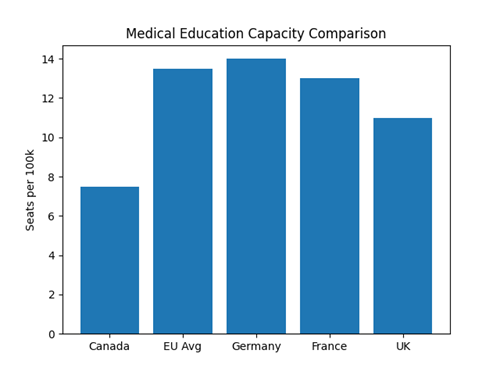
Chart 1: Medical School Seats per 100,000 Population

Medical Schools Seats

Canada operates at roughly half the medical education capacity of EU peers, despite comparable academic quality among applicants.

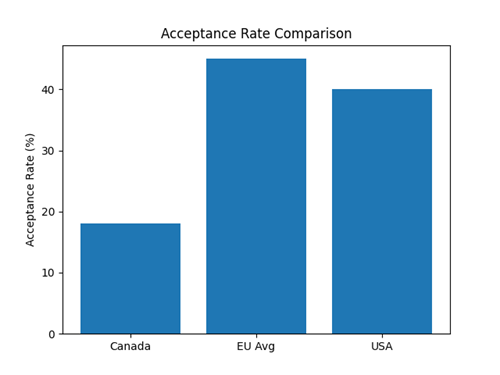
Chart 2: Medical School Acceptance Rates

 Medical School Acceptance

Canada’s extreme early filtering suppresses volume and diversity, reducing workforce scale and discovery probability.

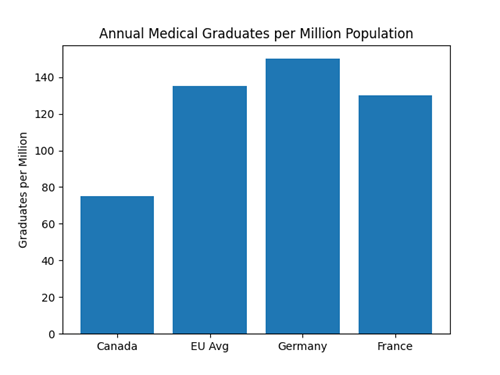
Chart 3: Medical Graduates per Million Population

 Medical graduates

Canada produces roughly half the medical graduates per capita compared to EU peers, explaining the persistent physician shortage despite high applicant volumes.

Canada trains approximately 7–8 medical graduates per 100,000 population, compared to 12–15 in EU systems and similar peer nations. Acceptance rates in Canada (~18%) are less than half those observed in European medical education systems. These differences are structural, not quality-based.

2. Core Structural Facts

Canada rejects more than 10,000 qualified Canadian applicants from medical school annually. Relative to EU peer nations, Canada trains approximately half the number of physicians per capita. This artificial scarcity is policy-driven and produces compounding national losses.

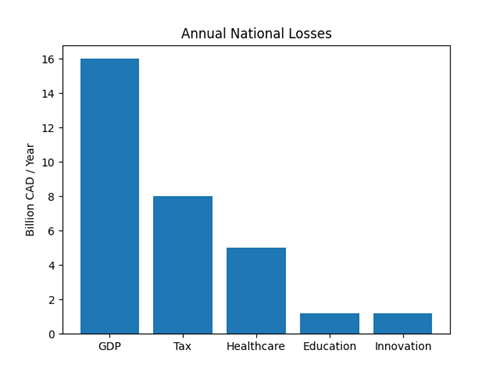
Annual Cost of Losses (Canada-Educated Doctors Only)

Category

Annual Cost (CAD)

Lost GDP

$14–18 Billion

Lost Tax Revenue

$7–9 Billion

Healthcare Inefficiency & ER Overload

$4–6 Billion

Education System Waste

$1–1.5 Billion

Lost Medical Discovery & Innovation $0.5-2 Billion

Total annual loss: approximately 

$30–40 Billion


Chart 4: Annual Cost of Losses (Canada-Educated Doctors Only)

Annual cost

Ten-Year Compounding National Losses

Category

10-Year Cost (CAD)

GDP Loss

$150–180 Billion

Tax Revenue Loss

$70–90 Billion

Healthcare Degradation

$40–60 Billion

Education & Talent Loss

$10–15 Billion

Missed Medical Discoveries

$5–20 Billion


Cost of Inaction vs Cost of Expansion

Scenario

Annual Cost

Outcome

Maintain current caps

   $30–40B loss

   Persistent shortage, ER collapse

Expand seats by 2,500/year

   $1.25B investment

  Self-sufficient system


Canada’s physician shortage represents one of the largest avoidable economic losses in the country. For every $1 invested in expanding medical education capacity, Canada recovers $7–10 in long-term value. Failure to act guarantees escalating costs, declining care, and lost innovation.


Chart 5: Ten- Year Compounding National Losses

Ten Year

Chart 6: Medical Discovery Pipeline Loss

Medical discovery

Medical Discovery and Sovereignty Loss

Medical discovery depends on training volume, early integration, and long-term academic continuity.  Restricting Canadian medical education reduces clinician-scientist pipelines and suppresses national innovation capacity.  Discovery cannot be imported retroactively.

Why International Substitution Fails as a Recovery Strategy

Policymakers often misinterpret international medical immigration as a substitute for domestic physician training. This belief relies on short-term budget optics and ignores integration delays, retention, discovery pipelines, and lifetime economic contribution. Immigration addresses symptoms but entrenches structural failure.

3. Final Conclusions

Across every metric, training capacity, acceptance rates, physician density, and discovery pipelines, Canada underperforms relative to the EU and peer nations. These gaps are policy-driven and result in long-term economic losses, reduced healthcare access, and missed medical breakthroughs.

Canada’s physician shortage is not an administrative failure. It is a deliberate policy outcome of restricting medical education capacity for Canadians. A country that does not educate its own doctors cannot outsource its way out of a physician shortage.

Expanding domestic medical education is one of the highest‑ROI investments available.


Blog written with the support of OpenAI, ChatGPT (GPT-5.2 Instant),  Feb. 9, 2026

Continue reading
  295 Hits

Canada’s Doctor Shortage Is Not a Mystery — It’s the Result of 30 Years of Policy Choices

By BITSPEC – Education, Quality, and Systems Policy Institute
(UNESCO MIL Alliance Member)

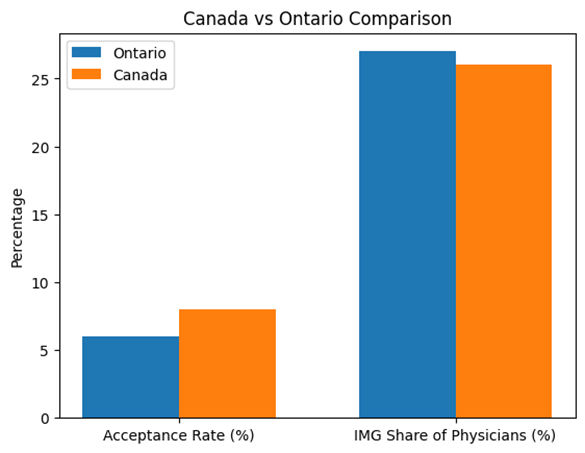
Ontario reflects the national pattern: very low admission rates to medical education combined with a sustained reliance on internationally trained physicians. Differences are of scale, not of structure.

Canadians are told, repeatedly, that the country faces a critical shortage of doctors. Emergency rooms are overwhelmed, millions lack a family physician, and wait times continue to grow. What Canadians are not told is that this crisis did not appear suddenly, and it is not the result of a lack of capable people willing to serve.

For more than three decades, Canada has maintained one of the most restrictive medical education systems in the developed world.

Since the early 1990s, admission to medical and dental schools has remained chronically limited. Acceptance rates have been consistently low, declining from roughly one in five applicants in the 1990s to well below one in ten today — and often closer to one in twenty in Ontario. This pattern exists across provinces, not just in one region.

At the same time, Canada has relied heavily on internationally trained physicians to keep the healthcare system functioning. Today, roughly one-quarter to one-third of doctors practicing in Canada earned their medical degrees abroad. This reliance is not accidental or temporary — it has been built into the system for decades.

The result is a quiet contradiction.

Canada depends on doctors, but makes it extraordinarily difficult for its own citizens to become one.

For aspiring physicians, the message is devastating. Students with outstanding academic records are encouraged to apply repeatedly, accumulate more volunteer hours, retake exams, and absorb rejection as normal — all while knowing that structural scarcity, not merit, is the primary barrier.

Families invest years of emotional and financial support. Many students ultimately leave the country to study medicine elsewhere, unsure whether they will ever be able to return to serve the communities that raised them.

This is not simply an education issue. It is a matter of trust.


Chart 1: Medical Admissions & Workforce Reliance

Results

Public systems rely on public confidence. When Canadians see that their chances of becoming doctors at home are statistically minimal — while the system simultaneously depends on internationally trained physicians to survive — a reasonable question emerges: How can this system be trusted to plan for the future of healthcare?

This is not an argument against immigration or international medical graduates. Canada benefits enormously from global expertise. But fairness demands consistency.

A sustainable system must do two things at once:

  • Welcome international professionals responsibly, and
  • Offer its own citizens a credible, attainable pathway to serve.


Chart 2: Canada vs. Ontario Comparison

Picture2

Policy Memory Failure

Canada’s physician workforce challenges are often framed as sudden crises. In reality, they are the predictable outcome of decades of constrained training capacity. The reduction of medical school seats in the early 1990s, followed by slow expansion, created a structural dependency on immigration that persists today.

The Human Cost: When Canadians Realize the Odds Are Against Them

For many Canadians who aspire to become medical doctors, the realization comes slowly — and then all at once.

Students are told to work harder, volunteer more, retake exams, and apply again. They are encouraged to believe that perseverance will be rewarded. Yet year after year, they encounter the same outcome: rejection driven not by lack of merit, but by structural scarcity.

The emotional impact is profound. Families invest years of effort and significant financial resources, only to discover that even exceptional candidates face statistically minimal chances of success. Peers leave the country to pursue medical education elsewhere, often unsure whether they will be able to return.

What is lost is not only opportunity — it is trust.

When a publicly funded system consistently excludes its own high-achieving students, it sends an unintended but powerful message: that endurance, wealth, or geographic access matter more than ability. Over time, this erodes confidence in public institutions.

Canadians begin to ask a reasonable question: if the system cannot fairly train its own doctors, how can it be trusted to plan for the future of healthcare at all?

Closing Reflection: Trust Is a Health-System Asset

Healthcare systems do not fail only when hospitals are understaffed. They fail when trust is depleted.

Canada’s long-standing reliance on internationally trained physicians has helped keep the system functional, but it has also masked a deeper issue: decades of underinvestment in domestic medical and dental education capacity.

This is not a question of immigration versus domestic training. It is a question of balance, fairness, and foresight.


Until Canadians can reasonably believe that excellence gives them a fair chance to become physicians in their own country, no workforce strategy will fully restore confidence.

Trust is not built by managing scarcity. It is built by expanding opportunities.

Illustrative comparison by BITSPEC based on publicly available admissions and workforce ranges reported by CMAJ, CIHI, AFMC, and provincial admissions services.

Sources and References

  • Barer–Stoddart Report (1991) – Canadian physician supply policy
    • Canadian Medical Association Journal (CMAJ): Historical medical school admissions data
    • Canadian Institute for Health Information (CIHI): International medical graduates workforce data
    • Association of Faculties of Medicine of Canada (AFMC): Medical education capacity reports

Blog written with the support of OpenAI, ChatGPT (GPT-5.2 Instant),  Feb. 7, 2026

Continue reading
  342 Hits

Physician Shortage Is Not a Talent Problem — It’s a Policy Design Failure

By BITSPEC – Education, Quality, and Systems Policy Institute
(UNESCO MIL Alliance Member)

Ontario and the rest of the country are facing a physician shortage that affects emergency rooms, primary care access, and rural communities. Yet at the same time, thousands of highly qualified Canadian students are denied access to medical education every year.

This contradiction reveals a hard truth:

Canada does not suffer from a lack of capable future doctors.
It suffers from a structural failure in how medical education and workforce policy are designed.


The Numbers Tell the Story

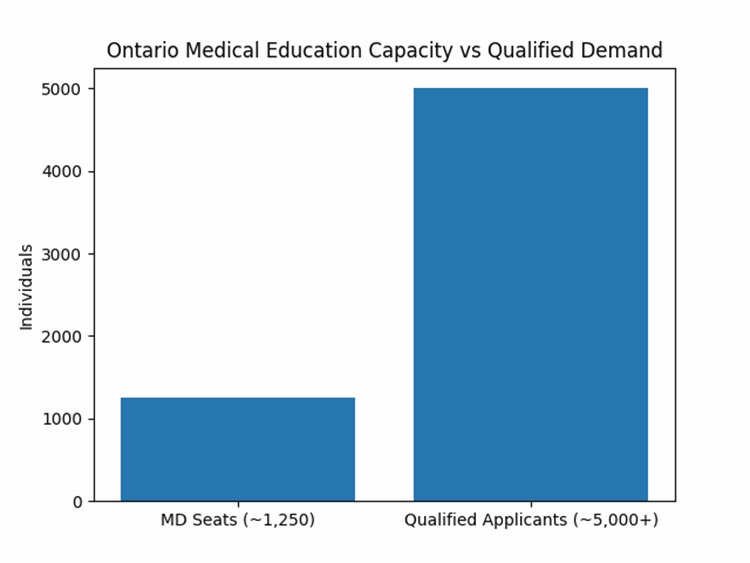
Ontario currently has seven MD-granting medical schools, producing approximately 1,200–1,300 new medical graduates per year.

At the same time:

  • Thousands of applicants meet or exceed academic thresholds
  • Acceptance rates are typically between 3% and 7%
  • Multiple application cycles have become the norm — even for top-performing candidates

This means exclusion is driven by seat scarcity, not lack of merit.

Chart 1: Ontario MD Capacity vs Qualified Demand

Chart_1.jpeg

What this shows

  • Ontario trains roughly 1,200–1,300 MDs per year
  • An estimated 5,000+ applicants meet competitive academic thresholds annually

Interpretation
This is not a quality filter.
It is a capacity bottleneck.

Scarcity — not competence — is determining who becomes a doctor.

Equal Results Must Mean Equal Treatment

Medical education in Ontario is publicly funded. That matters.

In any publicly funded professional system, applicants with equivalent academic and competency-based results must be treated equitably. A system that rewards endurance, wealth, or access to networks over demonstrated ability fails that test.

Yet Ontario’s current admissions model does exactly that.

Multiple application cycles disproportionately disadvantage:

  • Lower-income students, who cannot afford repeated fees, MCAT retakes, and unpaid preparation
  • Rural and regional applicants, who lack access to major teaching hospitals and academic networks
  • First-generation university students, who do not benefit from informal advising or professional social capital

This is not about lowering standards.
It is about not replacing merit with persistence as a selection criterion.

Chart 2: Medical School Acceptance Rates — Ontario vs United States

Picture1


Chart 3: Acceptance rates in Canada

Picture2

Ontario MD capacity vs qualified demand (data aggregated from OMSAS, Bemo Academic Consulting, and institutional admissions statistics; chart by BITSPEC)


Chart 4: Medical School Acceptance rates Canada vs. USA

Picture3

What this shows

  • Ontario / Canada: ~3–7% acceptance
  • United States: ~35–40% acceptance

Interpretation
The United States addresses physician shortages through capacity expansion.
Canada relies on exclusionary selectivity.

Ontario is an international outlier — not in standards, but in artificial scarcity.

The Hidden Asymmetry: Domestic Applicants vs International Medical Doctors

Ontario currently applies two very different logics to physician entry.

Domestic applicants:

  • Compete for extremely scarce MD seats
  • Face repeated application cycles
  • Are filtered through ranking and endurance

Internationally trained medical doctors (IMGs):

  • Enter through credential assessment and licensing pathways
  • Are evaluated based on demonstrated competence and workforce need
  • Do not compete for MD seats

This creates a structural asymmetry:

Domestic candidates are subjected to stricter exclusionary thresholds than externally trained physicians — even though both ultimately serve the same public health system.

This is not an argument against international physicians.
Ontario benefits from global medical expertise.

It is an argument for consistency, fairness, and patient safety.

Why Standardization Matters

If Ontario believes that:

  • Physicians should meet Canadian clinical, ethical, and system standards, and
  • Public trust depends on uniform quality of care,

Then all physicians must be trained to the same standards within Canada — regardless of where they originally studied.

BITSPEC’s Policy Position

BITSPEC proposes a capacity-first, equity-aligned reform built on four pillars:

1. Expand Domestic Medical Education Capacity

Increase MD seats across all seven Ontario medical schools, tied to:

  • Population growth
  • Regional physician shortages
  • Primary care and rural needs

Scarcity should never be the primary workforce strategy.

2. Treat Equal Results Equitably

Admissions systems must ensure that applicants with equivalent results are not excluded because they cannot afford:

  • Repeated application cycles
  • Geographic relocation
  • Prolonged uncertainty

Persistence is not competence.

3. Establish a Managed Intake Limit for International MDs

Ontario should set a transparent annual intake cap for internationally trained physicians, aligned with:

  • Domestic MD capacity
  • Residency positions
  • Long-term workforce planning

International recruitment should complement, not replace, domestic training.

4. Require Up to Five Years of Canadian Medical Re-Education

BITSPEC recommends that internationally trained physicians complete up to five years of structured Canadian education and supervised clinical training before independent practice, scaled to prior experience.

This pathway should include:

  • Canadian curriculum alignment
  • Accredited clinical training
  • Residency-equivalent supervised practice
  • Canadian medical law, ethics, patient safety, and system integration

This is not punitive.
It is standardization.

The Bigger Picture

Ontario’s physician shortage cannot be solved by:

  • Excluding qualified domestic candidates, and
  • Importing talent as a substitute for training capacity.

That approach is neither equitable nor sustainable.

A strong health system:

  • Trains its own professionals
  • Welcomes international expertise responsibly
  • Applies consistent standards
  • Invests in long-term capacity instead of managing scarcity

Call to Action: What Needs to Happen Now

BITSPEC calls on policymakers, academic leaders, and health-system stakeholders to:

  1. Expand MD training capacity immediately, aligned with population and care needs
  2. End endurance-based admissions filtering that disadvantages capable candidates
  3. Standardize international physician entry through Canadian re-education pathways
  4. Align education policy with workforce planning, not short-term crisis management
  5. Restore public trust by ensuring fairness, transparency, and patient safety

Ontario does not lack talent.
It lacks a policy framework that treats talent fairly.

Medical education is not just an academic issue.
It is a health-system intervention.

About BITSPEC

BITSPEC is an education, quality, and systems policy institute and a UNESCO MIL Alliance member, working at the intersection of equity, standards, and workforce sustainability.

Blog written with the support of OpenAI, ChatGPT (GPT-5.2 Instant),  Feb. 6, 2026


Sources for Canadian Medical Schools

  • BeMo Academic Consulting – regularly publishes acceptance rate summaries for Canadian and Ontario medical schools.

  • Ontario Medical School Admissions Service (OMSAS / OUAC) – the centralized admissions service providing applicant and seat data across Ontario, used by many analysts.

  • University admissions offices (e.g., Schulich School of Medicine & Dentistry) – publish class size, number of applicants, and admissions stats.

  • Independent aggregators (e.g., iGotIn) that compile admissions statistics from university reports.

Continue reading
  343 Hits

Just-in-Time Emergency Care Policy Framework

A Lean Systems Mandate for Canadian Emergency Departments

Policy Purpose

To establish Just-in-Time (JIT) Emergency Care as a non-negotiable operational and ethical standard for emergency departments (EDs) in Canada, ensuring that no patient experiences preventable harm or death due to delays in initial assessment.

Policy Statement

No healthcare system that claims to be patient-centred, evidence-based, or holistic can justify a death occurring while a patient waits for emergency assessment. When a patient suffers for hours and dies in an emergency department, the failure is not clinical—it is systemic.

Canada possesses advanced medical knowledge, technology, and trained professionals. The primary constraint in emergency care outcomes is system design and leadership accountability, not medical capability.

Emergency departments must therefore be governed as high-reliability, time-critical systems, using Just-in-Time and Lean flow principles already proven in safety-critical industries.

Core Policy Requirements

1. Immediate First Clinical Contact

  • Requirement:
    Every patient entering an ED must receive a documented clinical assessment within seconds, and no later than 1 minute from admission.

  • Rationale:
    This mirrors first-contact rules in aviation, nuclear operations, and manufacturing safety systems.

2. Zero-Wait Triage Architecture

  • Triage must operate as a continuous flow system, not a batching or queueing mechanism.

  • No patient may remain:

    • unseen

    • unclassified

    • unmonitored

Waiting without assessment constitutes uncontrolled risk exposure.

3. Just-in-Time Resource Synchronization

  • Staffing, diagnostic access, and escalation pathways must be synchronized in real time with patient inflow.

  • Surge capacity must be designed into the system, not improvised during crisis conditions.

4. Leadership Accountability

  • ED leadership must be directly accountable for:

    • time-to-first-contact

    • time-to-triage classification

    • escalation latency

  • These metrics must be treated as safety indicators, not operational KPIs.

5. Ethical Classification of Delay

Delays in emergency care are not neutral inefficiencies.
They are ethical failures with predictable, preventable consequences, including loss of life.

Lean & Just-in-Time Systems Mapping (Explicit)

Lean / JIT PrincipleEmergency Department Application
Just-in-Time (JIT) Patient assessment occurs immediately upon arrival, not after queue accumulation
Takt Time Maximum allowable time to first assessment = ≤ 1 minute
Little’s Law Excess WIP (patients waiting) directly increases lead time and mortality risk
Flow Over Batch Continuous triage flow replaces scheduled or periodic assessment
Visual Control Immediate visibility of unassessed patients
Andon / Escalation Automatic escalation when assessment thresholds are breached
Built-in Quality Errors prevented by design, not corrected after harm occurs

Canada-Specific Policy Context

In the Canadian publicly funded healthcare system:

  • Delays cannot be justified by cost containment or capacity strain

  • Universal access implies universal timeliness at first contact

  • Failure to assess promptly contradicts:

    • patient-centred care mandates

    • quality and safety frameworks

    • public trust obligations

Emergency departments are public safety infrastructures, not service counters.


Minimum Performance Standards (Non-Negotiable)

MetricPolicy Threshold
Time to first clinical contact ≤ 60 seconds
Unassessed patients in system 0
Triage batching Prohibited
Escalation trigger Automatic, real-time
Leadership review of delays Mandatory


Policy Principle

In emergency medicine, time is not a cost variable — it is a life variable.

Any system that tolerates prolonged waiting without clinical assessment is not overwhelmed; it is misdesigned.

Just-in-Time Emergency Care is not an efficiency initiative.
It is a clinical, ethical, and systems obligation.

Implementation Note (for Institutions & Policymakers)

This policy requires:

  • redesign of ED intake flow

  • real-time staffing models

  • leadership accountability frameworks

  • alignment with Lean healthcare governance

Technology enables this.


Leadership enforces it.


Patients depend on it.


Blog written with the support of OpenAI, ChatGPT (GPT-5.2 Instant),  Feb. 4, 2026

Continue reading
  294 Hits

When Children Sing of War: Discomfort, Denial, and the Persistence of Conflict


During a public performance, a critique was raised that a judge did not enjoy listening to children sing sad songs, particularly when those songs speak of great-grandparents lost in war. The discomfort expressed was framed as concern for children’s emotional well-being: children should not carry such sadness. Yet this reaction reveals a deeper contradiction that deserves reflection. If societies claim to protect children from grief, why do they continue to support the very conditions that produce it?


This tension is not accidental. It reflects a broader pattern in how modern societies engage with war: an ability to endorse violence in abstract terms while rejecting its emotional consequences when they become personal and visible.

Emotional Distance and Moral Comfort

War is often supported at a distance—through political language, strategic framing, and collective narratives of necessity. Concepts such as security, deterrence, national interest, or historical duty allow violence to be rationalized without sustained engagement with its human cost. When grief is abstract, it remains tolerable. When it is embodied—particularly in the voice of a child—it becomes unsettling.

Children singing about loss collapse the emotional distance that makes war socially acceptable. Their voices bypass ideology and appeal directly to human empathy. For many listeners, this creates cognitive and emotional discomfort. Rather than confronting the implications of that discomfort, it is easier to reject the expression of grief itself.

Compassion Without Accountability

Expressions such as “I don’t want to hear children being sad” may appear compassionate, but they risk becoming a form of moral evasion. Compassion that stops at emotional discomfort, without extending to accountability, allows societies to mourn selectively while continuing to legitimize the structures that produce suffering.

True ethical reflection requires asking not only how children feel, but why they feel that way—and who bears responsibility. Avoiding the sadness avoids the question.

The Institutional Persistence of War

Wars do not continue because people enjoy suffering. They persist because they are sustained by political incentives, economic systems, historical narratives, and institutional momentum. Individuals may sincerely wish for peace while still participating—through silence, normalization, or indirect support—in systems that reward conflict.

Children’s songs about war disrupt this equilibrium. They remind audiences that violence does not remain confined to history books or policy debates; it echoes across generations. That reminder can feel intrusive in spaces designed for entertainment or comfort, yet it is precisely this intrusion that gives such performances their moral significance.

Grief as Knowledge

In educational and cultural contexts, grief is often treated as something to be managed, softened, or removed. However, grief is also a form of knowledge. It carries historical memory, ethical warning, and social truth. When children articulate inherited loss, they are not being burdened with sadness—they are bearing witness to it.

Silencing that witness does not protect innocence; it preserves illusion.

Conclusion

The discomfort with hearing children sing about war reveals less about children’s vulnerability and more about society’s unresolved relationship with violence. It exposes a desire to maintain moral self-image without confronting moral consequence.

If we truly wish for children not to sing sad songs about lost relatives, the ethical response is not to silence the song—but to question why the wars that inspired it continue to be justified, supported, or normalized.

Until that question is faced honestly, the sadness will remain whether sung or unspoken.


Teodora Luca is very talented, so let's ensure that wars are ended because the talent in music and art will prevail in peace.

 Blog written with the support of OpenAI, ChatGPT (GPT-5.2 Thinking),  January 31, 2026


Continue reading
  357 Hits

Lean Six Sigma in Higher Education: A Performance System, an Object of Study, and a Framework for Responsible Alignment

Issued by: BITSPEC
Scope: Higher Education, Professional Credentialing, Workforce Development
Alignment: Performance Alignment (PA Levels) · UNESCO Media and Information Literacy (MIL)

Executive Position Statement

BITSPEC affirms the following position:

Lean Six Sigma is not, in its current form, an academic discipline.
It is a performance system that requires PA-level alignment for responsible application.
An academic discipline emerges when Lean Six Sigma is studied, critiqued, and advanced as an object of scholarly inquiry within a broader science of performance and improvement systems.

This position resolves persistent confusion between education, certification, and governance, and provides a defensible framework for universities, accreditation bodies, and employers.

1. What Lean Six Sigma Is — and Is Not

Lean Six Sigma (LSS) was designed to:

  • Improve real-world performance
  • Reduce variation and waste
  • Support evidence-based decisions
  • Operate across complex socio-technical systems

It is therefore a performance system, defined by:

  • Prescribed methodologies (e.g., DMAIC)
  • Standardized decision rules
  • Contextual application
  • Measurable operational outcomes

Lean Six Sigma is not:

  • A theory-driven academic discipline in itself
  • A body of abstract knowledge detached from application
  • A substitute for foundational academic fields (statistics, systems engineering, operations research)

Because of its applied nature, Lean Six Sigma cannot be governed by academic grading models alone.

2. Why PA-Level Alignment Is Mandatory

Performance systems involve decision authority, risk, and ethical responsibility.
As such, Lean Six Sigma must be aligned to Performance Alignment (PA) levels, which reflect:

  • Cognitive and analytical complexity
  • Degree of autonomy in decision-making
  • Systemic risk exposure
  • Ethical and societal impact

PA-levels ensure that:

  • Learners are not over-credentialed without judgment
  • Tools are applied within appropriate authority limits
  • Certification reflects capability, not course completion

PA-level alignment is a governance requirement, not a pedagogical preference.

BITSPEC explicitly rejects attempts to replace PA-levels with purely academic credit-hour or grade-based models.

3. Where the Academic Discipline Actually Exists

The apparent contradiction between “Lean Six Sigma as a performance system” and “Lean Six Sigma as an academic discipline” is resolved through proper epistemic placement:

Lean Six Sigma is the object of study.
The academic discipline is the science of performance and improvement systems.

Within this discipline, Lean Six Sigma is examined through:

  • Statistical validity and assumptions
  • Measurement theory and uncertainty
  • Systems optimization and flow
  • Decision-making under constraints
  • Ethical governance of metrics and algorithms

This mirrors how:

  • Medicine preceded medical science
  • Engineering preceded engineering theory
  • Accounting preceded accounting research

Practice comes first.
Scholarship follows when practice is studied rather than merely replicated.

4. Alignment with UNESCO Media and Information Literacy (MIL)

BITSPEC aligns Lean Six Sigma education with UNESCO Media and Information Literacy (MIL), particularly in the following ways:

UNESCO MIL Principle
Lean Six Sigma Academic Alignment

Evidence-based reasoning

Statistical inference & SPC

Critical evaluation of information

Assumption testing & model diagnostics

Ethical use of information

Metric governance & misuse prevention

Informed decision-making

PA-aligned judgment under uncertainty

Accountability & transparency

Measurement system analysis & auditability

This alignment positions Lean Six Sigma education not merely as technical training, but as responsible information practice in decision-driven systems.

5. What Must Happen for Legitimate Academic Recognition

BITSPEC identifies five non-negotiable conditions for universities wishing to integrate Lean Six Sigma responsibly.

1. Explicit Academic Framing

Lean Six Sigma must be taught as:

the study of variation, flow, measurement, and decision-making in socio-technical systems — not as tool memorization.

2. A Formal Mathematical Core

Instruction must include:

  • Control charts as probabilistic models
  • Capability indices as estimators with assumptions
  • DOE integrated with linear and nonlinear model theory
  • Optimization under real-world constraints

3. Research-Centered Treatment

Programs must engage learners in:

  • Methodological critique
  • Boundary and failure-mode analysis
  • Bias and misuse studies
  • Comparative system evaluation

4. Ethics and Governance Integration

Curricula must explicitly address:

  • Metric abuse and gaming
  • Algorithmic bias in AI-supported optimization
  • Human oversight vs automation
  • Accountability in continuous improvement systems

5. Structural Separation of Roles

  • Universities: theory, critique, research, ethics
  • Certification bodies: PA-aligned applied competence

This separation protects academic integrity and professional credibility.

6. Short Policy for Universities

BITSPEC Recommended Policy on Lean Six Sigma Integration

Universities offering Lean Six Sigma–related education shall distinguish clearly between academic instruction and professional certification.

Academic programs shall focus on theoretical foundations, statistical validity, ethical governance, and critical evaluation of performance systems.

Applied competence and professional authority shall be validated through PA-level–aligned certification frameworks, not academic grades alone.

All Lean Six Sigma education shall align with UNESCO Media and Information Literacy principles, emphasizing evidence integrity, ethical decision-making, and accountability in socio-technical systems.

7. Institutional Placement

BITSPEC does not recommend Lean Six Sigma as a standalone academic department. It belongs within:

  • Engineering and applied sciences
  • Health sciences
  • Business analytics
  • Public policy and operations
  • Education systems design

Over time, this supports the emergence of a recognized academic field focused on performance and improvement systems, with Lean Six Sigma as a mature applied framework.

Conclusion: Proper Alignment Is Institutional Responsibility

Lean Six Sigma does not gain legitimacy by being mislabeled as an academic discipline.
It gains legitimacy when it is correctly governed.

Lean Six Sigma is a performance system governed by PA-level alignment.
Academia’s role is to study, critique, and ethically advance performance systems as objects of knowledge, in alignment with UNESCO MIL principles.

This position safeguards learners, institutions, and society — and establishes a clear, responsible path forward.

BITSPEC helps institutions use performance systems responsibly by aligning evidence, authority, and ethics across academia and practice.

Blog written with the support of OpenAI, ChatGPT (GPT-5.2 Thinking),  January 29, 2026

Continue reading
  317 Hits

Performance Assessment (PA) Levels in Lean Six Sigma

A UNESCO Media and Information Literacy Perspective from BITSPEC

In an era saturated with credentials, frameworks, and content, a critical question confronts education and professional training alike:

Does certification reflect capability?

At BITSPEC, a member of the UNESCO MIL Alliance, we approach Lean Six Sigma through the lens of Media and Information Literacy (MIL)—not as content accumulation, but as responsible, contextualized, and demonstrable use of knowledge.

This perspective leads to a necessary clarification:

Lean Six Sigma is not an academic discipline.
It is a performance system.
And performance systems demand PA-level alignment.
Why UNESCO MIL Matters for Lean Six Sigma

According to UNESCO, Media and Information Literacy is not defined by access to information, but by the ability to:

  • Interpret information critically
  • Apply knowledge responsibly
  • Make evidence-based decisions
  • Act ethically within real systems

These principles align directly with the intent of Lean Six Sigma when it is taught correctly.

Lean Six Sigma knowledge is legitimate only if:

  • It improves process outcomes
  • It scales across sectors (manufacturing, healthcare, services, education)
  • It can be demonstrated in real projects

This is performance literacy in action.

PA Levels as Performance Literacy

PA levels (Performance Assessment levels) define how knowledge is used, not merely what is known.

They answer a question central to both Lean Six Sigma and UNESCO MIL:

Can the learner apply knowledge critically, responsibly, and effectively in a real context?

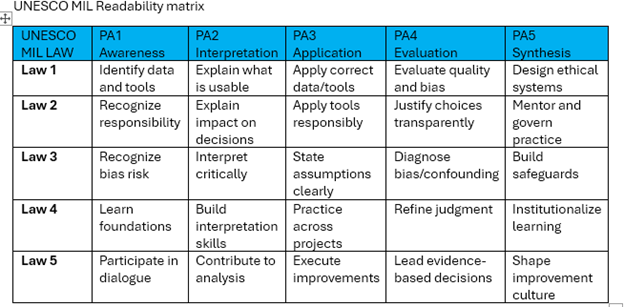
In Lean Six Sigma, PA levels progress as:

  • PA1 – Awareness: Recognizing and defining concepts
  • PA2 – Interpretation: Explaining meaning and interpreting outputs
  • PA3 – Application: Applying tools correctly to real data
  • PA4 – Evaluation: Diagnosing situations and justifying decisions
  • PA5 – Synthesis: Designing systems, mentoring others, and leading improvement

From an MIL standpoint, this progression reflects the shift from information consumption to knowledge agency.

Knowing a tool exists is not literacy.
Using it responsibly, contextually, and defensibly is.

Mapping PA Levels to UNESCO MIL Competencies

This alignment is deliberate, not accidental.

PA Levels ↔ UNESCO MIL Competency Alignment

PA Level
Lean Six Sigma Expectation
UNESCO MIL Competency Alignment

PA1 – Awareness

Define concepts, recognize tools

Access & identify information

PA2 – Interpretation

Explain outputs, interpret charts

Critical understanding of information

PA3 – Application

Apply tools to real data

Effective use of information

PA4 – Evaluation

Diagnose issues, justify decisions

Critical evaluation & ethical judgment

PA5 – Synthesis

Design systems, mentor others

Knowledge creation & responsible leadership


This mapping ensures that Lean Six Sigma training develops not just technical proficiency, but information literacy, critical judgment, and accountability—core UNESCO MIL outcomes.

Why PA-Level Alignment Is a Governance Requirement?

PA-level alignment is not a teaching preference.
It is a governance mechanism.

Without PA alignment:

  • Learners are certified without being capable
  • Employers lose trust in credentials
  • Knowledge becomes symbolic rather than functional

With PA alignment:

  • Green Belts demonstrate application, not memorization
  • Black Belts demonstrate evaluation and justification
  • Master Black Belts demonstrate system design and leadership

The same tools appear across levels, but the responsibility attached to their use increases.

This mirrors UNESCO MIL’s principle that greater knowledge entails greater responsibility.

Applied Statistics as Responsible Information Use

Statistics is where performance literacy is most visibly tested.

Traditional academic instruction emphasizes:

  • Formula derivation
  • Manual computation
  • Symbolic completeness

Lean Six Sigma—aligned with UNESCO MIL—requires:

  • Interpretation of evidence
  • Validation of assumptions
  • Decision-making under uncertainty

Teaching statistics without interpretation creates a misinformation risk.

That is why BITSPEC insists on:

  • Applied statistics over mechanical learning of formulas
  • Diagnostics over button-pushing
  • Decision justification over mechanical output
Formulas support judgment.
They do not replace it.


Sector Context and Knowledge Ethics

UNESCO MIL emphasizes that knowledge is contextual and ethical, never neutral.

A control chart in healthcare carries implications very different from one in manufacturing.
A regression model in education or public services affects people, not just processes.

Teaching Lean Six Sigma without sector context risks:

  • Misapplication
  • Overconfidence
  • Harmful decisions

Sector-specific context is therefore a requirement for responsible knowledge use, not an optional enhancement.

Reclaiming Credibility Through Performance Literacy

Lean Six Sigma regains its credibility when learners can:

  • Interpret information critically
  • Apply tools responsibly
  • Defend decisions transparently
  • Improve systems measurably

PA levels provide the structure that makes this possible.

When Lean Six Sigma education is:

  • PA-aligned
  • Application-driven
  • Context-aware

It aligns naturally with UNESCO’s vision of empowered, literate, and responsible knowledge users.

This is not academic rigor lost.
It is performance rigor restored.
Policy Note on Performance Assessment Alignment

In alignment with UNESCO Media and Information Literacy (MIL) principles, knowledge is assessed based on its responsible application, critical interpretation, and ethical use in real-world contexts.

As Lean Six Sigma is a performance system rather than an academic discipline, assessment emphasizes applied statistics, decision justification, sector-specific context, and project-based demonstration of competence appropriate to the learner’s certification level.

Picture


Framework aligns with UNESCO MIL principles

Original BITSPEC


Blog written with the support of OpenAI, ChatGPT (GPT-5.2 Thinking),  January 27, 2026


Continue reading
  381 Hits

Developmental Timing and Learning Outcomes: Lessons from Plant Nutrition for Self-Regulated Learning and Generative AI in Education


20260121 073326

Plants don’t thrive just because nutrients exist somewhere in the soil. They thrive when the right nutrients arrive at the right stage, and when conditions (water, light, healthy roots) allow the plant to actually absorb them. Education follows the same logic: learners grow best when the right learning supports arrive at the right moment of readiness, and when the environment enables “uptake” (clarity, feedback, confidence, motivation).

Growth happens in stages—and timing shapes potential

In a plant’s early development, the priority is building roots and structure. Later, the plant shifts toward flowering and yield. If nutrients are missing during a key window, the plant may survive, but its long-term growth and productivity can be permanently reduced.

Learning works similarly. Early foundations (literacy, numeracy, basic reasoning, language, and confidence) are like root development. When those supports are delayed or inconsistent, students often compensate by memorizing procedures rather than building understanding. Later, when tasks require critical thinking and transfer, the weaknesses show up as frustration, disengagement, or anxiety.

 Self-learning is the root system


Self-learning—the ability to set goals, monitor understanding, seek feedback, and practice deliberately—is the learner’s “root network.” Strong self-learning allows students to absorb new knowledge more efficiently and adapt to changing demands. Weak self-learning leads to dependency: students can’t easily “feed themselves” intellectually when challenges increase.

So the question becomes: How do we strengthen the roots without doing the growing for the learner?

GenAI can be fertilizer—or it can stunt the roots

GenAI can accelerate learning when it functions like a smart fertilizer—supporting growth without replacing it. Used well, GenAI can help students:

  • clarify concepts in multiple ways,

  • generate practice questions,

  • provide feedback on drafts,

  • plan study steps,

  • check reasoning and identify gaps.

Used poorly, GenAI becomes a shortcut that bypasses the very struggle that builds understanding. If students routinely outsource thinking, they may produce polished outputs while their internal “root system” (skill, confidence, reasoning) stays underdeveloped.

The goal is simple: GenAI should amplify thinking, not replace it.

Where GenAI belongs in education

A practical way to introduce GenAI is in three layers:

  1. AI Literacy (for everyone, across subjects)
    Students learn what GenAI is, what it cannot do reliably, how it can be biased or wrong, and why verification matters.

  2. AI as a Learning Partner (student-facing, skill-building)
    Students use GenAI as a coach: brainstorming, revision support, practice generation, concept explanations—paired with verification and reflection.

  3. AI for Teaching Support (teacher-facing, responsibly deployed)
    Teachers use GenAI to improve clarity, differentiation, and feedback systems—while keeping learning goals, evaluation, and relationships human-led.

How to introduce GenAI: stage-appropriate “dosing”

  • Early years: Focus on AI awareness and critical evaluation of information. If GenAI appears at all, it should be guided by teachers with clear boundaries.

  • Middle/secondary: Teach GenAI as a thinking tool: prompting as goal-setting, and responses as drafts that must be checked and improved.

  • Postsecondary: Expand into discipline-specific uses (research synthesis, design critique, data interpretation)—but require transparency and intellectual ownership.

The guardrails that make GenAI truly educational

To keep GenAI “nutritive” rather than harmful:

  • Require students to show their thinking (steps, drafts, reasoning, reflections).

  • Build in verification routines (“What evidence supports this? What would disprove it?”).

  • Use assessment methods GenAI can’t fake well: oral explanations, in-class reasoning, iterative projects, and authentic tasks.

  • Encourage disclosure: how GenAI was used and what the student learned as a result.

Some reflection

Plants reach their potential when nutrients are timed to development and conditions support uptake. Learners reach their potential when education strengthens self-learning—and when GenAI is introduced in a way that grows the learner, not just the output.

If GenAI is fertilizer, then education must still build the roots.

GenAI Use Statement 
Generative AI tools may be used to support learning (e.g., brainstorming, outlining, language support, and revision), but they must not replace the student’s original reasoning or academic work. Any use of GenAI must be transparent (briefly disclose how it was used), and all outputs must be verified against credible sources; students remain fully responsible for the accuracy, integrity, and proper citation of submitted work. Do not use GenAI to fabricate data, references, or claims, and do not enter confidential, personal, or proprietary information into AI tools.

Blog written with the support of OpenAI, ChatGPT (GPT-5.2 Thinking),  January 21, 2026


Continue reading
  337 Hits

Inherited Restarts: Generations of Sacrifice in a World That Rewrites Value

Generations of sacrifice

It has happened to many people, across many borders and eras: a life built carefully, then erased by a change of rules.

First, land is taken. Sometimes by force, sometimes by “law,” sometimes by war, collectivization, nationalization, rezoning, confiscation, or paperwork that arrives with authority and leaves with your future. Land is not only an asset. It is stability, identity, and the proof that work can become inheritance. When it is removed, the message is clear: your effort does not guarantee your security.

So the next generation adapts. They do what every society tells families to do when the ground shifts beneath them: they invest in skills. They study. They become engineers, technicians, teachers, chemists, accountants, and builders of systems. They learn discipline, precision, and endurance. They do not ask for favors; they ask for a fair exchange: time, competence, contribution—in return for a livelihood.

Then the regime changes. Or the economic model changes. Or the industry collapses. Or corruption becomes the only hiring channel. Or privatization happens in a way that rewards proximity, not merit. Factories close. Institutions shrink. Credentials that once had meaning become “old,” “irrelevant,” “not marketable.” The same people who carried the system are told they should have predicted the collapse of the system. Their work is not only undervalued; it is reframed as naïve.

So the children of that generation leave. They carry what their parents believed was untouchable: education. They arrive somewhere else expecting that ability will translate. Instead, they discover a different kind of dispossession—quiet, bureaucratic, polite:

  • “Your degree isn’t equivalent.”

  • “You don’t have local experience.”

  • “Your communication style isn’t a fit.”

  • “You need licensing, bridging, a local reference, more proof.”

They are not accused of being unskilled. They are treated as if their skill has no currency. They learn that the world does not run on competence alone. It runs on recognition, and recognition is controlled.

So a person may do work far below their level, accept lower pay, take temporary contracts, start over, swallow pride, and keep going. And then comes the deepest betrayal: even when they succeed, the reward often doesn’t match the sacrifice. Their labor is used, but their status remains conditional. They become “useful” without being fully welcomed as equals.

Why does it keep happening?

Not because people make the wrong choices. In fact, the pattern shows up precisely when people make the most responsible choices available to them at each moment: work hard, learn, comply, contribute, adapt.

It happens because systems repeatedly do three things:

1) They redefine legitimacy.
When power changes, it reissues what counts as “valid”: valid property, valid experience, valid education, valid identity. Those already inside the new order are automatically credible. Others must “prove” themselves again, and again, and again.

2) They turn transition into extraction.
When rules change suddenly, ordinary people pay the cost through lost assets, lost jobs, lost pensions, lost time. Meanwhile, those with access—networks, capital, political connections, insider information—capture what’s left. Transitions create winners not only by innovation, but by position.

3) They treat skills as available, but recognition as scarce.
Many economies want the labor that educated people provide. Fewer want to share the status and rewards that should come with that labor. So a contradiction becomes normal: a society can benefit from your expertise while still discounting you as a professional.

A harder truth

This pattern is not an accident. It is often a feature of how societies maintain hierarchy while pretending to reward merit.

If recognition were automatic, it would redistribute opportunity too quickly. If credentials were transferred cleanly, it would challenge gatekeepers. If work always led to reward, it would reduce the power of those who control access. So instead, many systems quietly run on a familiar design:

People can be invited to contribute, but are kept waiting to belong.
People can be needed, but not fully valued.

And families absorb it across generations as “normal,” calling it resilience, calling it duty, calling it fate—because it is painful to admit that sacrifice can be inherited while justice is not.

The question to ask

If land can be taken, and then skills can be made obsolete, and then education can be discounted abroad, what is being protected?

Are societies organized to recognize human value — or to harvest human effort?

And the question behind that question:

Who benefits when entire populations are forced to restart their lives every time the rules change?

Because “starting over” is not a personal virtue when it is imposed. It is a cost—paid in wasted talent, fractured families, delayed lives, and a quiet erosion of trust.

That is the truth worth saying out loud:


When a system repeatedly fails to reward competence, the problem is not the people. The problem is the system’s definition of who deserves to be recognized.

OpenAI, ChatGPT (GPT-5.2 Thinking),  January 15, 2026


Continue reading
  313 Hits

Neurodevelopmental Windows: Early Procedural Deficits and Adult Statistical Learning Barriers

Mature adults who struggle with statistics due to missed early basal ganglia training face significant cognitive and life consequences, amplifying challenges from poor procedural fluency.[1][2]

Cognitive Overload

Basics like formula application or data sequencing remain effortful, draining working memory needed for statistical inference, modeling, or interpretation. This leads to slower comprehension, higher error rates, and persistent math anxiety, as seen in 31% depression rates among adults with learning gaps.[3][4]

Educational and Career Impacts

Such difficulties mirror learning disability patterns: lower postsecondary completion (34% vs. 51% graduation), reduced STEM enrollment (12% vs. 23%), and remedial needs (45% vs. 28%). Employment drops to 48% from 72%, with underemployment common in data-intensive fields, resulting in $12,560 in annual lost productivity per individual.[5][3]

Mental Health Toll

Stats anxiety fosters avoidance, isolation, and distress; adults report 29% anxiety and poor mental health 2-3x higher than peers. Without remediation, this perpetuates cycles of low self-efficacy and economic disadvantage.[6][3]

Remediation Window

Intensive procedural drills can rebuild habits, but lifelong effects include delayed careers and higher societal costs ($35B/year in the US for related gaps). Early basal ganglia focus prevents these entrenched barriers.[7][3]

  1. https://pmc.ncbi.nlm.nih.gov/articles/PMC3772079/
  2. https://vuir.vu.edu.au/49181/1/Procedural_learning_is_associated_with_microstructure_of_basal_ganglia-cerebellar_circuitry_in_children.pdf
  3. https://crowncounseling.com/statistics/learning-disabilities/
  4. https://pmc.ncbi.nlm.nih.gov/articles/PMC9380669/
  5. https://open.library.ubc.ca/media/stream/pdf/24/1.0307417/4
  6. https://www.ldao.ca/faq-items/learning-disabilities-statistics/
  7. https://www.frontiersin.org/journals/human-neuroscience/articles/10.3389/fnhum.2021.683885/full
  8. https://pmc.ncbi.nlm.nih.gov/articles/PMC4475843/
  9. https://www.ldac-acta.ca/causes/for-adults/
  10. https://www.psychiatry.org/patients-families/specific-learning-disorder/what-is-specific-learning-disorder
  11. https://irisinstitute.ca/wp-content/uploads/sites/2/2016/07/Learning-difficulties-snapshot_iris_cr.pdf
  12. https://www150.statcan.gc.ca/n1/daily-quotidien/241008/dq241008d-eng.htm
  13. https://ldsociety.ca/how-common-are-learning-disabilities/

Perplexity AI. (2026, January 13). "Neurodevelopmental Windows: Early Procedural Deficits and Adult Statistical Learning Barriers." Retrieved from a conversation with Perplexity AI.

Continue reading
  346 Hits

From Habit to Spatial Mastery: Basal Ganglia-to-Hippocampus Transformation of Six Sigma DOE Learning Map

For hippocampus learners (who retain and connect information best through spatial, visual, and associative cues), we’ll use colors, icons, shapes, and memory-based metaphors to make the concepts easier to encode and retrieve. Imagine this version as a learning map — something your mind can “walk through” and visualize.

🧠 DOE Learning Map – Six Sigma Edition

🎯 What Is DOE?

Design of Experiments (DOE) = A structured way to test, learn, and improve a process.
Think of it like a scientific recipe book for finding out which “ingredients” make your process successful.

🧩 Step 1: Screening Designs

Goal: Find the factors that really matter.

🕵️‍♀️ Use these to filter out the noise and spotlight key drivers.

Design Type

Visual Symbol

What It Does

Brain Tag

Plackett-Burman

🔍

Quick scan for most important variables

“Find the stars”

Full Factorial (2^k)

⚙️⚙️

Tests all high/low combos

“Every switch flipped”

Fractional Factorial (2^(k-p))

✂️

Uses fewer runs, keeps key info

“Shortcut with smarts”

🧠 Memory Anchor: Imagine flipping multiple light switches in different on/off combinations to see which ones brighten the room most.

🔄 Step 2: Full Factorial Designs

Goal: Study all interactions between factors.

Design Type

Symbol

Use Case

Brain Tag

2^k Designs

💡

Two levels per factor

“Simple grid”

3^k or Mixed-Level

🧪

Multi-level mixes (like flavors in a soda test)

“3D flavor map”

🧠 Memory Anchor: Think of combining different Lego pieces — each connection changes the full structure.

🚀 Step 3: Response Surface Methodology (RSM)

Goal: Fine-tune the best combination.

Design Type

Symbol

Purpose

Brain Tag

Central Composite Design (CCD)

🌈

Adds center + outer points for curvature

“See the curve!”

Box-Behnken

🌀

Maps mid-range combos safely

“Balanced balloon”

🧠 Memory Anchor: Visualize a mountain peak — RSM helps you climb to the highest performance point.

🛡️ Step 4: Taguchi Methods – Build Tough Systems

Goal: Make the process strong against variation.

Method

Symbol

Meaning

Brain Tag

Orthogonal Arrays

🔢

Balanced test layout

“Miniaturized experiment grid”

Signal-to-Noise Ratio

📊

Measures process stability

“Volume knob for quality”

🧠 Memory Anchor: Imagine noise-canceling headphones — Taguchi makes your process “noise resistant.”

⚖️ Step 5: Randomized Block Designs

Goal: Handle differences you can’t control.

Type

Symbol

Use Case

Brain Tag

RCBD

🧱

Block similar groups to isolate variability

“Stack by type”

🧠 Memory Anchor: Picture students grouped by skill before testing — results make more sense when compared within each group.

🔢 Step 6: Latin Square Designs

Goal: Control two sources of variation without full testing.
Imagine labeling grid rows (e.g., machines) and columns (e.g., operators) — each cell holds a unique combo.

🧠 Memory Anchor: Think Sudoku — each row and column gets every number once.

🧭 Step 7: Nested Designs

Goal: Organize experiments that have levels within levels.
Example: Machines inside Plants, Operators inside Machines.

🧠 Memory Anchor: Visualize Russian nesting dolls — each level fits inside another.

🧰 The DOE Process — Step-by-Step Pathway

🔹 1. Define the problem 🧩
🔹 2. Set the goal 🎯
🔹 3. Choose what you’ll measure (output) 📏
🔹 4. Choose what you’ll change (inputs) 🎚️
🔹 5. Pick levels (high/low) 📈
🔹 6. Select the design 🧭
🔹 7. Run the experiment 🧪
🔹 8. Analyze data 📊
🔹 9. Find patterns and insights 💡
🔹 10. Validate and repeat 🔁
🔹 11. Apply and improve 💼

🧠 Hippocampus Tip: Link each step to a visual story — e.g.,

  • Define (detective hat)
  • Analyze (magnifying glass)
  • Apply (trophy)

Smart Planning Questions

🔍 Before you start, ask:

  • How much access do we have to the process?
  • Is everyone (team, experts, owners) involved?
  • Who owns the process, and do they understand DOE?
  • How much time and budget do we have?
  • What noise or environmental factors matter?
  • Where will this run — lab or real process?
  • Are we exploring big changes or small refinements?

🧠 Memory Anchor: Picture a pilot checklist before takeoff — every question ensures a safe and successful flight.

🌟 Key Takeaways

  • DOE = Smart Experimentation.
  • Good design saves time, money, and confusion.
  • Always visualize the process — the hippocampus loves patterns and structure.
  • Link concepts to meaningful symbols, stories, or analogies to boost recall.


Perplexity AI. (2026, January 13). DOE Learning Map – Six Sigma Edition
[Interactive learning materials]. Retrieved from a conversation with
Perplexity AI.

Continue reading
  425 Hits

Across Borders, One People: A Comparative Study of Inuit in Canada and Greenland

Abstract

The Inuit are a circumpolar Indigenous people whose homelands span contemporary state borders, including those of Canada and Greenland (Kalaallit Nunaat). This paper synthesizes recent demographic, legal, and policy sources to compare the differences in Inuit population distribution, language status, and governance frameworks between Canada and Greenland, and how shared pressures—especially housing constraints and climate-linked food security risks—shape wellbeing and self-determination. Using comparative document analysis of Canadian census publications, Inuit representative organization reports, and Greenland self-government/legal materials, the paper finds: (1) Inuit are a demographic majority in Greenland but a small national minority in Canada; (2) Greenlandic is legally established as Greenland’s official language, whereas Inuktut in Canada is central culturally yet governed through a more fragmented constitutional and policy landscape; (3) Inuit self-determination is institutionalized through different pathways—modern land claims and regional institutions in Canada versus territorial self-government within the Danish Realm in Greenland; and (4) both contexts face intensifying socio-ecological challenges, with overcrowded housing and changing sea-ice conditions acting as compounding risks. The study concludes with implications for policy comparability, community-led research, and cross-border Inuit governance. It also situates Inuit governance within international norms of self-determination and the UN Charter’s prohibition on the threat or use of force, and uses neo-feudalism as a heuristic for understanding how rent extraction and dependency can constrain Arctic autonomy.

Keywords: Inuit; Kalaallit; Inuit Nunangat; Greenland Self-Government; land claims; language policy; housing; climate change; food security; self-determination; non-use of force; neofeudalism

Across Borders, One People: A Comparative Study of Inuit in Canada and Greenland

Continue reading
  413 Hits

Neo-feudalism in Contemporary Political Economy: A Conceptual Dissertation with Empirical Illustrations

Abstract

This dissertation develops an analytic account of neo-feudalism as an emergent configuration of political economy in which access to essential infrastructures is organized through private, often monopoly-like, control, and where value extraction increasingly takes the form of rents rather than profits generated through competitive production. Building on recent political-economic and critical-theory scholarship, the argument treats neo-feudalism not as a metaphor but as a set of institutional tendencies: platform gatekeeping, proprietary rule-making, asset-based income streams, algorithmic command over labour, and the enclosure of everyday life within contractually governed spaces. The dissertation synthesizes competing conceptualizations (including 'digital feudalism' and 'technofeudalism') and connects them to empirical domains: app-store governance, housing financialization, and algorithmic management. It concludes by outlining policy and collective-action pathways that target the underlying mechanisms of enclosure and dependence, emphasizing interoperability, antitrust enforcement, labour rights in digitally mediated work, and decommodified access to foundational services.

Neo-feudalism in Contemporary Political Economy: A Conceptual Dissertation with Empirical Illustrations

Continue reading
  313 Hits

Epistemic Injustice in Canadian Engineering Pathways: Women Educated in Eastern Europe

In several blogs, I will bring to everyone's attention the different groups that have epistemic injustice in the engineering fields.

Thesis. Epistemic injustice is a distinct wrong done to someone “in their capacity as a knower.” In Miranda Fricker’s canonical formulation, it has two core forms: testimonial injustice, where prejudice deflates a speaker’s credibility, and hermeneutical injustice, where gaps or distortions in shared interpretive resources make it harder for someone to render their experience intelligible within dominant institutions. (Miranda Fricker) In Canada, women with engineering degrees from Eastern Europe can face both forms through a credentialing-and-employment ecosystem that often treats “foreign education” as a legibility problem to be managed—rather than treating internationally educated professionals as co-producers of evidence about competence.

1) Testimonial injustice: credibility deficits in “recognition” systems

Credential recognition is not only about documents; it is also about who gets believed. Statistics Canada’s LSIC-based analysis of foreign credential and work-experience recognition shows persistent gender differences in predicted probability of recognition after accounting for multiple factors. In the “credentials model,” men had a predicted probability of recognition of 36% versus 32% for women; in the “work experience model,” men were at 56% versus 48% for women. (Statistics Canada) These gaps are epistemically consequential: when recognition processes (formal and informal) operate through credibility judgments—about institutions, accents, communication norms, and references—women can be systematically assigned a credibility deficit even when their technical preparation is strong.

For engineering specifically, the same LSIC analysis reports a predicted credential-recognition probability of 33% for those whose highest education is “University—Engineering” (the reference category in that table), underscoring how recognition is neither automatic nor uniform even for high-demand fields. (Statistics Canada) The point is not that competence is absent; it is that the institutional uptake of competence is uneven—an epistemic harm that can translate into occupational downgrading, stalled licensing, and repeated demands to “prove it again.”

2) Hermeneutical injustice: “Canadian experience” as a meaning-system that misdescribes the problem

Hermeneutical injustice appears when institutions rely on interpretive shortcuts that turn complex biographies into administrable deficits. The long-standing “Canadian experience” screen is a textbook example: it frames the barrier as an individual lack rather than a structural recognition problem. The Ontario Human Rights Commission states plainly that requiring “Canadian experience” can create barriers for newcomers and may violate the Ontario Human Rights Code, and emphasizes that basing hiring/accreditation on Canadian experience is “not a reliable way” to assess skills; strict Canadian-experience requirements should be used only in limited circumstances and must be justified as bona fide. (www3.ohrc.on.ca) This is epistemic injustice in practice: a rule of thumb becomes a credibility technology—one that often blocks internationally trained professionals from having their knowledge count as knowledge.

Importantly, Ontario’s engineering regulator explicitly ties its reforms to fairness obligations for internationally educated applicants. Professional Engineers Ontario (PEO) notes that legislative amendments required it to eliminate the Canadian experience requirement while ensuring appropriate public protection, embedding fairness and transparency into the licensing timeline and decision standards. (Professional Engineers Ontario) In other words, what was once normalized as “common sense” is now treated—at least in part—as a barrier requiring correction.

3) Eastern Europe as a “legibility” signal in Canadian labour-market sorting

The epistemic issue is not “Eastern Europe” per se, nor any particular political era. The issue is that degrees from some regions are treated as less institutionally legible in Canadian employer and regulatory ecologies. Statistics Canada’s longitudinal study of persistent overqualification (2006–2016) provides region-level evidence consistent with this legibility gradient. In Chart 2, the predicted probability of persistent overqualification for those born in Eastern Europe is 2.7% when they studied in Canada versus 10.8% when they studied outside Canada (holding other factors constant in the model). (Statistics Canada) This “same region of birth, different place of study” contrast strongly suggests that Canadian institutional familiarity with the credential (and its signalling power) changes outcomes—an epistemic mechanism, not merely an individual one.

Gender compounds this dynamic. The same Statistics Canada study reports that immigrant women were more likely than immigrant men to experience persistent overqualification (11.6% vs 8.7%). (Statistics Canada) When combined with region-of-birth and place-of-study patterns (like the Eastern Europe gradient above), this aligns with an intersectional credibility story: women may face both gendered discounting and “foreign credential” discounting simultaneously.

4) Why this counts as epistemic injustice (and not only “labour-market friction”)

Across these mechanisms, the harm is not just economic; it is epistemic. When women engineers educated in Eastern Europe are routinely asked to convert their expertise into locally privileged forms of evidence (Canadian experience, familiar institutional brands, locally networked references), their knowledge is treated as conditionally credible—credible only after passing filters that Canadian-trained peers are less likely to face. That is testimonial injustice. (Miranda Fricker) When institutions lack (or resist) the interpretive resources to describe the problem as systemic—defaulting instead to “they lack Canadian experience” or “their credential doesn’t map neatly”—that is hermeneutical injustice: the dominant framework misnames the barrier and thereby misallocates responsibility. (Miranda Fricker)

Policy and practice implications (repairing the epistemic conditions of fairness)

  1. Competency-based assessment + transparent rubrics to reduce discretionary “credibility” judgments and make the evidentiary standard explicit. PEO’s move toward competency-based assessment and time-bound decisions is one model of procedural repair. (Professional Engineers Ontario)
  2. Replace “Canadian experience” with job-relevant assessment (work samples, structured interviews, supervised practice) consistent with OHRC guidance that Canadian experience is not a reliable proxy for ability. (www3.ohrc.on.ca)
  3. Track outcomes intersectionally (gender × region of education) so institutions can detect where recognition fails as a pattern rather than treating cases as isolated. The persistence of women’s underrepresentation in engineering makes this monitoring especially important. (Engineers Canada)
  4. Co-produce recognition policy with internationally educated women engineers to close hermeneutical gaps—ensuring the system’s categories reflect lived pathways (bridging, documentation realities, interrupted careers, caregiving constraints) rather than forcing experience into administratively convenient deficit labels. (Miranda Fricker)

Conclusion. The injustice experienced by women engineers educated in Eastern Europe is not anchored to any single political era; it is anchored to how Canadian institutions assign credibility and interpret evidence. The empirical pattern—gender gaps in recognition probabilities, persistent overqualification gradients tied to where education was completed, and the documented problems of “Canadian experience” screens—shows an epistemic system that can undervalue real expertise. Repair requires not only faster licensing or more bridging, but reforming how knowledge is recognized, interpreted, and trusted. (Statistics Canada)

OpenAI, ChatGPT (GPT-5.2 Thinking),  January 4, 2026


Continue reading
  397 Hits

Reflecting on 2025: AI-Assisted Thinking, Education, and Influence

This document captures the key themes of 2025 reflections using ChatGPT, highlighting educational innovation, quality systems thinking, and global Media & Information Literacy leadership.

Building Statistical Learning Foundations


Deepened course materials across regression, ANOVA, and nonparametric tests—designing datasets, rubrics, and Moodle XML files that made Lean Six Sigma concepts tangible and transferable.

Advancing BITSPEC and UNESCO MIL Goals


Expanded BITSPEC’s educational reach through certification guides, policy briefs, and branded learning resources aligned with UNESCO Media & Information Literacy and sustainable global education standards.


Designing AI's Enabled, Student's Centered Pedagogy


Explored how AI enhances creativity, feedback, and inclusivity in engineering and quality education—connecting data literacy with real world problem solving and learner empowerment.


Looking Ahead to 2026


The focus shifts from content creation to influence—embedding frameworks, shaping narratives, and enabling institutions to adopt sustainable, AI's enabled quality education practices.

Continue reading
  410 Hits
Cron Job Starts